

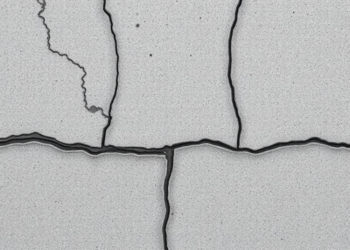
Hydrogen Bonds Turn Concrete’s Weakest Layer Into a Vibration-Killing Shield
Molecular dynamics simulations reveal that hydroxyl-rich polymers like PVA strengthen cement's weakest interlayer through hydrogen bonding, boosting damping capacity by ...
Molecular dynamics simulations reveal that hydroxyl-rich polymers like PVA strengthen cement's weakest interlayer through hydrogen bonding, boosting damping capacity by ...

Researchers at Dalian University of Technology have shown that arrays of water-filled aluminum eggshells sandwiched between plates can cut projectile ...
A novel latticed steel-concrete composite beam-column joint for prefabricated frames carried over 40 percent higher peak loads and dissipated more ...
High-resolution CFD simulations show that upstream flow aeration leaves hydraulic jump energy dissipation nearly unchanged but triggers threshold effects above ...
A multi-scale study shows that adding 1 percent chopped glass fibers to cementitious thin spray-on liners more than doubles toughness ...
New laboratory tests reveal that lightweight ceramsite aerated concrete block infill walls dramatically alter the stiffness, ductility, and failure modes ...
New experiments on gangue cemented backfill reveal that curing temperature boosts strength up to a critical threshold of 40 degrees ...
New experiments in Bangladesh show that burnt clay brick infills give reinforced concrete frames the highest lateral strength but brittle ...
Researchers in China have built and tested a semi-active friction damper that dissipates seismic energy only during unloading, extending structural ...
Researchers at Anna University have developed two novel ductile slab-to-beam connection details that kept hollow core floor slabs supported at ...

Embark on a thrilling journey of discovery with Scienmag.com—your ultimate source for cutting-edge breakthroughs. Immerse yourself in a world where curiosity knows no limits and tomorrow’s possibilities become today’s reality!