


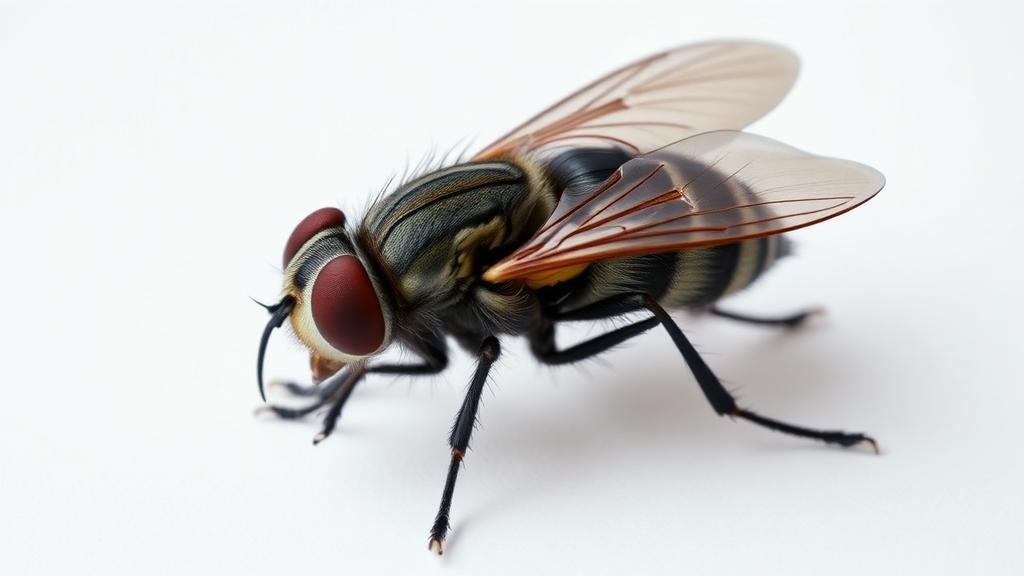
Every year, humanity throws away more than one billion tonnes of food, a squandered mountain that could feed over a million hungry people while rotting in landfills and pumping greenhouse gases into the atmosphere. At the same time, the world’s population is projected to reach 9.7 billion by 2050, intensifying the hunt for sustainable protein sources that do not require additional farmland or ocean resources. One of the most surprising candidates in this race is the larva of the black soldier fly, Hermetia illucens, an insect capable of devouring almost any organic waste and converting it into high-quality protein for animal feed, fertiliser, and even industrial applications. But a nagging safety question has shadowed this technology: what happens to the mould toxins, or mycotoxins, that often contaminate food waste? A new industrial-scale study from Portugal now offers the most realistic answer yet, and the results are reassuring for the future of insect-based circular food systems.
The research, published in the Journal of Agriculture and Food Research, was conducted at the facilities of EntoGreen in Santarém, Portugal, and took a deliberately different approach from most previous work. Earlier studies on mycotoxin behaviour in black soldier fly larvae typically relied on laboratory substrates artificially spiked with known quantities of specific toxins. While valuable for isolating chemical responses, such experiments fail to capture the messy, heterogeneous reality of actual food waste, which arrives at industrial facilities as a jumbled mixture of leftovers carrying naturally occurring, unpredictable contamination. To close this gap, the team collected 1,847.5 kilograms of pre- and post-consumer food waste from nine restaurants in Santarém, including fish, meat, cereals, vegetables, eggs, fruits, bones, and desserts, with logistical support from the local municipality. The material was ground, mixed with wheat bran to reach a moisture content of 65 to 67 percent, and fed to juvenile larvae over a 14-day rearing cycle under genuine industrial conditions.
The experimental design paired this food-waste test substrate with a control group raised on the Gainesville diet, a standardised, nutritionally balanced rearing medium composed of roughly 67 percent water, 17 percent wheat bran, 6.6 percent maize flour, and 9.9 percent alfalfa. In total, 114 experimental units were prepared for the test substrate and 144 for the control, each housed in PVC containers following the company’s standard production workflow. Samples of the initial substrate were taken on day one before larval inoculation, and on day 14 the researchers collected fresh larvae, dried and milled meal, and frass, the larval excrement that doubles as a valuable organic fertiliser. Samples were pooled into three independent biological replicates, and each analyte was measured with four analytical replicates, providing the statistical rigour needed to draw meaningful conclusions from a real production environment.
Two complementary hazards were assessed simultaneously. The first was biological: which fungi capable of producing mycotoxins were present in the substrates and larvae? The second was chemical: which mycotoxins were actually detectable, and did they accumulate in the larval biomass? Fungal characterisation relied on culturing samples on Malt Extract Agar and Dichloran Glycerol Agar at 27 degrees Celsius, with an additional incubation at 37 degrees Celsius to flag fungi with pathogenic potential. Isolates were identified by macroscopic and microscopic morphology according to established taxonomic criteria, targeting notorious toxin-producers such as Fusarium graminearum, Fusarium culmorum, Aspergillus section Nigri, Aspergillus section Flavi, Aspergillus section Circumdati, and Penicillium species. Chemical analysis was performed by liquid chromatography coupled to tandem mass spectrometry, following the analytical procedures defined in Regulation (EU) 2023/2782, with isotope-labelled internal standards ensuring accurate quantification across four matrices: substrate, larvae, meal, and frass.
The fungal results were striking in their overall restraint. Across both control and test groups, fungal contamination was generally low, and counts in larvae were frequently below the detection limit, often lower than in the corresponding substrates. In the control group, Mucorales counts were significantly higher in the substrate, at 6.11 log10 colony-forming units per gram, than in the larvae, at 2.43 log10 CFU per gram, while Fusarium graminearum was detected in the substrate but absent from larvae. In the food-waste group, Penicillium species appeared at similar low levels in both substrate and larvae, and the most concerning groups, Aspergillus section Flavi, which includes aflatoxin producers, and section Nigri, remained below detection in most matrices. The pattern suggests that fungi present in the feed are not readily transferred to the larval biomass, a finding consistent with earlier reports that mycelial fungi are eliminated during larval incubation.
What explains this apparent cleansing effect? The researchers point to the remarkable antimicrobial arsenal of black soldier fly larvae, which produce antimicrobial peptides and lipid-derived compounds such as lauric acid and glycerol monolaurate that inhibit microbial growth. In addition, frass itself has been shown to suppress several fungal plant pathogens, likely through the activity of associated microorganisms such as Bacillus velezensis. Bacterial competition for nutrients and ecological niches within the larval gut may further squeeze out fungal survivors, although the authors caution that these mechanisms were not directly tested and remain hypotheses for future investigation. The taxon-dependent patterns observed, with Mucorales suppressed but Penicillium persisting, hint at a complex ecological interplay rather than a simple sterilisation effect. This antifungal potential carries broader significance as climate change expands fungal pathogens into new agricultural regions, particularly the Mediterranean basin, while widespread azole fungicide use breeds resistant strains.
On the chemical side, the team screened a broad panel of 16 mycotoxins and metabolites, including deoxynivalenol, zearalenone, HT-2 toxin, fumonisins, ochratoxin A, and the aflatoxins. In the control group, only deoxynivalenol, zearalenone, and HT-2 toxin exceeded detection limits: deoxynivalenol at 164 micrograms per kilogram in the substrate, zearalenone at 16 micrograms per kilogram, and HT-2 toxin at 21 micrograms per kilogram. In the food-waste group, zearalenone was the sole detectable toxin, at just 3.4 micrograms per kilogram. Crucially, concentrations of all detected mycotoxins in the larval biomass and in the meal remained below detection or quantification limits, and all levels complied with current European Union regulatory limits for food and feed. The bioaccumulation factors, calculated as the moisture-corrected larval concentration divided by the substrate concentration, were all well below 1, ranging from 0.047 for zearalenone in the test group to 0.81 for zearalenone in the control, indicating not accumulation but reduction during bioconversion.
Where did the toxins go? The frass told part of the story: deoxynivalenol and zearalenone appeared at higher concentrations in frass than in the initial substrate, consistent with previous reports of Fusarium toxins being excreted rather than retained. The authors note, however, that this apparent enrichment may partly reflect a passive concentration effect, as larvae consume and reduce the residual substrate mass, and that because larvae were not fasted before frass collection, residual undigested substrate cannot be excluded. Nor can the absence of parent toxins rule out biotransformation into untargeted metabolites; prior work has shown that both larvae and their associated microbes can convert aflatoxin B1 into compounds such as aflatoxin P1 and aflatoxicol, and transcriptomic evidence indicates that larvae upregulate xenobiotic metabolism genes upon toxin exposure. A complete mycotoxin mass balance, combining fasting periods with targeted and non-targeted metabolite analysis, remains an essential next step.
The One Health implications cut in two directions. On the reassuring side, the harvested larval biomass, the product destined for feed and food chains, was free of detectable mycotoxins despite being reared on genuinely contaminated waste, validating the safety findings of earlier controlled studies under far more realistic conditions. On the cautionary side, residual mycotoxins in frass warrant attention because this material is increasingly marketed as organic fertiliser, creating a potential pathway for contaminants to re-enter agricultural soils. The authors stress that the absence of bioaccumulation in larvae should not be read as a blanket declaration that every output of the bioconversion process is risk-free. They also acknowledge limitations: the study covered a single food-waste mixture from one geographical setting and one rearing cycle, contamination levels were low, and fungal identification relied on morphology rather than molecular confirmation.
Even with those caveats, the study marks a milestone for the insect-farming industry, which must navigate strict European rules that currently prohibit using former foodstuffs containing meat or fish as insect substrate, precisely because of concerns about biological and chemical contaminants. By demonstrating, at genuine industrial scale, that black soldier fly larvae do not concentrate mycotoxins from heterogeneous restaurant waste and that larval biomass carries lower fungal loads than the feed itself, the Portuguese team has strengthened the scientific case for revisiting those restrictions and scaling circular protein production. As food waste mounts and protein demand climbs, the humble black soldier fly larva, armed with antimicrobial peptides, detoxification machinery, and a voracious appetite for our leftovers, is emerging as one of the most compelling allies in building a food system that is safer, cleaner, and radically less wasteful.
Subject of Research: Mycotoxin bioaccumulation and mycotoxigenic fungi in black soldier fly larvae reared on food waste at industrial scale
Article Title: Valorising food waste using black soldier fly larvae: A One Health assessment of mycotoxin bioaccumulation and mycotoxigenic fungi under industrial-scale conditions
Article References: Oliveira, J., Cervantes, R., Pena, P., Gomes, B., Kosicki, R., Trindade, A., Murta, D., Viegas, C., Twarużek, M., & Assunção, R. (2026). Valorising food waste using black soldier fly larvae: A One Health assessment of mycotoxin bioaccumulation and mycotoxigenic fungi under industrial-scale conditions. Journal of Agriculture and Food Research, 31, Article 103356. https://doi.org/10.1016/j.jafr.2026.103356
Image Credits: AI Generated
DOI: 10.1016/j.jafr.2026.103356
Keywords: black soldier fly larvae, food waste, mycotoxins, bioaccumulation, One Health, circular economy, food safety, insect farming, fungal contamination, zearalenone, deoxynivalenol, sustainable protein
Cite Scienmag News
Alan Morgan. (October 11, 2026). Fly Larvae Turn Restaurant Waste Into Safe Protein Without Accumulating Mycotoxins. Scienmag. https://scienmag.com/fly-larvae-turn-restaurant-waste-into-safe-protein-without-accumulating-mycotoxins/
Alan Morgan. "Fly Larvae Turn Restaurant Waste Into Safe Protein Without Accumulating Mycotoxins." Scienmag, 11 October 2026, https://scienmag.com/fly-larvae-turn-restaurant-waste-into-safe-protein-without-accumulating-mycotoxins/. Accessed 11 October 2026.
Alan Morgan. "Fly Larvae Turn Restaurant Waste Into Safe Protein Without Accumulating Mycotoxins." Scienmag. October 11, 2026. https://scienmag.com/fly-larvae-turn-restaurant-waste-into-safe-protein-without-accumulating-mycotoxins/


