

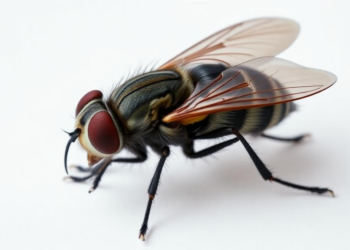
Fly Larvae Turn Restaurant Waste Into Safe Protein Without Accumulating Mycotoxins
An industrial-scale Portuguese study shows black soldier fly larvae reared on naturally contaminated restaurant food waste do not bioaccumulate mycotoxins ...
An industrial-scale Portuguese study shows black soldier fly larvae reared on naturally contaminated restaurant food waste do not bioaccumulate mycotoxins ...

A new review maps how the mycotoxin deoxynivalenol hijacks ribosomal and cellular signaling networks to drive intestinal, immune, neurological and ...
A conserved Lsm8-exosome module that safeguards RNA splicing fidelity has been revealed as a master switch controlling growth, stress adaptation, ...
A new scoping review compiles evidence that six common food-borne mycotoxins can cross the blood-brain barrier and drive neurodegeneration through ...
New research reveals that the polarisome protein FgPea2 directs the membrane-anchored FgBoi2 to drive polarized growth, toxin production, virulence and ...
A new review details the five types of wheat resistance to Fusarium head blight, the cloned genes Fhb1 and Fhb7, ...
New research shows that the conserved Pal/PacC pH signaling pathway in Fusarium graminearum governs fungal growth, stress tolerance, tissue penetration, ...
A genome-scale knockout study of Fusarium graminearum reveals that dozens of secondary metabolite gene clusters govern growth, stress tolerance, spore ...
Researchers have discovered that the transcription factor FgMetR physically interacts with the kinase Fgk3 in Fusarium graminearum, jointly controlling fungal ...

Embark on a thrilling journey of discovery with Scienmag.com—your ultimate source for cutting-edge breakthroughs. Immerse yourself in a world where curiosity knows no limits and tomorrow’s possibilities become today’s reality!