


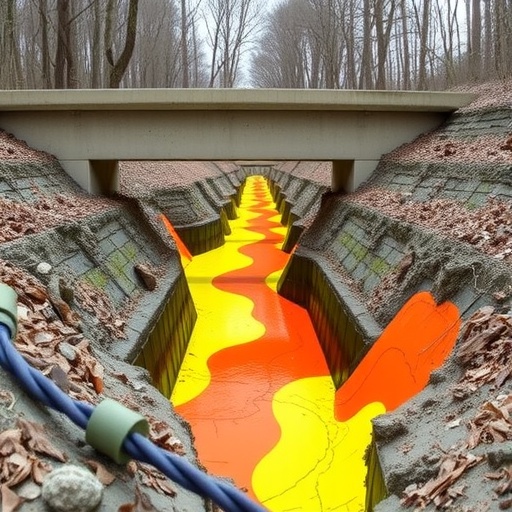
In the face of mounting climate challenges, urban and rural infrastructure must increasingly withstand the pressures of extreme weather events. Among the critical components of civil infrastructure, culverts – the underground channels that guide water beneath roads and railways – play an understated yet pivotal role in flood management. A groundbreaking study recently published in Communications Earth & Environment uncovers new insights into how these small but vital elements contribute to broader flood-risk patterns in New York State. Employing a scalable, high-resolution analytical framework, the research offers an unprecedented look at the interdependency patterns of culvert infrastructure under flood conditions, illuminating avenues for improved flood resilience strategies.
The study, led by researchers Omid Emamjomehzadeh and Oishimaya Wani, leverages advanced computational tools to analyze the flood risk posed to thousands of culverts scattered across New York State. Culverts, often overlooked in large-scale flood models, can act as critical bottlenecks or fail points that exacerbate flood impacts. Recognizing this, the researchers adopted a granular, system-wide approach, integrating hydrological and infrastructure data to characterize culvert vulnerability and network dependencies. This methodological leap bridges the gap between localized hydraulic behaviors and aggregate flood risk posed to transportation infrastructure.
Central to their approach was the development and deployment of a scalable flood-risk analysis platform that accommodates detailed culvert characteristics and watershed-scale hydrology. This platform synthesizes diverse data types including culvert geometry, material properties, upstream land use, and rainfall intensity distributions. By marrying these datasets within a probabilistic risk modeling framework, the study exposes complex spatial and functional dependencies among culverts. The results demonstrate that flood risk is not only a function of individual culvert capacity but also influenced by systemic interconnections and cascading failures, especially in densely networked infrastructure corridors.
One of the striking revelations from this research is the identification of distinct patterns of dependence across the culvert networks. Certain culverts, situated at hydrologically strategic nodes, exhibit disproportionate influence over downstream flood outcomes. These “keystone” culverts can either mitigate or amplify flood risk depending on their operational condition and design adequacy. The identification of such critical infrastructure elements paves the way for targeted maintenance and retrofitting interventions that optimize flood risk reduction at a system-wide level rather than piecemeal upgrades.
From a hydrological modeling perspective, the study integrates high-resolution rainfall-runoff simulations with advanced failure probability assessments. This fusion allows the researchers to estimate not only the likelihood of individual culvert overtopping or collapse but also the resultant impacts on adjacent infrastructure and flood propagation patterns. By embedding this risk assessment within the state’s spatial topology, decision-makers gain a powerful tool to prioritize flood mitigation investments in line with spatial risk gradients and dependency structures.
Crucially, the research finds that culvert failures are not independent events. Rather, under extreme rainfall scenarios, the likelihood of simultaneous or sequential failures increases—leading to compounding flood effects. This networked failure mode aligns with emerging understandings of infrastructure resilience, where interdependent systems exhibit nonlinear vulnerabilities to climactic stressors. The scalable analysis method proposed in the study effectively captures these cascading risks, moving beyond traditional isolated component assessments.
The implications for flood risk management are profound. In New York State, where a dense web of culverts supports a sprawling transportation grid, understanding these systemic interactions equips agencies with actionable intelligence to reinforce weak links. Prioritization of upgrades can be informed not merely by individual culvert condition but by their systemic importance, enabling more resilient infrastructure planning under future climate uncertainties.
Moreover, the study highlights data gaps and the need for comprehensive culvert inventories paired with continuous monitoring technologies. Incorporating sensor networks and remote sensing could enhance real-time understanding of culvert performance during storm events, enabling adaptive management. The scalable nature of the proposed risk analysis framework means this approach is well-suited for integration with emerging smart infrastructure paradigms, potentially revolutionizing flood resilience practices.
In addition to its regional focus, this research makes a methodological contribution by demonstrating how scalable, data-driven techniques can be applied to infrastructure systems of national or even global relevance. The scalable approach facilitates handling of heterogeneous data and computational intensity associated with thousands of culverts, showing that detailed infrastructure risk modeling need not be constrained by scale. This opens doors for similar analyses in other flood-prone regions where hydraulic infrastructure vulnerability remains poorly quantified.
The study also underscores the interconnectedness of hydrologic and engineered systems in flood risk landscapes. Flooding cannot be fully understood or mitigated without integrating physical processes with infrastructure network behaviors. Such integrated approaches are gaining urgency as climate change intensifies precipitation extremes, rendering traditional infrastructure designs increasingly inadequate. The results advocate for infrastructure resilience frameworks that explicitly account for interdependencies and feedbacks within coupled natural-human systems.
By advancing the understanding of culvert-scale flood dynamics within a systems context, the research contributes vital knowledge toward proactive climate adaptation strategies. Investing in robust culvert infrastructure, informed by scalable risk analytics, can reduce flood hazards to critical transportation routes, lower economic losses, and save lives. The study’s findings reinforce the role of infrastructure systems science as an indispensable tool in confronting 21st-century challenges of extreme weather resilience.
In conclusion, Emamjomehzadeh and Wani’s work represents a significant leap forward in flood risk science by quantifying infrastructural interdependencies at scale. Their scalable flood-risk analysis framework offers a replicable blueprint for infrastructure risk assessments beyond New York State. As climate-driven flood risks grow, such nuanced and actionable perspectives will be crucial in safeguarding vital infrastructure assets. This pioneering study not only exposes hidden vulnerabilities but also guides strategic investments, heralding a smarter era for flood-risk management grounded in sophisticated science and engineering principles.
The emergent message is clear: infrastructures are not isolated components but a web of interdependent elements whose collective performance under stress defines flood outcomes. Addressing flood challenges demands embracing this systems perspective, enabled by cutting-edge data science and computational modeling. In doing so, climate adaptation agencies can turn the tide from vulnerability toward resilience, ensuring infrastructure sustainability amid an uncertain environmental future.
Cite Scienmag News
Violet Maxwell. (April 27, 2026). Flood Risk Patterns in New York Culvert Infrastructure. Scienmag. https://scienmag.com/flood-risk-patterns-in-new-york-culvert-infrastructure/
Violet Maxwell. "Flood Risk Patterns in New York Culvert Infrastructure." Scienmag, 27 April 2026, https://scienmag.com/flood-risk-patterns-in-new-york-culvert-infrastructure/. Accessed 3 September 2026.
Violet Maxwell. "Flood Risk Patterns in New York Culvert Infrastructure." Scienmag. April 27, 2026. https://scienmag.com/flood-risk-patterns-in-new-york-culvert-infrastructure/


