


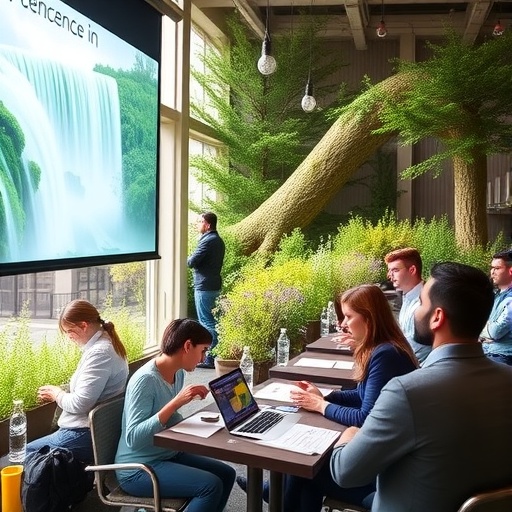
In late June 2025, the European scientific community gathered in Tampere, Finland, for a landmark event that promises to redefine the future of ecosystem research. The inaugural Science Conference of the European Long-Term Ecosystem, Critical Zone, and Socio-Ecological Research Infrastructure (eLTER RI) convened over 350 researchers, policymakers, and stakeholders from across Europe and beyond. This assembly marked a significant step forward in promoting transdisciplinary collaboration aimed at addressing some of the most pressing environmental challenges of our time. Bridging diverse scientific disciplines, the conference underscored an urgent need for integrated, holistic approaches to ecosystem science in the face of accelerating global change.
The overarching theme, “Towards a Whole-System Approach for Ecosystem Science,” resonated throughout the conference proceedings. This vision calls for moving beyond traditional, siloed research frameworks toward comprehensive, in-situ investigations that incorporate biotic and abiotic components as well as human influences. Central to this progression is the WAILS concept—Whole system Approach for In-situ research on Life-sustaining Systems—which serves both as a philosophical foundation and a methodological guide for tackling complex ecosystem dynamics at multiple spatial and temporal scales. The conference rigorously examined how such systemic approaches can unravel the cascading effects of climate change, biodiversity erosion, pollution, and groundwater fluctuations, which collectively threaten ecosystem integrity.
Crucially, the event emphasized that holistic ecosystem understanding demands not only methodological innovation but also organizational and cultural shifts within the scientific community. To that end, each conference session was designed and led collaboratively by researchers from distinct disciplines, ensuring cross-pollination of perspectives and expertise. This structural commitment extended beyond academia, incorporating early-career scientists and promoting gender and geographic diversity among session conveners. By deconstructing barriers between fields like ecology, hydrology, socio-ecology, and data science, the conference ignited dynamic conversations contextualized by rigorous empirical analysis and theoretical synthesis.
Keynote addresses set an ambitious tone, featuring leading experts who illuminated the multifaceted nature of sustainability challenges at global to local scales. These presentations foregrounded the urgency of embedding socio-ecological complexity into ecosystem models, recognizing human activities as integral, driving components rather than external pressures. Featured speakers also explored cutting-edge technologies enabling in-situ data collection, such as remote sensing drones, automated sensors, and machine-learning frameworks capable of handling high-dimensional datasets. Such tools are pivotal for capturing real-time ecosystem responses and feedbacks within dynamically coupled natural-human systems.
The conference sessions traversed a rich spectrum of topics. Among them was the intricate role of groundwater as a critical yet often overlooked component of ecosystem functioning. Carefully monitored hydrogeological networks showcased relationships between underground water flows and surface ecological processes, illuminating pathways through which contamination or depletion may propagate. These insights are essential for devising effective management strategies that maintain water quality and availability amidst increasing anthropogenic pressures and climate variability.
Biodiversity loss remained a central concern, with presentations detailing mechanisms linking species decline to ecosystem service degradation. Novel approaches deploying long-term monitoring plots combined with genomic tools revealed previously hidden dimensions of ecosystem resilience and vulnerability. Discussions highlighted how whole-system methodologies facilitate detection of tipping points and regime shifts—phenomena that traditional snapshot studies risk missing. By embracing temporal depth and spatial breadth, researchers aim to preempt irreversible changes and guide adaptive conservation policies.
Pollution dynamics, particularly in relation to emerging contaminants, received focused attention. Persistent pollutants such as microplastics, pharmaceuticals, and heavy metals infiltrate ecosystems in complex ways that defy simplistic cause-effect narratives. The integrated ecosystem approach showcased at the conference enables comprehensive tracking and impact assessment of these pollutants across trophic levels and abiotic compartments. This knowledge undergirds the development of mitigation measures that are both scientifically robust and societally relevant.
Another innovative aspect underscored at Tampere was the importance of socio-ecological feedback loops. The interdependencies between human behavior, policy decisions, and ecosystem responses introduce nonlinearities that complicate forecasting and management. Participants advocated enhanced interdisciplinarity encompassing social sciences, economics, and governance studies alongside biophysical research. Such integrative frameworks are indispensable for designing interventions that are not only ecologically sound but also culturally acceptable and equitable.
Throughout the event, attention was given to the vast data infrastructures and open-access platforms required to support whole-system ecosystem science. Harmonizing diverse datasets—from remote sensing imagery to on-the-ground measurements—across multiple countries and scales poses formidable technical and logistical challenges. The eLTER RI community demonstrated promising solutions in data interoperability, quality assurance, and collaborative analytics designed to accelerate knowledge production and dissemination. This open-science ethos amplifies transparency and fosters broader engagement beyond traditional academic circles.
The conference concluded with a call to scale up ecosystem observatories and enhance international cooperation under the umbrella of initiatives like eLTER. Participants recognized that addressing the intertwined crises facing Earth’s life-support systems demands unprecedented coordination, long-term commitment, and innovative funding mechanisms. The European Union’s Horizon 2020 Research and Innovation Programme, identified as a major supporter, exemplifies such investment in building resilient research infrastructures capable of generating actionable insights on ecosystem sustainability.
In effect, the Tampere conference represents a pivotal moment in ecosystem science—a convergence point where interdisciplinary collaboration, technological innovation, and societal engagement coalesce to chart a path forward. By instituting whole-system, in-situ research paradigms exemplified by the WAILS concept, the field moves toward a more comprehensive understanding of life-sustaining systems. Such progress is critical for informing environmental policy and fostering nature-based solutions that secure a sustainable future in the face of accelerating global change.
The images accompanying the conference narratives underscore the diversity and sophistication of modern ecosystem research settings. Visual documentation from sites like the Kevo Subarctic Research Institute in Finland—where remote northern landscapes serve as living laboratories—illustrates how high-tech tools merge with natural environments to enhance data collection and interpretation. These places are not only crucial for ground-truthing models but also for inspiring cross-generational scientists committed to the stewardship of Earth’s vital systems.
Looking forward, the legacies of the first eLTER Science Conference promise to ripple through the scientific ecosystem, spawning novel collaborations, refined methodologies, and impactful discoveries. As the environmental challenges escalate globally, the principles and infrastructures forged in Tampere stand to empower researchers in anticipating, mitigating, and adapting to the dynamic shifts shaping our planet’s trajectory. The conference’s success affirms that only through whole-system thinking and collective effort can humanity hope to safeguard the ecosystems that underpin all life.
News Publication Date: June 27, 2025
Web References:
- eLTER RI Science Conference information page
- Kevo Subarctic Research Institute (Kevo LTER) — https://deims.org/3f6a14de-1efb-4c06-8d1a-ce5765fe59e8
Cite Scienmag News
Gavin Prescott. (August 2, 2025). First eLTER Science Conference Paves the Way for Integrated Environmental Research. Scienmag. https://scienmag.com/first-elter-science-conference-paves-the-way-for-integrated-environmental-research/
Gavin Prescott. "First eLTER Science Conference Paves the Way for Integrated Environmental Research." Scienmag, 2 August 2025, https://scienmag.com/first-elter-science-conference-paves-the-way-for-integrated-environmental-research/. Accessed 4 September 2026.
Gavin Prescott. "First eLTER Science Conference Paves the Way for Integrated Environmental Research." Scienmag. August 2, 2025. https://scienmag.com/first-elter-science-conference-paves-the-way-for-integrated-environmental-research/


