


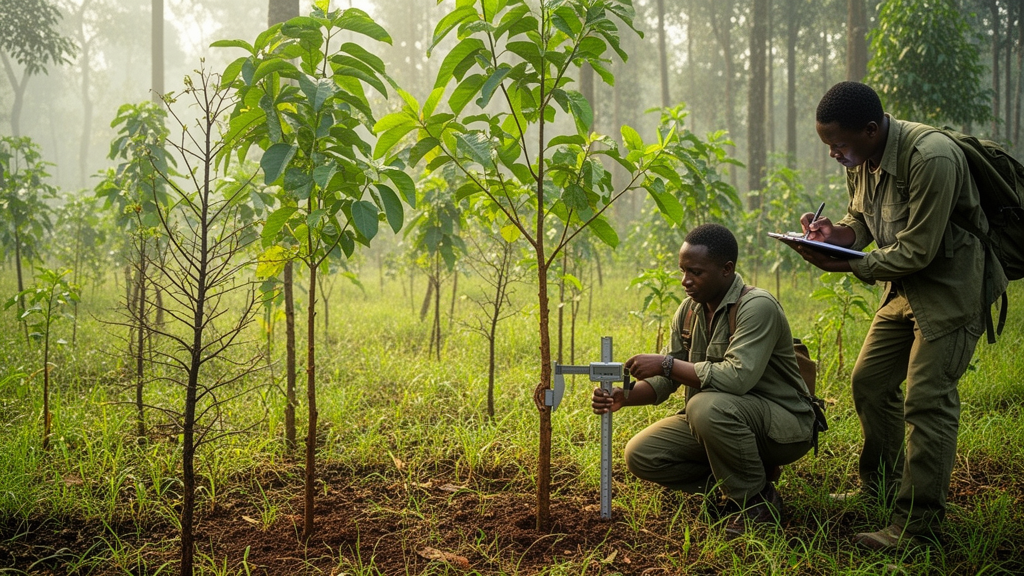
A field assessment of 2,301 one-year-old native trees across six sanctuaries in Rwanda’s Eastern Province found marked variation in growth and survival, with outcomes associated with species selection, site matching and management practices. The study examined trees planted under the COMBIO project between 2024 and 2025. Researchers used Cochran’s formula and stratified random sampling to select trees for measurements of height and base diameter, while survival was tracked through counts of living, dead and missing trees.
Among the faster-growing species, Acacia polyacantha , Entada abyssinica , Ficus sur , Maesopsis emenii and Ziziphus mucronata reached average heights of 1–2.7 metres and base diameters of 3–5.8 centimetres. Slower-growing Ficus thonningii and Pappea capensis remained below 1 metre in height and below 1 centimetre in diameter. These measurements describe the assessed young trees during the study period and do not establish their eventual development as the planted areas mature into restored forests.
Survival rates ranged from 60% to 100% across the assessed trees, with the highest rates reported for species characterized as resilient under local conditions. The researchers analyzed growth and survival data in Excel and R. They also used interviews and field observations with technicians, agronomists and cooperative members to identify practices and local conditions associated with tree establishment. Taken together, the results indicated that performance was influenced by site matching and management rather than by species traits alone, although the reported evidence does not isolate the causal contribution of each factor.
Tree locations were captured with a differential global positioning system and analyzed in ArcGIS Pro alongside information on topography, rainfall and temperature. The spatial analysis allowed the researchers to examine tree performance in relation to environmental and site conditions within the six COMBIO project areas. The study population was limited to one-year-old native trees planted across those sanctuaries, so the findings should not be generalized to mature trees, other project locations or Rwanda’s other regions without further evidence.
Interviews and field observations identified several challenges associated with poorer establishment. These included variability in rainfall, pest infestation, livestock grazing, competition from unwanted vegetation, inadequate planting techniques and limited technical knowledge among laborers. The findings identify factors that may explain variation observed across the sampled trees; they do not demonstrate that any single challenge produced a particular survival rate.
The authors’ recommended practices included selecting native species appropriate to site conditions, implementing the Taungya system, maintaining planted areas, using quality seedlings and strengthening community awareness of tree management. These recommendations emerged from the assessment’s field observations and qualitative interviews. The COMBIO project is intended to restore degraded lands and forests in Rwanda’s Eastern Province through native-tree planting, with the broader aim of enhancing ecological resilience and supporting community livelihoods; the present study assessed growth and survival rather than directly measuring either ecosystem resilience or livelihood outcomes.
The assessment provides a field-based account of early establishment across six restoration sites. Its principal measured result is substantial variation among species and locations: average height and diameter differed markedly, and survival spanned 60% to 100%. The study also shows how environmental data, tree measurements and local operational knowledge can be combined to evaluate restoration plantings.
Because it covered only 2,301 of 60,335 planted trees and focused on one-year-old trees, its conclusions are most directly applicable to the sampled material and period. The data indicate that planting native species is not sufficient on its own: seedling quality, careful establishment, maintenance and responses to local stresses were all associated with the field performance reported by the researchers. Larger and longer assessments would be needed to determine which early differences persist as the COMBIO plantings grow and to evaluate the contribution of individual management practices.
Subject of Research: Growth and survival of one-year-old native trees across six COMBIO restoration sites in Rwanda’s Eastern Province
Article Title: Assessment of growth and survival rate of native tree species across COMBIO project areas in Eastern Province of Rwanda
Article References: Julien, N., Myriam, M., Aloysie, M., & Ernest, U. (2026). Assessment of growth and survival rate of native tree species across COMBIO project areas in Eastern Province of Rwanda. Discover Sustainability. https://doi.org/10.1007/s43621-026-04642-3
Image Credits: AI Generated
DOI: 10.1007/s43621-026-04642-3
Keywords: Rwanda, COMBIO project, native trees, forest restoration, tree survival, tree growth, Eastern Province, restoration ecology, field sampling, Assessment, growth, survival
Cite Scienmag News
Violet Maxwell. (October 26, 2026). Field assessment finds varied native-tree growth and survival in Rwanda. Scienmag. https://scienmag.com/field-assessment-finds-varied-native-tree-growth-and-survival-in-rwanda/
Violet Maxwell. "Field assessment finds varied native-tree growth and survival in Rwanda." Scienmag, 26 October 2026, https://scienmag.com/field-assessment-finds-varied-native-tree-growth-and-survival-in-rwanda/. Accessed 26 October 2026.
Violet Maxwell. "Field assessment finds varied native-tree growth and survival in Rwanda." Scienmag. October 26, 2026. https://scienmag.com/field-assessment-finds-varied-native-tree-growth-and-survival-in-rwanda/


