


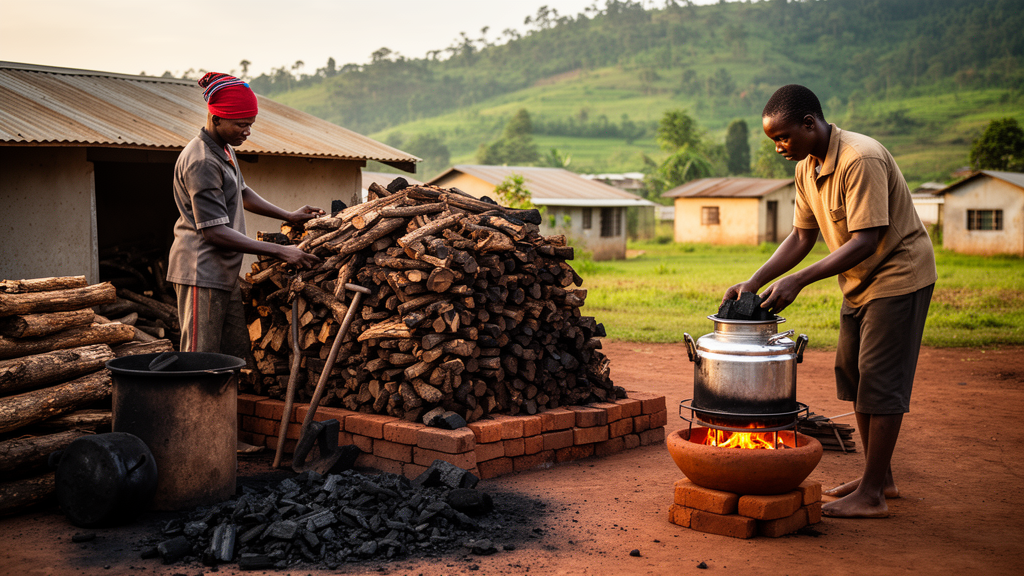
A peer-reviewed briefing concludes that Tanzania’s transition from charcoal to cleaner cooking fuels cannot succeed through technology alone, because affordability, cultural resistance, institutional support and deforestation linked to charcoal use present interconnected challenges. The briefing examines current strategies for shifting households toward electricity and liquefied petroleum gas (LPG) and proposes financial, educational, institutional and environmental measures to support the transition. Cost is a central obstacle.
The briefing identifies expensive LPG and electricity as factors that prevent people from using cleaner cooking fuels and recommends LPG subsidies, expanded electricity access and pay-as-you-go financing. These are proposed policy responses, not demonstrated results. The analysis also treats clean cooking as a socio-cultural transition.
It says that resistance to change must be addressed through comprehensive education and awareness campaigns intended to influence public perceptions. Such campaigns are presented as necessary alongside the introduction of alternative fuels, rather than as a substitute for making those fuels affordable. The briefing further identifies inadequate institutional support for policy execution and proposes establishing a Clean Energy Transition Authority (CETA) to strengthen implementation.
The briefing links charcoal consumption with deforestation and recommends reforestation and environmental protection as part of the wider response. Its proposed approach therefore combines cleaner cooking technologies with social, economic, institutional and environmental changes. The National Cooking Energy Strategies are described as offering a promising path toward a sustainable future, but their success would depend on inclusive participation, a long-term commitment to change and responses suited to local conditions.
Rather than prescribing a uniform national model, the briefing concludes that Tanzania’s energy transitions are “spatial-temporal” and should not follow a “one-size-fits-all” approach. As a brief report, it synthesizes barriers and proposes responses; the supplied evidence does not show that the policies have already been implemented or evaluated in the field. Its central finding is that a durable shift away from charcoal requires more than technically available alternatives: cleaner cooking fuels must also be financially accessible, supported by public engagement and policy institutions, and accompanied by action on the environmental consequences of charcoal dependence.
Subject of Research: Challenges and proposed strategies for Tanzania’s transition from charcoal to clean cooking fuels
Article Title: Energy transitions and the charcoal dilemma in Tanzania
Article References: Lwankomezi, E. (2026). Energy transitions and the charcoal dilemma in Tanzania. Discover Sustainability. https://doi.org/10.1007/s43621-026-04738-w
Image Credits: AI Generated
DOI: 10.1007/s43621-026-04738-w
Keywords: Tanzania, clean cooking, charcoal, energy transition, liquefied petroleum gas, electricity access, deforestation, reforestation, energy policy, Energy, transitions, dilemma
Cite Scienmag News
Violet Maxwell. (October 26, 2026). Tanzania’s Charcoal Transition Requires More Than Clean Technology. Scienmag. https://scienmag.com/tanzanias-charcoal-transition-requires-more-than-clean-technology/
Violet Maxwell. "Tanzania’s Charcoal Transition Requires More Than Clean Technology." Scienmag, 26 October 2026, https://scienmag.com/tanzanias-charcoal-transition-requires-more-than-clean-technology/. Accessed 26 October 2026.
Violet Maxwell. "Tanzania’s Charcoal Transition Requires More Than Clean Technology." Scienmag. October 26, 2026. https://scienmag.com/tanzanias-charcoal-transition-requires-more-than-clean-technology/


