

Monday, October 26, 2026
Science
No Result
View All Result
  • Login
  • HOME
  • SCIENCE NEWS
  • CONTACT US
  • HOME
  • SCIENCE NEWS
  • CONTACT US
No Result
View All Result
Scienmag
No Result
View All Result
Home Science News Medicine

Machine learning predicts next-year fitness assessment failure in university students

October 26, 2026
in Medicine
Teresa Odom
By Teresa Odom Scienmag Editorial Profile - Machine Learning
Reading Time: 3 mins read
0
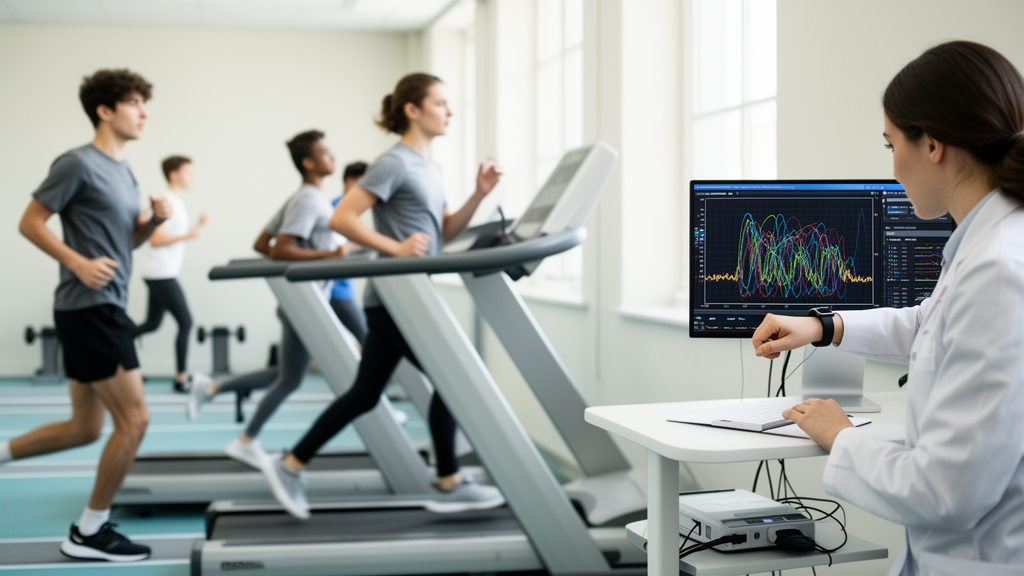
Machine learning predicts next-year fitness assessment failure in university students

Machine learning predicts next-year fitness assessment failure in university students

65
SHARES
587
VIEWS
Share on FacebookShare on Twitter
ADVERTISEMENT

Routine physical fitness assessments collected from university students in China contained useful signals for identifying students who would fail the following year’s assessment, according to a retrospective longitudinal prediction study. Researchers developed and tested logistic regression, random forest and XGBoost models on linked annual records from 2023 to 2025. The results showed that the practical value of each model depended on the evaluation metric: logistic regression had the highest discrimination and recall, while random forest achieved the highest accuracy and F1 score and the lowest Brier score.

The study used annual physical fitness assessment records from one Chinese university. The model-development dataset contained 11,430 linked student-year pairs spanning 2023–2024, and the out-of-time test dataset contained 11,427 linked pairs spanning 2024–2025. This temporal separation tested whether models fitted to earlier records could predict outcomes in a later cohort.

Predictors came from the preceding year’s assessment and included body mass index, vital capacity, 50-meter sprint time, standing long-jump distance, sit-and-reach distance, endurance run time and sex-specific muscular strength. The investigators compared the three algorithms using discrimination, calibration and classification metrics at a prespecified probability threshold of 0.50. They also applied SHapley Additive exPlanations, or SHAP, to the fitted XGBoost model to characterize the contribution of each predictor to its output.

No single algorithm led on every measure. Logistic regression achieved the highest area under the receiver operating characteristic curve, with an ROC-AUC of 0.8167, and the highest precision-recall area under the curve, with a PR-AUC of 0.3227. Its recall was 0.7569, the highest among the three models, indicating that it detected the largest proportion of subsequent-year failures at the chosen threshold.

Random forest recorded the highest accuracy, at 0.9320, and F1 score, at 0.3573, as well as the lowest Brier score, at 0.0578. Its recall was 0.3000, however, and its calibration slope was 0.4985. XGBoost produced an ROC-AUC of 0.7935 and a recall of 0.5458.

SHAP analysis identified body mass index, endurance run time, standing long-jump distance and vital capacity as the largest overall contributors to XGBoost’s model output. The analysis quantified feature contributions within the fitted algorithm, but it did not establish that changing any individual measurement would cause a student to pass a later assessment or that the same feature was most influential for every student. The model’s performance was also sensitive to how failure was defined: sensitivity analyses found lower predictive performance when subsequent-year failure was based on percentile-based thresholds rather than the absolute total-score cutoff of 60.

The findings therefore depend in part on the outcome definition applied to the annual assessment. Several limitations constrain the conclusions. Although the predictors preceded the outcomes they were used to predict, both the measurements and the subsequent-year total fitness score were derived from the same physical fitness assessment framework.

The authors noted that persistence of the underlying fitness construct and conceptual overlap between predictors and outcomes may have contributed to the observed performance. In addition, the out-of-time evaluation occurred within a single university and did not constitute independent external validation. The researchers said that external validation, local calibration, threshold assessment and prospective evaluation would be required before the models could be used for routine student monitoring or intervention.

Subject of Research: Longitudinal machine-learning prediction of annual physical fitness assessment failure among university students

Article Title: Predicting subsequent-year physical fitness assessment failure in university students using longitudinal data and explainable machine learning

Article References: Luo, L., Huang, F., & Li, B. (2026). Predicting subsequent-year physical fitness assessment failure in university students using longitudinal data and explainable machine learning. BMC Public Health. https://doi.org/10.1186/s12889-026-29742-7

Image Credits: AI Generated

DOI: 10.1186/s12889-026-29742-7

Keywords: physical fitness, university students, machine learning, longitudinal data, risk prediction, XGBoost, random forest, logistic regression, SHAP analysis, out-of-time validation, Predicting, subsequent-year

Cite Scienmag News

Teresa Odom. (October 26, 2026). Machine learning predicts next-year fitness assessment failure in university students. Scienmag. https://scienmag.com/machine-learning-predicts-next-year-fitness-assessment-failure-in-university-students/


Teresa Odom. "Machine learning predicts next-year fitness assessment failure in university students." Scienmag, 26 October 2026, https://scienmag.com/machine-learning-predicts-next-year-fitness-assessment-failure-in-university-students/. Accessed 26 October 2026.

Teresa Odom. "Machine learning predicts next-year fitness assessment failure in university students." Scienmag. October 26, 2026. https://scienmag.com/machine-learning-predicts-next-year-fitness-assessment-failure-in-university-students/

Tags: early detection of fitness assessment failurefeature importance in fitness failure predictionhealth assessment outcome forecastinglogistic regressionlogistic regression for fitness predictionlongitudinal datalongitudinal health data analysisMachine learningmachine learning in university healthout-of-time validationPhysical fitnessphysical fitness indicators in student assessmentPredictingpredictive modeling in university sportsRandom Forestrandom forest model for student health outcomesrisk predictionSHAP analysisSHAP explainability in health modelsstudent fitness assessment predictionsubsequent-yearuniversity studentsXGBoostXGBoost for physical fitness failure
Share26Tweet16
Previous Post

Tanzania’s Charcoal Transition Requires More Than Clean Technology

Next Post

Multicancer blood test detects cancer signals across 17 tumor types

Related Posts

Healthcare provider opinions and work experiences toward diagnosing, treating, or caring for individuals with hypermobile Ehlers-Danlos syndrome (hEDS), hypermobility spectrum disorders (HSD), and vulvar pain disorders: a qualitative study
Medicine

Healthcare provider opinions and work experiences toward diagnosing, treating, or caring for individuals with hypermobile Ehlers-Danlos syndrome (hEDS), hypermobility spectrum disorders (HSD), and vulvar pain disorders: a qualitative study

October 26, 2026
China’s congenital anomaly mortality fell as regional relative inequalities rose
Medicine

China’s congenital anomaly mortality fell as regional relative inequalities rose

October 26, 2026
WHO decomposition links Singapore’s longevity gains to fewer major-disease deaths
Medicine

WHO decomposition links Singapore’s longevity gains to fewer major-disease deaths

October 26, 2026
2024 Burundi cross-sectional survey: low effective refractive coverage in adults 50+
Medicine

2024 Burundi cross-sectional survey: low effective refractive coverage in adults 50+

October 26, 2026
Swiss adolescent play patterns linked to eating, sleep and activity
Medicine

Swiss adolescent play patterns linked to eating, sleep and activity

October 26, 2026
Tshwane managers identify continuous support for quality-of-care regulations
Medicine

Tshwane managers identify continuous support for quality-of-care regulations

October 26, 2026
Next Post
Multicancer blood test detects cancer signals across 17 tumor types

Multicancer blood test detects cancer signals across 17 tumor types

  • Mothers who receive childcare support from maternal grandparents show more optimized

    Mothers who receive childcare support from maternal grandparents show more parental warmth, finds NTU Singapore study

    27656 shares
    Share 11059 Tweet 6912
  • University of Seville Breaks 120-Year-Old Mystery, Revises a Key Einstein Concept

    1061 shares
    Share 424 Tweet 265
  • Bee body mass, pathogens and local climate influence heat tolerance

    682 shares
    Share 273 Tweet 171
  • Researchers record first-ever images and data of a shark experiencing a boat strike

    546 shares
    Share 218 Tweet 137
  • Groundbreaking Clinical Trial Reveals Lubiprostone Enhances Kidney Function

    531 shares
    Share 212 Tweet 133
Science

Embark on a thrilling journey of discovery with Scienmag.com—your ultimate source for cutting-edge breakthroughs. Immerse yourself in a world where curiosity knows no limits and tomorrow’s possibilities become today’s reality!

RECENT NEWS

  • Deeper Foundation Treatment Increases Uneven Settlement in Coastal Soil Model
  • Würzburg VR laser lab wins German Physical Society teaching prize
  • China’s congenital anomaly mortality fell as regional relative inequalities rose
  • Healthcare provider opinions and work experiences toward diagnosing, treating, or caring for individuals with hypermobile Ehlers-Danlos syndrome (hEDS), hypermobility spectrum disorders (HSD), and vulvar pain disorders: a qualitative study

Categories

  • Agriculture
  • Anthropology
  • Archaeology
  • Athmospheric
  • Biology
  • Biotechnology
  • Blog
  • Bussines
  • Cancer
  • Chemistry
  • Climate
  • Earth Science
  • Editorial Policy
  • Marine
  • Mathematics
  • Medicine
  • Pediatry
  • Policy
  • Psychology & Psychiatry
  • Science Education
  • Science News
  • Social Science
  • Space
  • Technology and Engineering

Subscribe to Blog via Email

Enter your email address to subscribe to this blog and receive notifications of new posts by email.

Join 5,151 other subscribers

© 2025 Scienmag - Science Magazine

Welcome Back!

Login to your account below

Forgotten Password?

Retrieve your password

Please enter your username or email address to reset your password.

Log In
No Result
View All Result
  • HOME
  • SCIENCE NEWS
  • CONTACT US

© 2025 Scienmag - Science Magazine

Discover more from Science

Subscribe now to keep reading and get access to the full archive.

Continue reading