


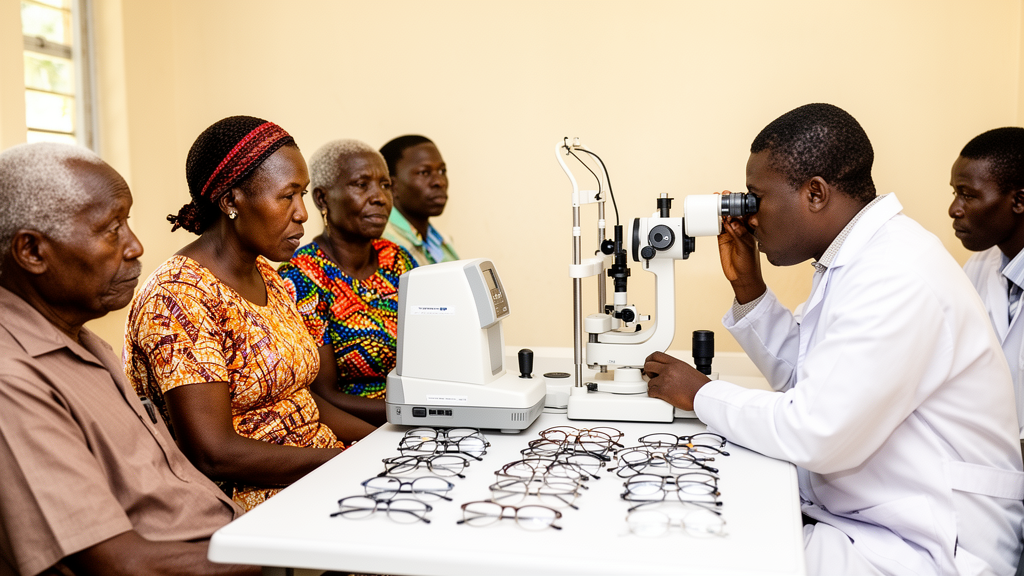
Burundi’s 2024 national survey found that effective refractive error coverage was 6.1% among adults aged 50 years and older, below the 8.6% recorded for refractive error coverage. The estimates came from a secondary analysis of an observational, cross-sectional, population-based survey, making them a national baseline rather than evidence about the effectiveness of a particular intervention. Among the people classified as having access to refractive services, the results also show that such access did not always produce effective visual correction, although the survey could not identify why.
The analysis used the published dataset from Burundi’s first national Rapid Assessment of Avoidable Blindness survey, known as RAAB7, covering all six regions of the country. Investigators selected a target sample of 3,850 adults aged at least 50 years from 77 clusters. The researchers reproduced the parent survey’s estimates for refractive error coverage, abbreviated REC, and effective refractive error coverage, abbreviated eREC, using standard RAAB7 definitions.
Their contribution was a joint interpretation of the two indicators and the gap between them, rather than a new estimation of the underlying survey population. REC reflects access to refractive services, whereas eREC reflects access that results in effective visual correction. The investigators calculated both the absolute and relative differences between these measures.
Estimates were adjusted for age and sex, and post hoc comparisons between women and men used approximate two-sided Wald tests based on design-adjusted standard errors. Adjusted REC was 8.6%, with a 95% confidence interval of 4.9% to 12.4%, while adjusted eREC was 6.1%, with a 95% confidence interval of 3.1% to 9.1%. The absolute difference was 2.5 percentage points, and the relative gap was 29.2%.
Equivalently, eREC represented 70.8% of REC. Women had higher coverage than men on both measures, although the confidence intervals around the national estimates indicate substantial uncertainty in the precise levels. REC was 11.9% among women compared with 4.9% among men, while eREC was 8.8% compared with 3.0%.
The approximate p values for these sex comparisons were 0.029 for REC and 0.028 for eREC. Despite their higher proportional coverage, women had a greater estimated absolute unmet or under-met need: approximately 64,600 people, compared with 58,800 men. The distinction shows why percentage coverage and the number of people lacking effective correction answer different questions.
Uncorrected refractive error was the leading cause of early vision impairment in the survey, accounting for 69.4% of cases. The results therefore identify two separate measurement needs: REC exposes limited access to refractive services, while the lower eREC estimate shows that access alone does not guarantee useful visual correction. The findings provide Burundi’s first national estimates for these World Health Organization-recommended indicators and can serve as a baseline for assessing the World Health Assembly target of a 40-percentage-point increase in eREC by 2030.
The survey does not predict whether that target will be met, and because it was cross-sectional, it cannot establish trends over time or causal effects. The analysis also did not test corrective interventions or service models.
Subject of Research: National effective refractive error coverage among adults aged 50 and older in Burundi
Article Title: Effective refractive error coverage among adults aged ≥ 50 years in Burundi: a secondary analysis of the 2024 national Rapid Assessment of Avoidable Blindness (RAAB7) survey
Article References: Kandeke, L., Bironkwaninguvu, A., & Ndikumukiza, M. (2026). Effective refractive error coverage among adults aged ≥ 50 years in Burundi: a secondary analysis of the 2024 national Rapid Assessment of Avoidable Blindness (RAAB7) survey. BMC Public Health. https://doi.org/10.1186/s12889-026-29747-2
Image Credits: AI Generated
DOI: 10.1186/s12889-026-29747-2
Keywords: Burundi, refractive error, effective coverage, vision impairment, RAAB7, older adults, eye care, cross-sectional survey, universal health coverage, Effective, refractive, error
Cite Scienmag News
Ophelia Keating. (October 26, 2026). 2024 Burundi cross-sectional survey: low effective refractive coverage in adults 50+. Scienmag. https://scienmag.com/2024-burundi-cross-sectional-survey-low-effective-refractive-coverage-in-adults-50/
Ophelia Keating. "2024 Burundi cross-sectional survey: low effective refractive coverage in adults 50+." Scienmag, 26 October 2026, https://scienmag.com/2024-burundi-cross-sectional-survey-low-effective-refractive-coverage-in-adults-50/. Accessed 26 October 2026.
Ophelia Keating. "2024 Burundi cross-sectional survey: low effective refractive coverage in adults 50+." Scienmag. October 26, 2026. https://scienmag.com/2024-burundi-cross-sectional-survey-low-effective-refractive-coverage-in-adults-50/


