


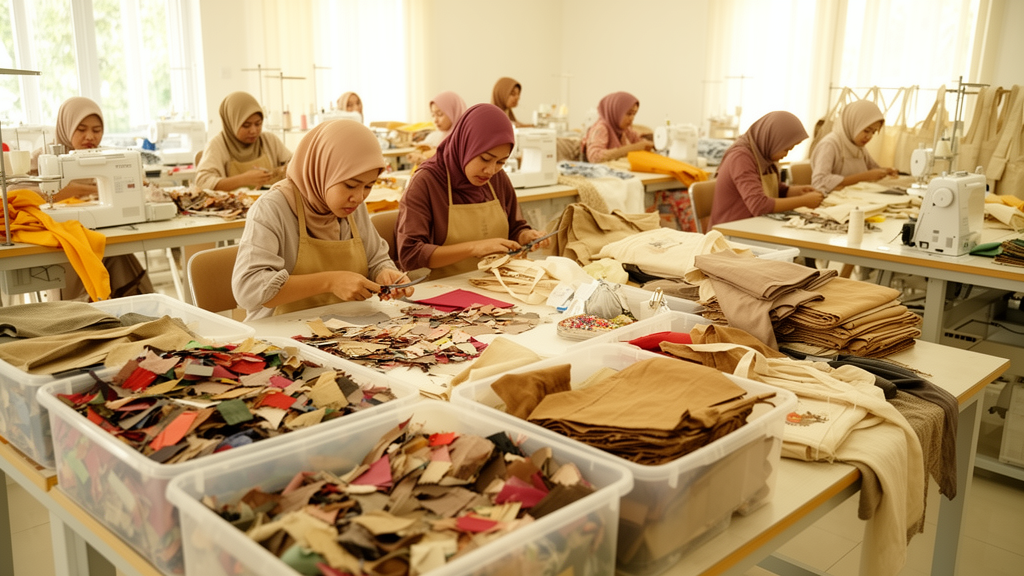
A systematic review of women’s participation in Indonesia’s circular economy finds that increased income does not automatically translate into empowerment. The analysis examined whether participation in activities associated with resource recovery and circular livelihoods produced safer work, fairer returns and greater control over women’s working lives. Instead, the outcomes depended on how economic gains were converted into practical capabilities, with care duties, occupational position, pay, safety, access to productive resources, markets, organisational practices and institutional support acting as important influences.
The researchers searched Scopus and the Sunway University EBSCO Discovery Service within a Malaysia–Indonesia scope. They identified 670 unique records for screening, assessed 11 full-text articles and included seven reports representing six distinct empirical studies. Every eligible study was conducted in Indonesia. This means the findings support conclusions specific to Indonesia, while the absence of eligible Malaysian studies identifies Malaysia as an evidence gap rather than permitting a comparison between the two countries.
The synthesis distinguishes livelihood gains from empowerment outcomes. Household economic improvements or additional income can coexist with occupational inequality, unequal remuneration, hazardous conditions or constrained decision-making. Women’s capacity to benefit from circular-economy participation was shaped not only by whether they entered the sector, but also by their position within it and the conditions under which they worked. The review therefore treats material recovery, waste diversion and job creation as incomplete indicators when evaluating whether circular programmes advance women’s welfare.
Based on the evidence, the authors propose an evidence-informed Gendered Capability Conversion Framework. The framework accommodates enabling, constraining and ambivalent effects, recognising that the same participation pathway may strengthen some aspects of women’s livelihoods while limiting others. The authors describe it as a provisional analytical heuristic that still requires validation, not as a tested causal model. The small and heterogeneous body of evidence also limits generalisation. As a systematic review centred on women’s circular livelihoods in Indonesia, the study provides a structured account of the conditions under which economic participation may become usable capability, while leaving the framework’s transferability and causal performance to future research.
Subject of Research: Gendered capability conversion in women’s circular-economy livelihoods in Indonesia
Article Title: Systematic review of gendered capability conversion in women’s circular livelihoods in Indonesia
Article References: Ismail, Z. A., Santano, D., Zainuddin, M., Anuar, M. F. B. M., & Pratama, H. S. (2026). Systematic review of gendered capability conversion in women’s circular livelihoods in Indonesia. Discover Sustainability. https://doi.org/10.1007/s43621-026-04979-9
Image Credits: AI Generated
DOI: 10.1007/s43621-026-04979-9
Keywords: women’s livelihoods, circular economy, gendered capability, Indonesia, systematic review, economic empowerment, occupational safety, fair pay, care work, inclusive development, Systematic, review
Cite Scienmag News
Violet Maxwell. (October 26, 2026). Systematic review maps how circular work may empower women in Indonesia. Scienmag. https://scienmag.com/systematic-review-maps-how-circular-work-may-empower-women-in-indonesia/
Violet Maxwell. "Systematic review maps how circular work may empower women in Indonesia." Scienmag, 26 October 2026, https://scienmag.com/systematic-review-maps-how-circular-work-may-empower-women-in-indonesia/. Accessed 26 October 2026.
Violet Maxwell. "Systematic review maps how circular work may empower women in Indonesia." Scienmag. October 26, 2026. https://scienmag.com/systematic-review-maps-how-circular-work-may-empower-women-in-indonesia/


