

Monday, October 26, 2026
Science
No Result
View All Result
  • Login
  • HOME
  • SCIENCE NEWS
  • CONTACT US
  • HOME
  • SCIENCE NEWS
  • CONTACT US
No Result
View All Result
Scienmag
No Result
View All Result
Home Science News Earth Science

Groundwater Across Warangal District Often Unfit for Drinking, Study Finds

October 26, 2026
in Earth Science, Science News
Violet Maxwell
By Violet Maxwell Scienmag Editorial Profile - Natural Hazards
Reading Time: 2 mins read
0
Groundwater Across Warangal District Often Unfit for Drinking, Study Finds

Groundwater Across Warangal District Often Unfit for Drinking, Study Finds

65
SHARES
587
VIEWS
Share on FacebookShare on Twitter
ADVERTISEMENT

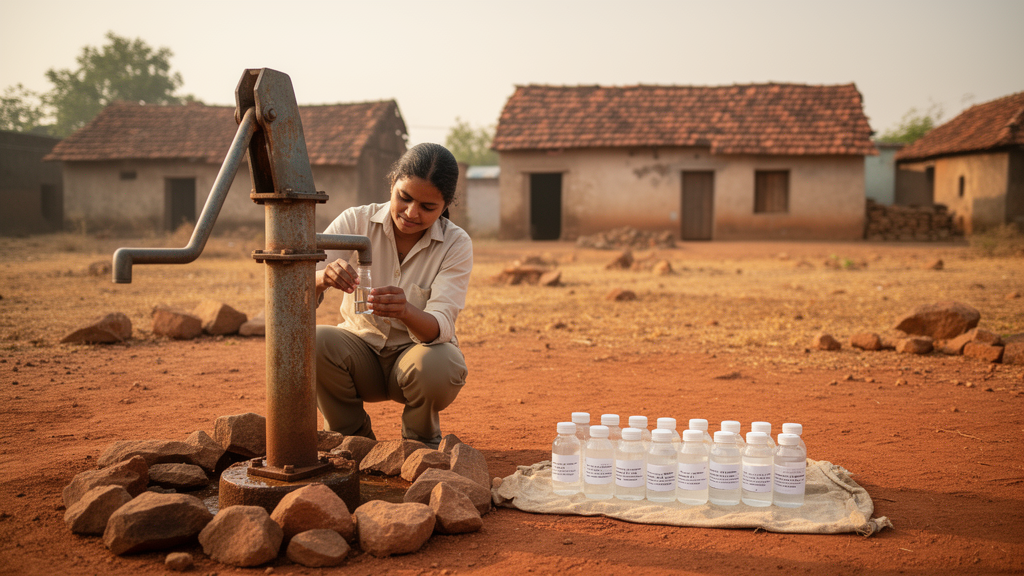
Groundwater in Warangal District, a semi-arid hard-rock region of Telangana, India, is largely poor to unsuitable for drinking, according to an integrated assessment of 58 well-water samples collected during the pre-monsoon season. The study, which combined hydrochemical analysis, geochemical modelling, multivariate statistics and GIS-based spatial mapping, found that most samples remained suitable for irrigation despite localized salinity and sodium hazards.

The samples showed wide hydrochemical variability. Measured pH ranged from 6.52 to 8.95, electrical conductivity from 0.26 to 3.29 dS per metre, and total dissolved solids from 166.4 to 2105.6 milligrams per litre. The dominant water type was the sodium bicarbonate facies, a signature the researchers attribute mainly to rock–water interaction, silicate weathering and ion exchange within the crystalline aquifer.

The team applied the Water Quality Index, which placed most samples in the poor-to-unsuitable category for drinking purposes. Irrigation suitability indices told a more favourable story: the majority of samples remained acceptable for agricultural use, although localized zones showed elevated salinity and sodium levels that could pose risks to soils and crops over time.

Several complementary techniques were used to identify what controls water chemistry. Piper and Gibbs diagrams classified hydrochemical facies and dominant evolutionary mechanisms, while ionic ratio analysis helped distinguish geogenic processes from human influences. PHREEQC saturation index modelling assessed which minerals the waters are dissolving or precipitating. Multivariate statistics, including Pearson correlation, Principal Component Analysis, Factor Analysis and Hierarchical Cluster Analysis, grouped samples and parameters to reveal shared underlying drivers.

Together, these methods pointed to mineral weathering, ion exchange and localized agricultural activity as the principal controls on groundwater evolution. This combination allowed the authors to separate natural, geogenic influences from anthropogenic ones, a distinction that matters for deciding where management interventions are likely to be effective.

Geospatial techniques added a spatial dimension: GIS-based interpolation mapped quality patterns across the district, identifying hotspots where poor drinking-water quality concentrates. Such maps can guide monitoring priorities and help target irrigation management to the areas where salinity and sodium hazards actually occur, rather than applying uniform measures district-wide.

The authors frame the study’s novelty as its unified framework, integrating hydrochemical characterization, statistical analysis, geochemical modelling and geospatial assessment, which had been lacking for the crystalline aquifers of southern India. They argue the approach provides a scientific basis for groundwater monitoring, irrigation management and sustainable water-resource planning in semi-arid hard-rock regions.

As with any single-season sampling campaign, the findings represent pre-monsoon conditions in one district, and the observed quality patterns reflect the interplay of natural aquifer processes and local land use rather than a permanent verdict on the resource.

Subject of Research: Groundwater quality evaluation using water quality index and geospatial techniques in semi-arid regions of Telangana, India

Article Title: Groundwater quality evaluation using water quality index and geospatial techniques in semi-arid regions of Telangana, India

Article References: Chandragiri, R., Pandit, V. B., & Reddy, R. U. (2026). Groundwater quality evaluation using water quality index and geospatial techniques in semi-arid regions of Telangana, India. Frontiers in Environmental Science, 14, Article 1882612. https://doi.org/10.3389/fenvs.2026.1882612

Image Credits: AI Generated

DOI: 10.3389/fenvs.2026.1882612

Keywords: Groundwater, quality, evaluation, water, index, geospatial, techniques, semi-arid, regions, Telangana, India, scientific research

Cite Scienmag News

Violet Maxwell. (October 26, 2026). Groundwater Across Warangal District Often Unfit for Drinking, Study Finds. Scienmag. https://scienmag.com/groundwater-across-warangal-district-often-unfit-for-drinking-study-finds/

Violet Maxwell. "Groundwater Across Warangal District Often Unfit for Drinking, Study Finds." Scienmag, 26 October 2026, https://scienmag.com/groundwater-across-warangal-district-often-unfit-for-drinking-study-finds/. Accessed 26 October 2026.

Violet Maxwell. "Groundwater Across Warangal District Often Unfit for Drinking, Study Finds." Scienmag. October 26, 2026. https://scienmag.com/groundwater-across-warangal-district-often-unfit-for-drinking-study-finds/


Tags: evaluationGeochemical modelling of groundwater chemistrygeospatialGIS mapping of groundwater qualitygroundwatergroundwater quality assessmentGroundwater suitability for irrigation in TelanganaHydrochemical facies analysis using Piper and Gibbs diagramsHydrochemical variability in semi-arid regionsImpact of salinity on soil and crop healthindexIndiaPre-monsoon groundwater sampling and analysisqualityregionsRock–water interaction and ion exchange processesSalinity and sodium hazards in groundwaterScientific Researchsemi-aridtechniquesTelanganaWarangal District hydrochemistrywaterWater quality index for drinking water safety
Share26Tweet16
Previous Post

Kerala study co-designs supervised toothbrushing through Anganwadi centres

Next Post

From team-based cardiopulmonary resuscitation simulation training to clinical practice: a qualitative study

Related Posts

Specialized deep learning improves UAV-based solar fault detection
Technology and Engineering

Specialized deep learning improves UAV-based solar fault detection

October 26, 2026
Central obesity prevalence differs across Australian remoteness areas
Medicine

Central obesity prevalence differs across Australian remoteness areas

October 26, 2026
Survey finds mixed patient-centred orientations among South African optometry students
Science Education

Survey finds mixed patient-centred orientations among South African optometry students

October 26, 2026
XPAR-Net: cross-paradigm alignment and reconstruction network for high-fidelity lens-free on-chip microscopy
Technology and Engineering

XPAR-Net: cross-paradigm alignment and reconstruction network for high-fidelity lens-free on-chip microscopy

October 26, 2026
Iranian child-development providers report referral, funding and coordination barriers
Medicine

Iranian child-development providers report referral, funding and coordination barriers

October 26, 2026
Survey links Industry 4.0 tools to sustainability in Pakistani SMEs
Earth Science

Survey links Industry 4.0 tools to sustainability in Pakistani SMEs

October 26, 2026
Next Post
From team-based cardiopulmonary resuscitation simulation training to clinical practice: a qualitative study

From team-based cardiopulmonary resuscitation simulation training to clinical practice: a qualitative study

  • Mothers who receive childcare support from maternal grandparents show more optimized

    Mothers who receive childcare support from maternal grandparents show more parental warmth, finds NTU Singapore study

    27656 shares
    Share 11059 Tweet 6912
  • University of Seville Breaks 120-Year-Old Mystery, Revises a Key Einstein Concept

    1061 shares
    Share 424 Tweet 265
  • Bee body mass, pathogens and local climate influence heat tolerance

    682 shares
    Share 273 Tweet 171
  • Researchers record first-ever images and data of a shark experiencing a boat strike

    546 shares
    Share 218 Tweet 137
  • Groundbreaking Clinical Trial Reveals Lubiprostone Enhances Kidney Function

    531 shares
    Share 212 Tweet 133
Science

Embark on a thrilling journey of discovery with Scienmag.com—your ultimate source for cutting-edge breakthroughs. Immerse yourself in a world where curiosity knows no limits and tomorrow’s possibilities become today’s reality!

RECENT NEWS

  • Specialized deep learning improves UAV-based solar fault detection
  • Central obesity prevalence differs across Australian remoteness areas
  • Survey finds mixed patient-centred orientations among South African optometry students
  • XPAR-Net: cross-paradigm alignment and reconstruction network for high-fidelity lens-free on-chip microscopy

Categories

  • Agriculture
  • Anthropology
  • Archaeology
  • Athmospheric
  • Biology
  • Biotechnology
  • Blog
  • Bussines
  • Cancer
  • Chemistry
  • Climate
  • Earth Science
  • Editorial Policy
  • Marine
  • Mathematics
  • Medicine
  • Pediatry
  • Policy
  • Psychology & Psychiatry
  • Science Education
  • Science News
  • Social Science
  • Space
  • Technology and Engineering

Subscribe to Blog via Email

Enter your email address to subscribe to this blog and receive notifications of new posts by email.

Join 5,151 other subscribers

© 2025 Scienmag - Science Magazine

Welcome Back!

Login to your account below

Forgotten Password?

Retrieve your password

Please enter your username or email address to reset your password.

Log In
No Result
View All Result
  • HOME
  • SCIENCE NEWS
  • CONTACT US

© 2025 Scienmag - Science Magazine

Discover more from Science

Subscribe now to keep reading and get access to the full archive.

Continue reading