


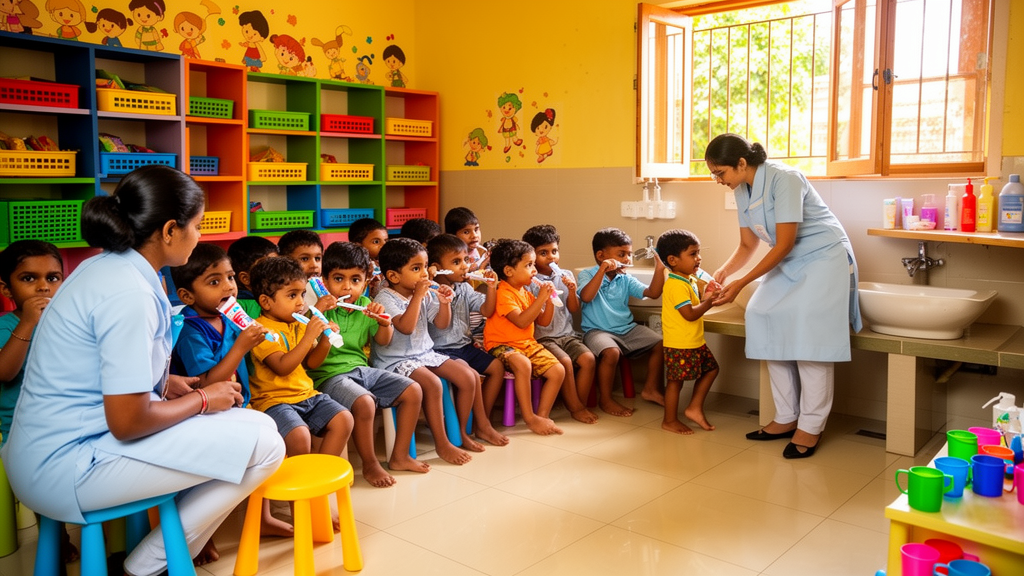
A formative mixed-methods study in Kerala has identified the conditions needed to design a supervised toothbrushing programme for preschool children through Anganwadi centres. Researchers surveyed 168 Anganwadi workers and helpers in Nilambur Block, Malappuram district, and conducted in-depth interviews with stakeholders to examine oral health knowledge, motivation, confidence, current practices and barriers to implementation. The combined evidence was used to develop a six-component, CFIR-informed programme blueprint, known as Model 0.
The research did not test the programme or measure whether it improves children’s oral health. The survey findings revealed a workforce that was highly motivated but poorly prepared to deliver oral health education. Overall, 94.0% of the 168 participants had received no prior oral health training, and 69.6% lacked knowledge about fluoride.
Low confidence in providing oral health education was reported by 94.6% of respondents. Despite these gaps, participants showed strong motivation to promote oral health and perceived it as relevant to their work with preschool children and families. The findings suggest that willingness to participate was not the principal obstacle identified in the study; instead, the central challenges concerned training, confidence and structural support.
Stakeholders described several barriers, including inadequate training, workload constraints, limited policy prioritisation and existing community-level oral health practices. They also identified possible facilitators: structured routines, existing infrastructure and stakeholder support. The researchers analysed the interview data thematically, integrated the qualitative and quantitative findings through a convergence coding matrix, and mapped the resulting information to the CFIR implementation framework.
The study used a convergent parallel design to examine implementation determinants and support contextual co-design rather than estimate an intervention effect. The resulting Model 0 blueprint contains six components informed by the study’s findings. The reported abstract specifically describes elements including training, workflow integration, community engagement and governance mechanisms, but it does not provide a full component-by-component account.
The proposed approach is intended to fit Anganwadi centres, the community-based facilities in India’s Integrated Child Development Services system that provide preschool education, nutrition and child health-related services. Anganwadi workers and helpers interact routinely with preschool children and families, making the centres an accessible potential delivery setting for preventive oral health activities. The study’s contribution is therefore a theory-informed, locally adapted design for further assessment, not evidence that supervised toothbrushing has already been delivered successfully through those centres.
The scope and design limit what can be concluded. Participants were Anganwadi workers and helpers from one block in one district, and the research focused on identifying implementation determinants and co-designing a programme. It did not assess children’s toothbrushing frequency, fluoride exposure, dental caries or other clinical outcomes, nor did it establish the blueprint’s feasibility, acceptability or effectiveness in practice.
The authors’ interpretation is that motivational readiness exists within the Integrated Child Development Services system, while capability gaps and structural limitations constrain implementation across CFIR domains. As a formative study, the work supplies a structured foundation for evaluating a supervised toothbrushing programme through an established community infrastructure. It does not show that the intervention reduces dental caries, improves oral health behaviour or produces clinical benefit among preschool children.
Subject of Research: Co-designing a supervised toothbrushing programme for preschool children through Kerala Anganwadi centres
Article Title: CFIR-guided formative implementation research to co-design a supervised toothbrushing programme through Anganwadi centres in Kerala, India
Article References: James, A., Janakiram, C., Karuveettil, V., Groisman, S., & Weisfuse, D. (2026). CFIR-guided formative implementation research to co-design a supervised toothbrushing programme through Anganwadi centres in Kerala, India. BMC Public Health. https://doi.org/10.1186/s12889-026-29535-y
Image Credits: AI Generated
DOI: 10.1186/s12889-026-29535-y
Keywords: dental caries prevention, toothbrushing, preschool children, Anganwadi centres, Kerala, CFIR, implementation research, mixed-methods study, oral health training, community health workers, CFIR-guided, formative
Cite Scienmag News
Ophelia Keating. (October 26, 2026). Kerala study co-designs supervised toothbrushing through Anganwadi centres. Scienmag. https://scienmag.com/kerala-study-co-designs-supervised-toothbrushing-through-anganwadi-centres/
Ophelia Keating. "Kerala study co-designs supervised toothbrushing through Anganwadi centres." Scienmag, 26 October 2026, https://scienmag.com/kerala-study-co-designs-supervised-toothbrushing-through-anganwadi-centres/. Accessed 26 October 2026.
Ophelia Keating. "Kerala study co-designs supervised toothbrushing through Anganwadi centres." Scienmag. October 26, 2026. https://scienmag.com/kerala-study-co-designs-supervised-toothbrushing-through-anganwadi-centres/


