

Monday, October 26, 2026
Science
No Result
View All Result
  • Login
  • HOME
  • SCIENCE NEWS
  • CONTACT US
  • HOME
  • SCIENCE NEWS
  • CONTACT US
No Result
View All Result
Scienmag
No Result
View All Result
Home Science News Medicine

Cross-sectional study links Swiss bus driver burnout to demanding working conditions

October 26, 2026
in Medicine
Ophelia Keating
By Ophelia Keating Scienmag Editorial Profile - Health Services Research
Reading Time: 3 mins read
0
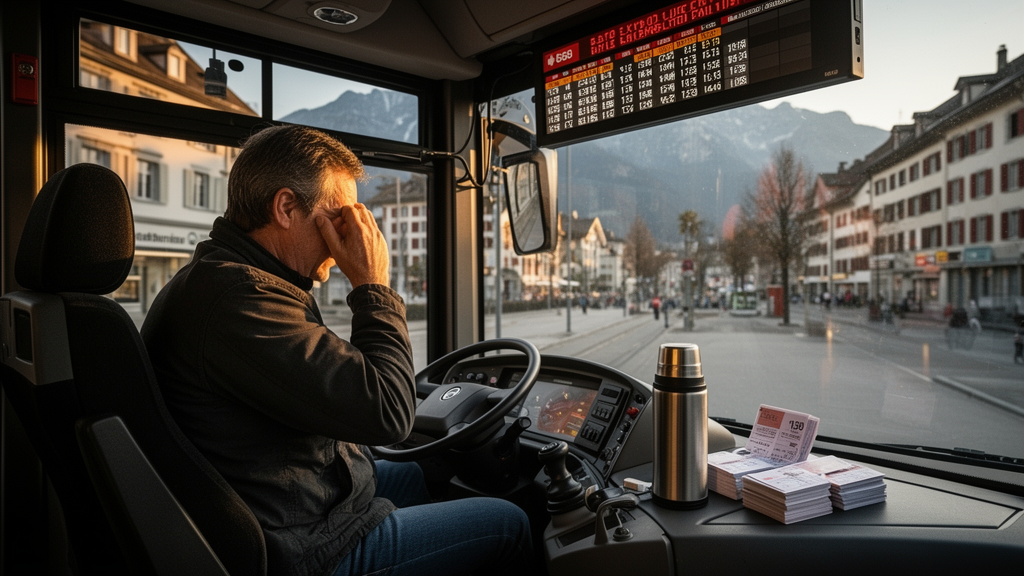
Cross-sectional study links Swiss bus driver burnout to demanding working conditions

Cross-sectional study links Swiss bus driver burnout to demanding working conditions

65
SHARES
587
VIEWS
Share on FacebookShare on Twitter
ADVERTISEMENT

A cross-sectional analysis of 424 Swiss bus drivers found that 17.2% were categorized as being at risk of occupational burnout and 15.3% as being at high risk using the 12-item Burnout Assessment Tool (BAT-12). Higher burnout scores were associated with work-related effort–reward imbalance, daily fear of accidents, internal organizational hostility, frequent aggression from passengers, urban driving and workdays longer than 10 hours. Better-equipped break areas were associated with lower burnout scores. The results identify working conditions correlated with burnout in this group of drivers, but the study did not establish that any of these conditions caused the outcome.

The findings were drawn from the baseline questionnaires of the Swiss Transport Personnel Health Cohort, known as TRAPHEAC. All 424 participating bus drivers completed the relevant questionnaires between June and October 2024. Their mean age was 49.5 years, and 16.1% were women. Researchers measured work stress with the Effort–Reward Imbalance (ERI) model and evaluated 15 working conditions as potential predictors of burnout. Statistical analyses used multilevel linear regression models, with transport company represented as a random intercept. The models accounted for age, sex and interaction terms, while model performance and explanatory power were assessed using the Akaike Information Criterion and marginal R².

Drivers’ mean ERI score was 1.25, with a standard deviation of 0.58, indicating greater effort than reward. ERI showed a significant dose–response association with burnout: each one-unit increase in ERI was associated with an estimated 0.37-point increase in the burnout score, with a 95% confidence interval of 0.31 to 0.42. The estimated association was larger among men, at β = 0.47, than among women, at β = 0.31. Analyses stratified by career duration suggested greater vulnerability among drivers with three or fewer years of experience than among those with longer careers, although this subgroup result was described as suggestive rather than definitive.

In the multivariable models, daily fear of accident was associated with an estimated 0.63-point increase in burnout score, while internal organizational hostility was associated with an increase of 0.30 points. Frequent aggression from passengers and urban driving were also significant predictors. Each weekly workday lasting more than 10 hours was associated with an estimated 0.08-point increase in burnout score. In contrast, amenities in break areas were associated with lower burnout scores, making them the protective factor identified in the analysis. The authors concluded that efforts to reduce long workdays, mitigate passenger aggression, improve the organizational climate and enhance break facilities should be priorities. They also called for regulatory measures that limit excessive hours and support safer, more respectful working environments, which the authors linked to safeguarding drivers’ mental health and the sustainability of public transport services. As a cross-sectional study based on one baseline questionnaire round, the research cannot determine whether working conditions preceded burnout, whether burnout affected reported conditions, or whether changes to any single factor would reduce burnout scores over time.

Subject of Research: Occupational burnout and associated working conditions among Swiss bus drivers

Article Title: Predictors of occupational burnout in Swiss bus drivers: results from the TRAPHEAC study

Article References: Guseva Canu, I., Soumillion, M., & Remy, V. F. M. (2026). Predictors of occupational burnout in Swiss bus drivers: results from the TRAPHEAC study. BMC Public Health. https://doi.org/10.1186/s12889-026-29784-x

Image Credits: AI Generated

DOI: 10.1186/s12889-026-29784-x

Keywords: occupational burnout, bus drivers, TRAPHEAC cohort, work stress, effort–reward imbalance, passenger aggression, workplace hostility, long workdays, accident fear, public transport, Predictors, occupational

Cite Scienmag News

Ophelia Keating. (October 26, 2026). Cross-sectional study links Swiss bus driver burnout to demanding working conditions. Scienmag. https://scienmag.com/cross-sectional-study-links-swiss-bus-driver-burnout-to-demanding-working-conditions/


Ophelia Keating. "Cross-sectional study links Swiss bus driver burnout to demanding working conditions." Scienmag, 26 October 2026, https://scienmag.com/cross-sectional-study-links-swiss-bus-driver-burnout-to-demanding-working-conditions/. Accessed 26 October 2026.

Ophelia Keating. "Cross-sectional study links Swiss bus driver burnout to demanding working conditions." Scienmag. October 26, 2026. https://scienmag.com/cross-sectional-study-links-swiss-bus-driver-burnout-to-demanding-working-conditions/

Tags: accident fearburnout assessment tools in occupational healthBus driver burnoutbus driverseffort-reward imbalance in transit workerseffort–reward imbalanceinfluence of break area quality on driver stresslong work hours and burnout risklong workdaysOccupationaloccupational burnoutoccupational stress in transportationorganizational hostility in transportation industrypassenger aggressionpassenger aggression impact on driver mental healthPredictorspublic transportSwiss transport personnel health studyTRAPHEAC cohorturban driving stress factorswork stresswork-related fear of accidents among bus driversworkplace environment and driver well-beingworkplace hostility
Share26Tweet16
Previous Post

Neural Network Learns to Predict Heat Transfer in Elastic Nanofluid Flow Over an Electromagnetic Surface

Next Post

Blood RNA patterns track essential tremor brain and cognitive differences

Related Posts

Australian survey finds broad acceptability of lifestyle medicine for brain health
Medicine

Australian survey finds broad acceptability of lifestyle medicine for brain health

October 26, 2026
Free Healthy Food Access May Reduce Food Insecurity, Not Significantly Improve HbA1c
Medicine

Free Healthy Food Access May Reduce Food Insecurity, Not Significantly Improve HbA1c

October 26, 2026
Indian district survey maps low birth weight, temperature and health
Medicine

Indian district survey maps low birth weight, temperature and health

October 26, 2026
Central obesity prevalence differs across Australian remoteness areas
Medicine

Central obesity prevalence differs across Australian remoteness areas

October 26, 2026
Iranian child-development providers report referral, funding and coordination barriers
Medicine

Iranian child-development providers report referral, funding and coordination barriers

October 26, 2026
Health literacy linked to metabolic syndrome prevalence in Korean adults
Medicine

Health literacy linked to metabolic syndrome prevalence in Korean adults

October 26, 2026
Next Post
Blood RNA patterns track essential tremor brain and cognitive differences

Blood RNA patterns track essential tremor brain and cognitive differences

  • Mothers who receive childcare support from maternal grandparents show more optimized

    Mothers who receive childcare support from maternal grandparents show more parental warmth, finds NTU Singapore study

    27656 shares
    Share 11059 Tweet 6912
  • University of Seville Breaks 120-Year-Old Mystery, Revises a Key Einstein Concept

    1061 shares
    Share 424 Tweet 265
  • Bee body mass, pathogens and local climate influence heat tolerance

    682 shares
    Share 273 Tweet 171
  • Researchers record first-ever images and data of a shark experiencing a boat strike

    546 shares
    Share 218 Tweet 137
  • Groundbreaking Clinical Trial Reveals Lubiprostone Enhances Kidney Function

    531 shares
    Share 212 Tweet 133
Science

Embark on a thrilling journey of discovery with Scienmag.com—your ultimate source for cutting-edge breakthroughs. Immerse yourself in a world where curiosity knows no limits and tomorrow’s possibilities become today’s reality!

RECENT NEWS

  • Australian survey finds broad acceptability of lifestyle medicine for brain health
  • Virtual patient scores rose after emergency internship in 86-intern single-group study
  • Survey links Ethiopian small firms’ performance to innovation capability
  • Free Healthy Food Access May Reduce Food Insecurity, Not Significantly Improve HbA1c

Categories

  • Agriculture
  • Anthropology
  • Archaeology
  • Athmospheric
  • Biology
  • Biotechnology
  • Blog
  • Bussines
  • Cancer
  • Chemistry
  • Climate
  • Earth Science
  • Editorial Policy
  • Marine
  • Mathematics
  • Medicine
  • Pediatry
  • Policy
  • Psychology & Psychiatry
  • Science Education
  • Science News
  • Social Science
  • Space
  • Technology and Engineering

Subscribe to Blog via Email

Enter your email address to subscribe to this blog and receive notifications of new posts by email.

Join 5,151 other subscribers

© 2025 Scienmag - Science Magazine

Welcome Back!

Login to your account below

Forgotten Password?

Retrieve your password

Please enter your username or email address to reset your password.

Log In
No Result
View All Result
  • HOME
  • SCIENCE NEWS
  • CONTACT US

© 2025 Scienmag - Science Magazine

Discover more from Science

Subscribe now to keep reading and get access to the full archive.

Continue reading