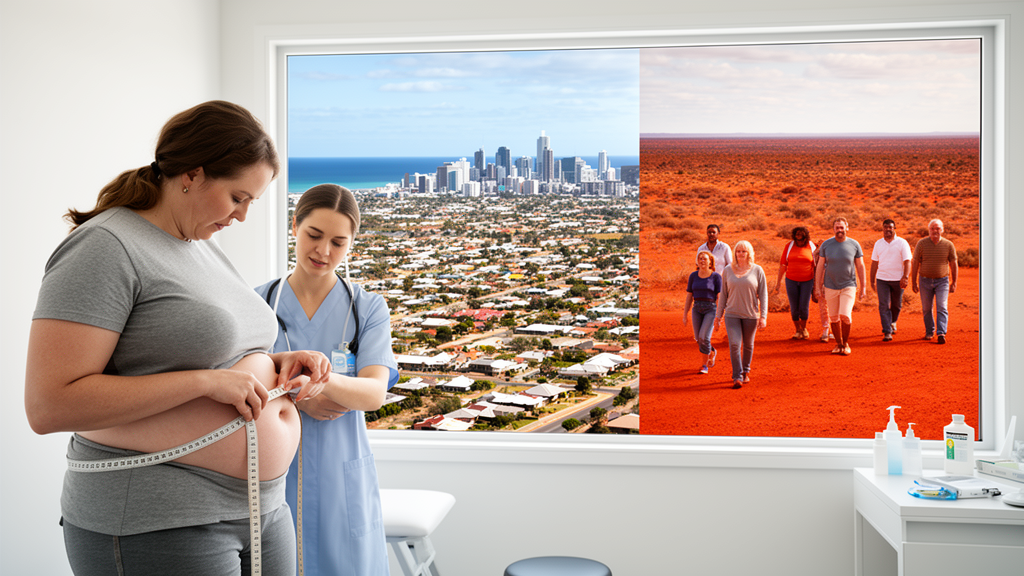
Central obesity was more prevalent among adults in Australia’s Outer Regional and Remote areas than in other remoteness categories, according to a population-based analysis of the 2017–18 Australian National Health Survey. The study estimated that 46.2% of adults in Outer Regional and Remote areas met the central-obesity threshold, compared with 38.8% across Australia as a whole. Central obesity was defined as a waist circumference of at least 102 cm for males and at least 88 cm for females.
The findings concern differences among geographic categories rather than an increase over time, and the observational study did not establish that remoteness caused the differences. Researchers analysed a weighted sample of 18,655 adults aged 18 years or older from the national survey. They used Bayesian multivariable logistic regression to estimate associations between central obesity and a range of sociodemographic, lifestyle and psychosocial characteristics, reporting odds ratios with 95% credible intervals.
In Inner Regional areas, several factors were associated with higher adjusted odds of central obesity. Adults who had not completed Year 12 had 27% higher odds than the relevant reference group (odds ratio 1.27; 95% credible interval 1.09–1.50), while those living in the most socioeconomically disadvantaged areas had 71% higher odds (odds ratio 1.71; 95% credible interval 1.26–2.34). These estimates identify population-level associations and do not demonstrate direct causal effects.
Physical inactivity and depression were also associated with higher odds in Inner Regional areas. Physically inactive adults had more than twice the odds of central obesity (odds ratio 2.15; 95% credible interval 1.73–2.69), and adults with depression had 96% higher odds (odds ratio 1.96; 95% credible interval 1.49–2.60). Socioeconomic disadvantage was associated with higher odds in both Inner Regional and Outer Regional and Remote areas, although the magnitude differed between the models.
Daily consumption of sugary drinks was another correlate identified in Outer Regional and Remote areas. Adults who consumed them daily had 38% higher odds of central obesity than the relevant reference group (odds ratio 1.38; 95% credible interval 1.08–1.77). In that same category, residents of the most socioeconomically disadvantaged areas had 54% higher odds than those in the reference group (odds ratio 1.54; 95% credible interval 1.13–2.13).
Because the analysis drew on survey observations and adjusted multivariable models, it cannot determine whether physical inactivity, disadvantage, sugary drink consumption or other measured factors produced the higher odds. The analysis also identified a subgroup that a BMI-only assessment could miss. Among adults in Outer Regional and Remote areas whose body mass index was classified as normal, 6.7% still met the study’s waist-circumference threshold for central obesity—approximately one in 15.
This finding supports the authors’ concern that assessing obesity only by BMI may overlook some adults with central obesity in regional and remote communities. The study is cross-sectional, so it cannot show how central obesity developed or changed over time, and it did not test whether any policy or intervention would improve cardiometabolic outcomes. Its scope was limited to adults represented in the 2017–18 national survey and to the sociodemographic, lifestyle and psychosocial factors included in the analysis.
Subject of Research: Population-based study of central obesity and associated factors among regional and remote Australian adults
Article Title: Central obesity in regional and remote Australian adults: a population-based Bayesian study
Article References: Aychiluhm, S. B., Ahmed, K. Y., Ross, A. G., Thapa, S., Astawesegn, F. H., Isaac, V., Berhe, F. T., Nezenega, Z. S., Leshargie, C. T., Kassa, Z. Y., Huda, M. M., Mahmood, S., Mondal, U. K., Anyasodor, A. E., Mengist, T. Y., Demissie, B. W., & Bore, M. G. (2026). Central obesity in regional and remote Australian adults: a population-based Bayesian study. BMC Public Health. https://doi.org/10.1186/s12889-026-29863-z
Image Credits: AI Generated
DOI: 10.1186/s12889-026-29863-z
Keywords: central obesity, Australia, waist circumference, remoteness, Bayesian regression, socioeconomic disadvantage, physical inactivity, depression, sugary drinks, body mass index, Central, obesity
Cite Scienmag News
Daisy Hatcher. (October 26, 2026). Central obesity prevalence differs across Australian remoteness areas. Scienmag. https://scienmag.com/central-obesity-prevalence-differs-across-australian-remoteness-areas/
Daisy Hatcher. "Central obesity prevalence differs across Australian remoteness areas." Scienmag, 26 October 2026, https://scienmag.com/central-obesity-prevalence-differs-across-australian-remoteness-areas/. Accessed 26 October 2026.
Daisy Hatcher. "Central obesity prevalence differs across Australian remoteness areas." Scienmag. October 26, 2026. https://scienmag.com/central-obesity-prevalence-differs-across-australian-remoteness-areas/