


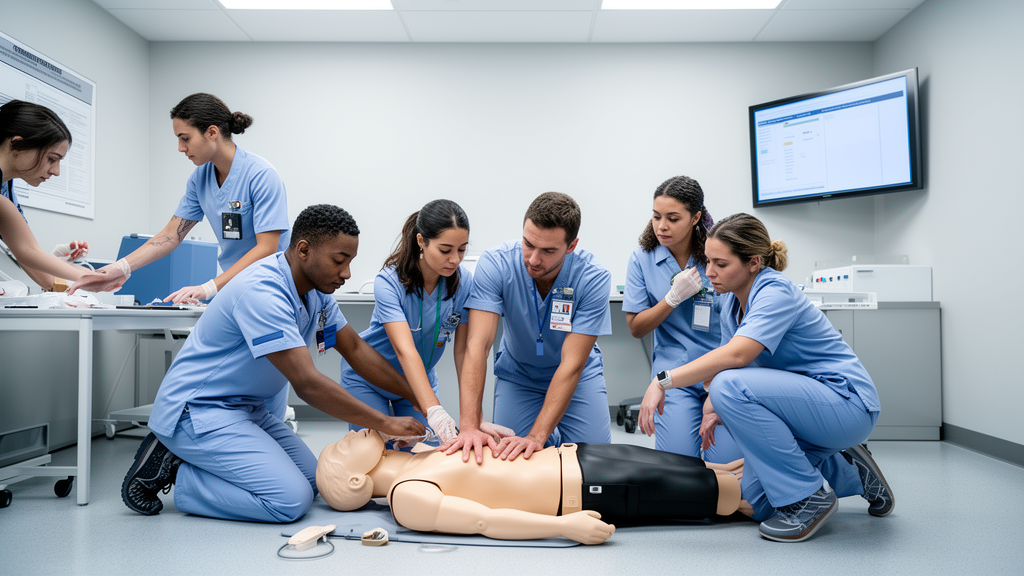
Nursing interns described an uneven transfer of learning from team-based cardiopulmonary resuscitation simulation to real clinical practice, according to a qualitative study of 22 purposively selected interns. Standardized procedures and clearly defined team roles were easier to recall and apply than responses that required interpretation and adaptation to changing clinical situations. The study also identified emotional pressure, uncertainty about interns’ roles and a perceived mismatch between performing well in simulation and feeling prepared for real resuscitation.
Researchers used a qualitative descriptive design to explore how nursing interns experienced applying learning from team-based CPR simulation training during clinical resuscitation. They conducted semi-structured, in-depth interviews with 22 participants after the training. The interns’ clinical exposure varied: some had directly participated in resuscitations or provided supporting assistance, while others had only observed them. Qualitative content analysis was used to examine the interview data, and the study was reported according to the Consolidated Criteria for Reporting Qualitative Research.
The analysis produced three themes and nine subthemes: physical and emotional experiences of clinical resuscitation; perceived learning from team-based CPR simulation training; and factors affecting the transfer of simulated CPR skills to clinical practice. Together, these themes show that the transition from training to practice involved more than the recall of technical steps. Participants described real resuscitation as an experience shaped by changing information, team coordination, uncertainty and the pressure of a clinical emergency.
Standardized procedures and clearly defined team roles appeared easier to carry into practice. In simulation, participants could rehearse prescribed sequences and practice responsibilities within a structured team format. In clinical practice, however, interns sometimes had to respond to situations that required them to interpret information and adapt established procedures to the particular patient and circumstances. The findings therefore point to a difference between applying a rehearsed action and adjusting that action in response to a changing clinical context.
Emotional and role-related challenges were also prominent in the interviews. Interns described physical and emotional strain, uncertainty about their role as interns and concern about how they could contribute during a real resuscitation. These experiences were not fully represented by the simulation environment, according to the participants. The reported mismatch between success in simulation and preparedness for actual resuscitation suggests that technical rehearsal alone did not resolve the uncertainty and situational demands encountered in clinical care.
Clinical mentors were valued for explaining clinical reasoning and helping interns understand aspects of practice that were difficult to capture in standardized simulation. Their guidance helped participants see how procedural knowledge could be adapted to a particular patient and situation. This mentorship role addressed a different part of learning from simulation: not only what to do in sequence, but how to interpret the condition of a patient and modify an approach as circumstances changed.
The study’s design and scope limit the conclusions that can be drawn. It included 22 nursing interns and relied on their accounts of experiences after simulation training, with differing levels of direct clinical involvement. The findings describe perceived learning and reported challenges; they do not quantify how frequently each difficulty occurred, establish that simulation improved resuscitation outcomes or compare the interns with a group that did not receive the training. Nor can the study determine whether mentorship itself produced a measurable improvement in performance.
Overall, the research portrays the transfer of CPR learning as uneven rather than complete. Fixed procedures and team roles appeared easier to apply in practice, while adaptation, uncertainty and emotional demands were more difficult to reproduce in simulation. The authors’ conclusion is that structured simulation and supervised clinical learning may play complementary roles in CPR education, particularly in preparing nursing interns to respond to uncertainty and context-dependent clinical demands. Because the study is qualitative and centered on a small group of interns, that complementary relationship remains a conclusion from participants’ experiences rather than a demonstrated effect on clinical outcomes.
Subject of Research: Nursing interns’ experiences transferring team-based CPR simulation learning into clinical resuscitation practice
Article Title: From team-based cardiopulmonary resuscitation simulation training to clinical practice: a qualitative study
Article References: Li, M., Liu, H., Huang, H., Chen, Q., Xia, Y., Tao, H., Jiang, Y., Zhao, S., Zhang, A., Sun, Y., Liu, Z., Zhang, X., & Liu, Q. (2026). From team-based cardiopulmonary resuscitation simulation training to clinical practice: a qualitative study. BMC Medical Education. https://doi.org/10.1186/s12909-026-10674-0
Image Credits: AI Generated
DOI: 10.1186/s12909-026-10674-0
Keywords: cardiopulmonary resuscitation, simulation training, nursing education, nursing interns, team-based learning, clinical mentorship, skills transfer, qualitative study, clinical practice, team-based, cardiopulmonary, resuscitation
Cite Scienmag News
Courtney Benton. (October 26, 2026). From team-based cardiopulmonary resuscitation simulation training to clinical practice: a qualitative study. Scienmag. https://scienmag.com/from-team-based-cardiopulmonary-resuscitation-simulation-training-to-clinical-practice-a-qualitative-study/
Courtney Benton. "From team-based cardiopulmonary resuscitation simulation training to clinical practice: a qualitative study." Scienmag, 26 October 2026, https://scienmag.com/from-team-based-cardiopulmonary-resuscitation-simulation-training-to-clinical-practice-a-qualitative-study/. Accessed 26 October 2026.
Courtney Benton. "From team-based cardiopulmonary resuscitation simulation training to clinical practice: a qualitative study." Scienmag. October 26, 2026. https://scienmag.com/from-team-based-cardiopulmonary-resuscitation-simulation-training-to-clinical-practice-a-qualitative-study/


