


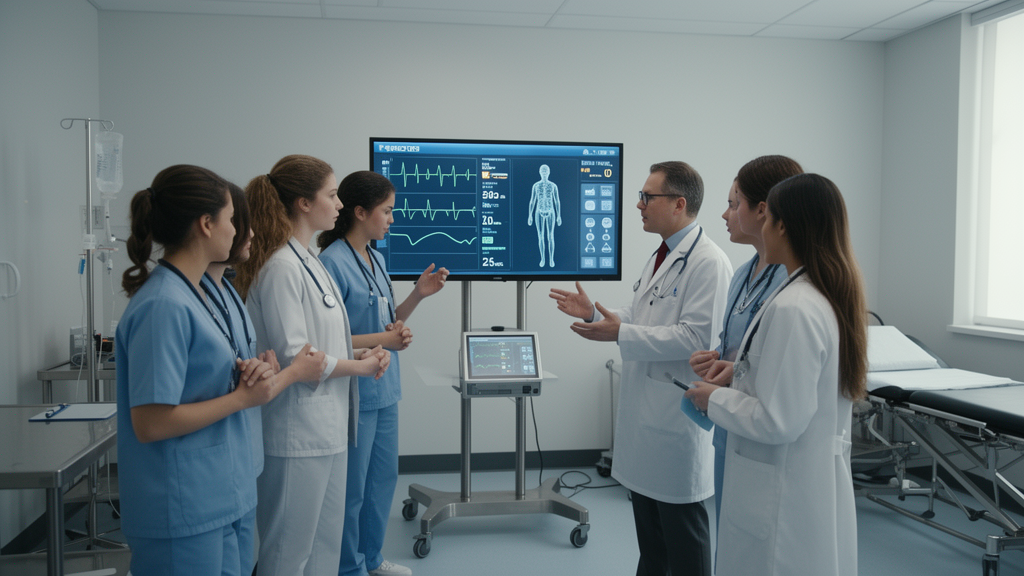
Medical students with more favorable patient-safety perceptions also reported stronger critical trust in artificial intelligence and digital clinical tools in a cross-sectional survey at Gaziantep University Faculty of Medicine in Türkiye. Researchers found that the student-derived patient-safety index had the largest standardized association with critical trust among the factors examined, but the survey cannot establish that safety perceptions cause greater trust or that additional training changes either measure. The study surveyed 359 medical students between April and May 2026.
After seven responses from students younger than 18 were excluded from 366 submitted responses, participants completed study-developed Likert-type item sets assessing patient safety, lifelong learning and approaches to AI and digital clinical tools. The investigators used exploratory factor analysis, informed by parallel analysis, to derive exploratory indices. They examined associations with nonparametric tests and multivariable linear regression, then conducted sensitivity analyses using complete item sets and excluding respondents who gave invariant answers.
Reported exposure to relevant training was limited in the survey. Seventy-two students, or 20.1%, reported receiving patient-safety training during the previous 12 months, while 50 students, or 13.9%, reported training involving AI, digital health or clinical decision-support systems. Among 79 clinical-phase students, 10, or 12.7%, reported having encountered an adverse-event or near-miss reporting system.
These results describe the responses of students at one institution and do not establish the effectiveness of the reported training or the adequacy of preparation elsewhere. The clearest relationship was a positive correlation between the exploratory patient-safety index and the exploratory critical-trust index, which had a Spearman’s rho of 0.453 and a p value below 0.001. In the multivariable analysis, patient-safety perceptions had the largest standardized association with critical trust, with a regression coefficient of 0.473, a 95% confidence interval of 0.385 to 0.560, a standardized beta of 0.507 and a p value below 0.001.
Clinical-phase status was also positively associated with critical trust, with a coefficient of 0.167 and p = 0.010. By contrast, reported AI or digital-health training was inversely associated with critical trust, with a coefficient of −0.177 and p = 0.018. The authors did not interpret this association as evidence that training reduces trust.
A separate measure of whether students had used any digital clinical or AI-based tool was not independently associated with critical trust after adjustment. Measurement sensitivity qualified the main result. When the researchers repeated the analysis with complete item sets, the association between patient-safety perceptions and critical trust persisted but was attenuated, with a standardized beta of 0.292 and p below 0.001.
The investigators said the lower coefficient showed that the estimated magnitude depended on how the scores were constructed. They also identified possible contributions from item composition, measurement reliability and wording-related structure. Because the indices were derived exploratorily from study-developed questions, their construction limits direct transfer to other medical-student populations.
Overall, the findings provide an exploratory association between how medical students view patient safety and their critical trust in AI-supported clinical tools. The results also show that reported use of a digital clinical or AI-based tool was not independently associated with the trust measure in the adjusted analysis. The study offers a rationale for longitudinal, interventional and simulation-based research into how patient safety, lifelong learning and critical evaluation of AI-supported recommendations may intersect in medical education.
As a single-center, cross-sectional study based on exploratory indices, however, it cannot determine causality, curricular effects or changes in trust over time.
Subject of Research: Cross-sectional associations among patient-safety perceptions and medical students’ critical trust in AI and digital clinical tools
Article Title: Associations of patient safety-related perceptions and lifelong learning-related attitudes with critical trust in AI/digital clinical tools among medical students: a cross-sectional study
Article References: Nariçi, B., Demir, M., Güvenç, N., & Keten, H. S. (2026). Associations of patient safety-related perceptions and lifelong learning-related attitudes with critical trust in AI/digital clinical tools among medical students: a cross-sectional study. BMC Medical Education. https://doi.org/10.1186/s12909-026-10677-x
Image Credits: AI Generated
DOI: 10.1186/s12909-026-10677-x
Keywords: medical education, clinical AI, patient safety, critical trust, medical students, digital health, lifelong learning, cross-sectional survey, exploratory factor analysis, Türkiye, Associations, patient
Cite Scienmag News
Courtney Benton. (October 26, 2026). Research report: Associations of patient safety-related perceptions and lifelong learning-related attitudes with critical trust in AI/digital clinical tools among medical students: a cross-sectional study. Scienmag. https://scienmag.com/research-report-associations-of-patient-safety-related-perceptions-and-lifelong-learning-related-attitudes-with-critical-trust-in-ai-digital-clinical-tools-among-medical-students-a-cross-sectional-s/
Courtney Benton. "Research report: Associations of patient safety-related perceptions and lifelong learning-related attitudes with critical trust in AI/digital clinical tools among medical students: a cross-sectional study." Scienmag, 26 October 2026, https://scienmag.com/research-report-associations-of-patient-safety-related-perceptions-and-lifelong-learning-related-attitudes-with-critical-trust-in-ai-digital-clinical-tools-among-medical-students-a-cross-sectional-s/. Accessed 26 October 2026.
Courtney Benton. "Research report: Associations of patient safety-related perceptions and lifelong learning-related attitudes with critical trust in AI/digital clinical tools among medical students: a cross-sectional study." Scienmag. October 26, 2026. https://scienmag.com/research-report-associations-of-patient-safety-related-perceptions-and-lifelong-learning-related-attitudes-with-critical-trust-in-ai-digital-clinical-tools-among-medical-students-a-cross-sectional-s/


