

Monday, October 26, 2026
Science
No Result
View All Result
  • Login
  • HOME
  • SCIENCE NEWS
  • CONTACT US
  • HOME
  • SCIENCE NEWS
  • CONTACT US
No Result
View All Result
Scienmag
No Result
View All Result
Home Science News Technology and Engineering

Finite-element study maps stresses around 4-mm ultra-short dental implants

October 26, 2026
in Technology and Engineering
Denise Maddox
By Denise Maddox Scienmag Editorial Profile - Mechanical Engineering
Reading Time: 2 mins read
0
Finite-element study maps stresses around 4-mm ultra-short dental implants

Finite-element study maps stresses around 4-mm ultra-short dental implants

65
SHARES
587
VIEWS
Share on FacebookShare on Twitter
ADVERTISEMENT

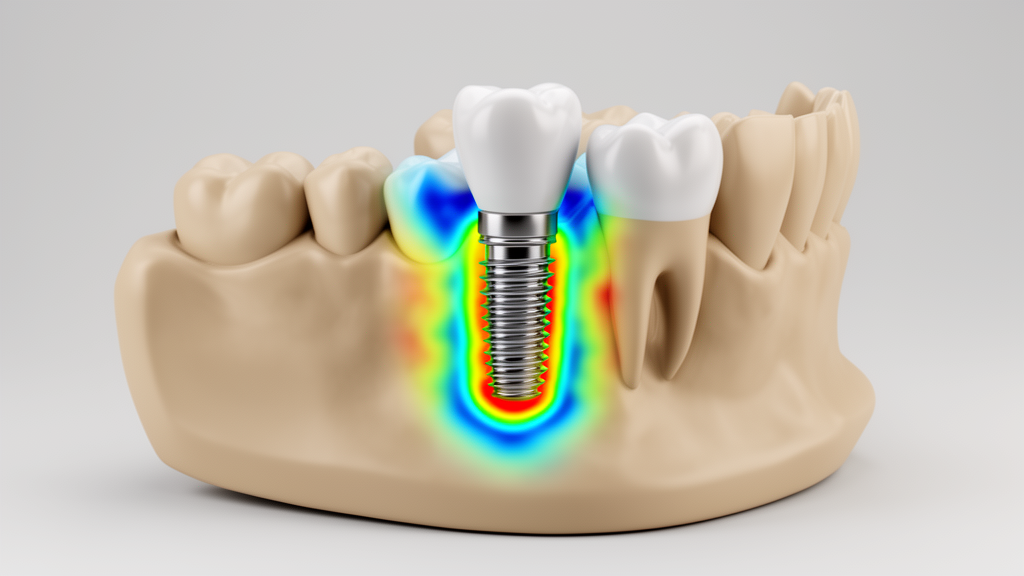
A three-dimensional finite-element analysis found that loading direction and prosthetic configuration had greater effects on calculated stress and strain around 4-mm ultra-short dental implants than crown material. In the modeled posterior setting, oblique loading increased stress in single-crown restorations, while a splinted two-crown arrangement produced lower calculated values under the modeled oblique conditions. These are computational results and do not establish that any implant configuration is clinically safer, more reliable or superior.

The researchers developed three-dimensional finite-element models of single-crown restorations and a splinted two-crown configuration supported by 4-mm ultra-short implants. The models included zirconia and composite-resin crowns subjected to vertical loading and loading inclined by 30 degrees, each tested with and without a simulated food bolus between the crown and the opposing surface. The bolus was assigned a Young’s modulus of 10 MPa and a Poisson’s ratio of 0.30.

Primary outcomes were volume-weighted mean von Mises stress and equivalent elastic strain within a fixed 0.50-mm peri-implant volumetric region of interest. Without a simulated bolus, changing the single-crown load from vertical to oblique increased stress in the cortical-bone region of interest from approximately 10.01 to 43.02 MPa. In the trabecular-bone region, the corresponding values rose from about 4.95 to 12.35 MPa.

Interposing the simulated food bolus reduced the oblique-loading values to approximately 19.57 MPa in the cortical region and 5.63 MPa in the trabecular region. The results therefore show lower calculated stress under the modeled oblique conditions when a bolus was present, although the study evaluated only one specified bolus representation. In the splinted two-crown models, cortical-region stress under oblique loading ranged from 8.63 to 10.43 MPa.

These calculated peri-implant stress and strain outcomes were lower than those in the single-crown configuration under oblique loading. Splinting cannot, however, be treated as an independent causal factor in that comparison because the two configurations carried different total loads. Crown material made little difference in the single-crown models, which produced nearly identical region-of-interest outcomes for zirconia and composite resin.

A modest, configuration-specific material difference appeared under oblique loading in the splinted two-crown model. The researchers assessed numerical convergence using three nominal local mesh-refinement levels, and all primary outcomes met a 5% acceptance threshold. No patients were evaluated, and the analysis did not measure biological healing, implant failure or clinical outcomes.

Experimental and clinical validation would be required before the model could support claims of biomechanical reliability or clinical superiority.

Subject of Research: Finite-element assessment of peri-implant stress under different occlusal loading conditions

Article Title: Effect of occlusal loading and crown material on stress and strain distribution in bone around 4-mm ultra-short implants: a 3D-FEA

Article References: Renno, F., Gasparro, R., Mariniello, M., Aliberti, A., Garcia-Godoy, F., Lanzotti, A., & Ausiello, P. (2026). Effect of occlusal loading and crown material on stress and strain distribution in bone around 4-mm ultra-short implants: a 3D-FEA. Scientific Reports. https://doi.org/10.1038/s41598-026-76024-8

Image Credits: AI Generated

DOI: 10.1038/s41598-026-76024-8

Keywords: dental implants, finite-element analysis, occlusal loading, peri-implant bone, zirconia crowns, composite resin, bone stress, dental biomechanics, Effect, occlusal, loading, crown

Cite Scienmag News

Denise Maddox. (October 26, 2026). Finite-element study maps stresses around 4-mm ultra-short dental implants. Scienmag. https://scienmag.com/finite-element-study-maps-stresses-around-4-mm-ultra-short-dental-implants/

Denise Maddox. "Finite-element study maps stresses around 4-mm ultra-short dental implants." Scienmag, 26 October 2026, https://scienmag.com/finite-element-study-maps-stresses-around-4-mm-ultra-short-dental-implants/. Accessed 26 October 2026.

Denise Maddox. "Finite-element study maps stresses around 4-mm ultra-short dental implants." Scienmag. October 26, 2026. https://scienmag.com/finite-element-study-maps-stresses-around-4-mm-ultra-short-dental-implants/


Tags: biomechanical assessment of 4-mm ultra-short implantsbone stresscomparison of single-crown and splinted crown arrangementscomposite resincomputational modeling of dental implant biomechanicscrowndental biomechanicsdental implantsEffecteffects of oblique versus vertical load on implant stabilityfinite element analysisfinite element analysis of ultra-short dental implantsimpact of loading direction on implant stressesimplications of loading conditions on implantinfluence of crown material on stress patternsloadingocclusalocclusal loadingperi-implant boneperi-implant stress analysis in finite element studiesposterior implant loading simulationsprosthetic configuration effects on implant longevitystress distribution around dental implantszirconia crowns
Share26Tweet16
Previous Post

Kinematic Model Tests Ductile-Hinge Layouts for Curved Bridge Launching

Next Post

Semantic Labels Guide Terrain-Specific Humanoid Behavior in Simulation

Related Posts

Sentinel-node gastrectomy linked to better five-year pancreatic volume preservation
Technology and Engineering

Sentinel-node gastrectomy linked to better five-year pancreatic volume preservation

October 26, 2026
Attention-enhanced YOLOv8s advances photovoltaic defect detection
Technology and Engineering

Attention-enhanced YOLOv8s advances photovoltaic defect detection

October 26, 2026
Thicker walls and more openings raise bending loads in PLA specimens
Technology and Engineering

Thicker walls and more openings raise bending loads in PLA specimens

October 26, 2026
Semantic Labels Guide Terrain-Specific Humanoid Behavior in Simulation
Technology and Engineering

Semantic Labels Guide Terrain-Specific Humanoid Behavior in Simulation

October 26, 2026
Kinematic Model Tests Ductile-Hinge Layouts for Curved Bridge Launching
Technology and Engineering

Kinematic Model Tests Ductile-Hinge Layouts for Curved Bridge Launching

October 26, 2026
Higher Platelet-to-White Blood Cell Ratio Linked to Survival in HFpEF
Technology and Engineering

Higher Platelet-to-White Blood Cell Ratio Linked to Survival in HFpEF

October 26, 2026
Next Post
Semantic Labels Guide Terrain-Specific Humanoid Behavior in Simulation

Semantic Labels Guide Terrain-Specific Humanoid Behavior in Simulation

  • Mothers who receive childcare support from maternal grandparents show more optimized

    Mothers who receive childcare support from maternal grandparents show more parental warmth, finds NTU Singapore study

    27656 shares
    Share 11059 Tweet 6912
  • University of Seville Breaks 120-Year-Old Mystery, Revises a Key Einstein Concept

    1061 shares
    Share 424 Tweet 265
  • Bee body mass, pathogens and local climate influence heat tolerance

    682 shares
    Share 273 Tweet 171
  • Researchers record first-ever images and data of a shark experiencing a boat strike

    546 shares
    Share 218 Tweet 137
  • Groundbreaking Clinical Trial Reveals Lubiprostone Enhances Kidney Function

    531 shares
    Share 212 Tweet 133
Science

Embark on a thrilling journey of discovery with Scienmag.com—your ultimate source for cutting-edge breakthroughs. Immerse yourself in a world where curiosity knows no limits and tomorrow’s possibilities become today’s reality!

RECENT NEWS

  • Sentinel-node gastrectomy linked to better five-year pancreatic volume preservation
  • Traceability Linked to Modest Smallholder Price Gains and Export Readiness
  • Attention-enhanced YOLOv8s advances photovoltaic defect detection
  • Thicker walls and more openings raise bending loads in PLA specimens

Categories

  • Agriculture
  • Anthropology
  • Archaeology
  • Athmospheric
  • Biology
  • Biotechnology
  • Blog
  • Bussines
  • Cancer
  • Chemistry
  • Climate
  • Earth Science
  • Editorial Policy
  • Marine
  • Mathematics
  • Medicine
  • Pediatry
  • Policy
  • Psychology & Psychiatry
  • Science Education
  • Science News
  • Social Science
  • Space
  • Technology and Engineering

Subscribe to Blog via Email

Enter your email address to subscribe to this blog and receive notifications of new posts by email.

Join 5,151 other subscribers

© 2025 Scienmag - Science Magazine

Welcome Back!

Login to your account below

Forgotten Password?

Retrieve your password

Please enter your username or email address to reset your password.

Log In
No Result
View All Result
  • HOME
  • SCIENCE NEWS
  • CONTACT US

© 2025 Scienmag - Science Magazine

Discover more from Science

Subscribe now to keep reading and get access to the full archive.

Continue reading