


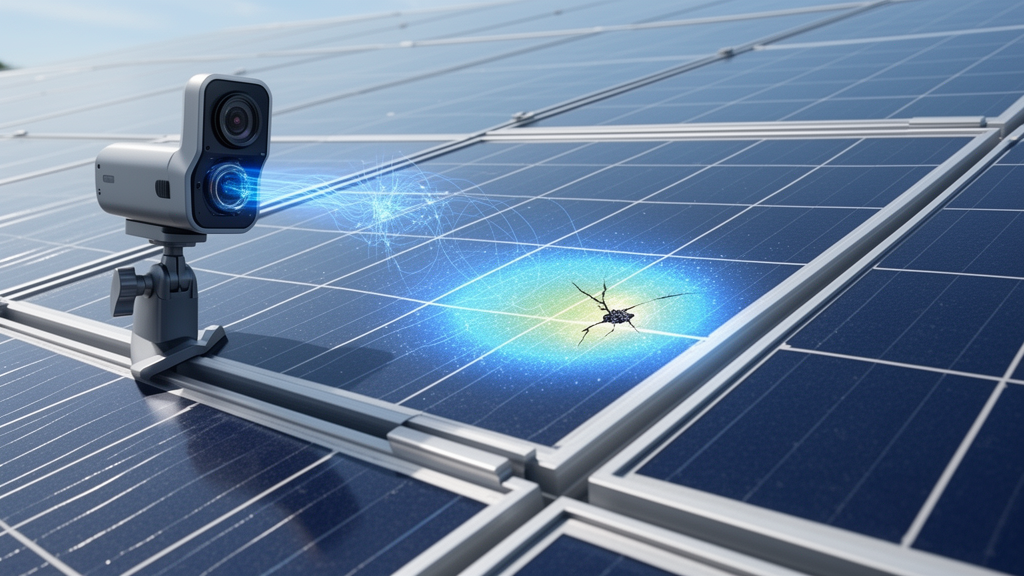
An attention-enhanced version of the YOLOv8s computer-vision model achieved a precision of 93.2%, an F1-score of 92.7% and a mean average precision at an intersection-over-union threshold of 0.5, or mAP@0.5, of 93.5% in a dataset-based evaluation for detecting defects in photovoltaic modules. The framework, named AMA-YOLOv8s, produced incremental improvements over the YOLOv8s baseline while maintaining comparable real-time inference speed.
Defect detection is an important part of maintaining the reliability and energy efficiency of photovoltaic systems. The study notes that existing deep-learning inspection methods can miss defects, localize small defects imprecisely and lose robustness when defect scales or background conditions vary. To address these challenges, the researchers developed AMA-YOLOv8s specifically for photovoltaic defect detection rather than as a general-purpose modification of the object detector.
The architecture adds three components to YOLOv8s: an Adaptive Bottleneck Attention Mechanism, a Multi-scale Adaptive Fusion Module and an Adaptive Pooling Fusion Module. The first was designed to strengthen representations of defect-related features and suppress irrelevant background information. The two fusion modules were designed to strengthen feature integration across scales, with the aim of improving detection for small and irregular defects. Together, these elements form the attention-and-fusion design that distinguishes AMA-YOLOv8s from the baseline model.
For training and evaluation, the researchers constructed a photovoltaic defect dataset by combining publicly available images, field-collected samples and data augmentation. On the resulting current evaluation dataset, AMA-YOLOv8s improved detection measurements relative to YOLOv8s, although the researchers characterized the gains as incremental rather than transformative. Its overall performance was also competitive with the other evaluated detectors.
That comparison comes with qualifications. Recent lightweight YOLO variants retained advantages in some individual metrics and in computational complexity, meaning AMA-YOLOv8s was not uniformly superior across every measure. The reported evidence comes from evaluation of the constructed dataset; it does not establish performance in a live photovoltaic facility or demonstrate downstream effects on power generation, equipment failures or costs. The supported conclusion is therefore focused: in its reported experimental evaluation, the coordinated attention and multi-scale feature-fusion design improved measured photovoltaic defect detection over the YOLOv8s baseline while retaining comparable real-time inference performance.
Subject of Research: Experimental evaluation of an attention-enhanced YOLOv8s model for detecting defects in photovoltaic modules.
Article Title: Adaptive multi-scale YOLOv8s framework for defect detection in photovoltaic facilities
Article References: Zuo, X., Dai, Y., Zhuang, Y., Chen, J., Almutairi, A. D., & Zhou, Y. (2026). Adaptive multi-scale YOLOv8s framework for defect detection in photovoltaic facilities. Scientific Reports. https://doi.org/10.1038/s41598-026-76816-y
Image Credits: AI Generated
DOI: 10.1038/s41598-026-76816-y
Keywords: photovoltaic defects, YOLOv8s, computer vision, defect detection, attention mechanisms, multi-scale fusion, solar modules, object detection, Adaptive, multi-scale, framework, defect
Cite Scienmag News
Blake Davidson. (October 26, 2026). Attention-enhanced YOLOv8s advances photovoltaic defect detection. Scienmag. https://scienmag.com/attention-enhanced-yolov8s-advances-photovoltaic-defect-detection/
Blake Davidson. "Attention-enhanced YOLOv8s advances photovoltaic defect detection." Scienmag, 26 October 2026, https://scienmag.com/attention-enhanced-yolov8s-advances-photovoltaic-defect-detection/. Accessed 26 October 2026.
Blake Davidson. "Attention-enhanced YOLOv8s advances photovoltaic defect detection." Scienmag. October 26, 2026. https://scienmag.com/attention-enhanced-yolov8s-advances-photovoltaic-defect-detection/


