


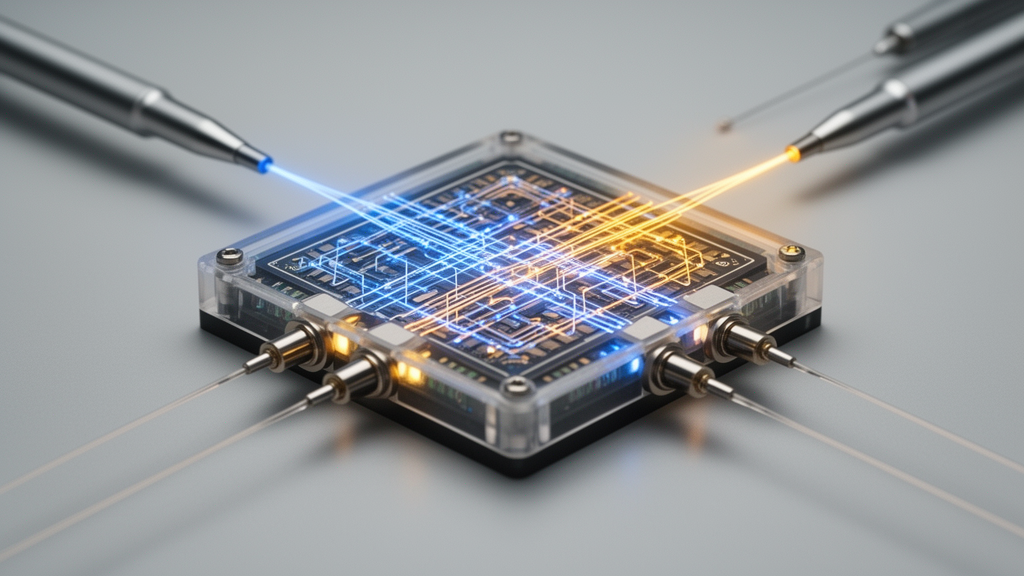
A research team has demonstrated a fully functional photonic chip that trains an optical neural network without conventional backpropagation, maintaining classification performance despite optical misalignment and phase noise that reportedly caused severe failure in backpropagation-based systems. The peer-reviewed work, published in Light: Science & Applications, introduces a Bio-inspired Backpropagation-Free Optical Neural Network, or B-ONN, designed to make training less dependent on the physical symmetry and reciprocal signal paths required by standard optical neural-network architectures.
The central problem is that backpropagation-based optical neural networks need a precise reciprocal path for propagating errors through the optical system. Fabrication errors, environmental disturbances, misaligned components, and phase fluctuations can disrupt that path and cause training to fail. Backpropagation can also require repeated conversion between optical and electrical signals, reducing the potential speed and energy advantages of performing computation with light. B-ONN instead uses a layer-wise, decoupled and synchronous training mechanism in which each layer contains a forward optical layer for feature transformation and an error layer that reconstructs the target optical field needed for local learning.
After a forward pass, the error layer in each layer receives the local error signal from the next layer and uses a target-propagation mechanism to construct the target field for the current layer. Optical interference then calculates the difference between the layer’s actual output and that target field. This local error independently guides updates to both sets of trainable parameters. The researchers describe the arrangement as providing learning equivalent to global backpropagation while making localized training more feasible on physical photonic hardware. The approach also allows training and inference to remain in the optical domain rather than requiring repeated optical-to-electrical conversion.
The chip’s physical implementation has three specialized units: an Optical Complex-Amplitude Encoding Unit that generates complex error fields, an Optical Local Error Unit that performs optical subtraction, and an Optical Parallel Gradient Unit that carries out massively parallel gradient computation. Together, these components support successive cognitive tasks with a single photonic device in real time. Inference is performed through diffractive propagation, while the use of smooth, hardware-compatible phase profiles is intended to preserve performance in the presence of physical imperfections. Because training is parallelized spatially and inference is carried out optically, the team says the architecture offers a route to high throughput and scalability.
The reported device maintained high classification accuracy under significant optical misalignment and phase noise, two conditions that the researchers say would cause conventional backpropagation-based optical neural networks to fail severely. The release does not provide numerical classification accuracies, dataset names, network sizes, measured power consumption, inference latency, or direct comparisons with competing training methods, so the scale of the advantage cannot be quantified from the available information. It also reports a prototype demonstration rather than a commercial system, and the claims about real-world optical computing, ultrafast vision processing, optical interconnects, and smart photonic sensing remain potential applications rather than demonstrated deployments.
The authors also present B-ONN as a possible foundation for more advanced all-optical systems as optical training methods mature, including optical Transformer networks for sequential modeling and optical generative models for multimodal information synthesis. Those directions are forward-looking and were not part of the reported chip demonstration. The demonstrated result is narrower: a peer-reviewed prototype shows that an optical neural network can be trained locally and synchronously on physical photonic hardware while retaining classification performance under selected imperfections, offering a practical route toward fault-tolerant, high-speed, low-power optical computation without relying on a globally reciprocal backpropagation path.
Subject of Research: A photonic prototype for backpropagation-free training of optical neural networks under hardware imperfections
Article Title: Bio-inspired backpropagation-free training for optical neural networks
Article References: Bio-inspired backpropagation-free training for optical neural networks. Original publication (Bibliographic details unavailable.)
Image Credits: AI Generated
DOI: Not provided
Keywords: optical neural networks, backpropagation-free learning, photonic computing, in-situ training, fault-tolerant hardware, optical chips, phase noise, optical interference, parallel gradient computation, Bio-inspired, backpropagation-free, training
Cite Scienmag News
Cassandra Pierce. (October 26, 2026). Prototype photonic chip trains optical neural network without backpropagation. Scienmag. https://scienmag.com/prototype-photonic-chip-trains-optical-neural-network-without-backpropagation/
Cassandra Pierce. "Prototype photonic chip trains optical neural network without backpropagation." Scienmag, 26 October 2026, https://scienmag.com/prototype-photonic-chip-trains-optical-neural-network-without-backpropagation/. Accessed 26 October 2026.
Cassandra Pierce. "Prototype photonic chip trains optical neural network without backpropagation." Scienmag. October 26, 2026. https://scienmag.com/prototype-photonic-chip-trains-optical-neural-network-without-backpropagation/


