


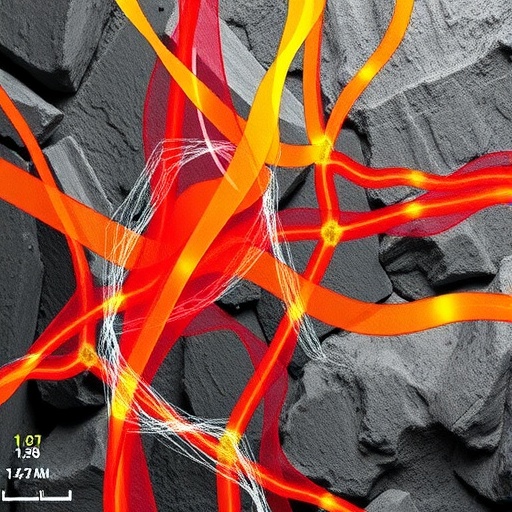
A new study is putting the deep ocean’s most elusive tectonic features under a sharper lens, revealing that the Gorda slab—the downgoing piece of oceanic crust beneath parts of the Pacific Northwest—varies in structure far more dramatically than previously appreciated. Using a fiber-optic sensor array, the researchers mapped how seismic signals propagate through the slab, exposing complex patterns that can’t be explained by smooth, uniform models alone.
Traditional imaging approaches often struggle with fine-scale heterogeneity at subduction zones, where temperature, hydration, and deformation evolve rapidly over small distances. By contrast, the fiber array method effectively turns long stretches of buried sensing infrastructure into a dense observational grid. That density enables the team to detect subtle changes in seismic velocity and structural boundaries that define how the slab bends, fractures, and interacts with surrounding mantle.
The authors report “sharp structural variability,” meaning that the slab’s interior is not only fractured or layered, but also segmented into zones with abrupt transitions. Such contrasts can reflect changes in rock composition, the presence of fluids released during subduction, and localized deformation processes that would otherwise remain blurred in coarser datasets. In effect, the slab behaves less like a single coherent plate and more like a mosaic of interacting domains.
Technically, the study relies on the high sensitivity of distributed acoustic sensing to capture ground motion along the fiber’s length. The resulting seismic record supports detailed imaging of the slab geometry and internal features, allowing the researchers to trace how seismic waves scatter and refract as they encounter different material properties.
The findings are significant because structural variability has direct consequences for subduction dynamics. Abrupt internal contrasts can influence where earthquakes nucleate, how stress is transferred, and how efficiently fluids migrate. That, in turn, affects forecasts of seismic hazard and the long-term evolution of the margin’s tectonic architecture.
Importantly, the work demonstrates that fiber-based seismic imaging can resolve features at scales relevant to the processes that shape active subduction zones. The ability to see sharp boundaries also suggests that previous interpretations based on smoother slab models may have underestimated the complexity of slab deformation.
For the scientific community, the study provides a high-resolution benchmark for next-generation subduction imaging workflows. It also motivates further deployments of fiber arrays in other subduction settings to test whether similar heterogeneity patterns appear elsewhere.
In a time when “viral science news” often rewards big visuals and clear implications, this research stands out for its tangible message: the deep structure of the Earth’s most dangerous plate boundaries may be far less uniform—and far more dynamic—than we have been able to observe.
Cite Scienmag News
Violet Maxwell. (July 26, 2026). Fiber array reveals sharp structural variability in the Gorda slab. Scienmag. https://scienmag.com/fiber-array-reveals-sharp-structural-variability-in-the-gorda-slab/
Violet Maxwell. "Fiber array reveals sharp structural variability in the Gorda slab." Scienmag, 26 July 2026, https://scienmag.com/fiber-array-reveals-sharp-structural-variability-in-the-gorda-slab/. Accessed 3 September 2026.
Violet Maxwell. "Fiber array reveals sharp structural variability in the Gorda slab." Scienmag. July 26, 2026. https://scienmag.com/fiber-array-reveals-sharp-structural-variability-in-the-gorda-slab/


