


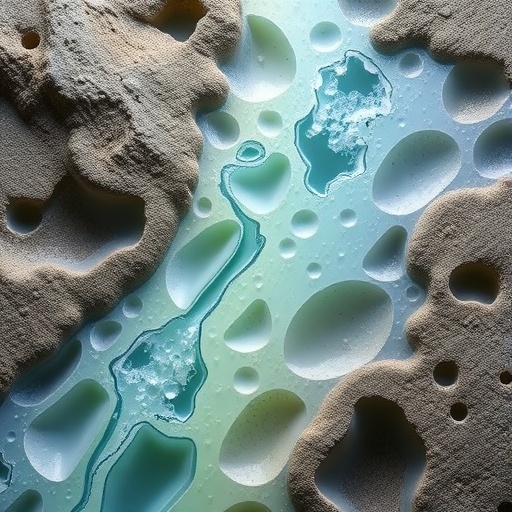
In a groundbreaking study published in Nature Communications in 2025, researchers have unveiled that feldspar, a ubiquitous mineral found in Earth’s crust, plays a pivotal role in modulating the frictional healing rates of faults under hydrothermal conditions. This discovery offers profound insights into the mechanics of earthquake faulting and potentially revolutionizes our understanding of seismic hazard assessments in geothermal and volcanic regions where hydrothermal activity is prevalent.
Frictional healing refers to the process by which faults regain strength after sliding, a phenomenon critical to earthquake recurrence intervals. Traditionally, the rate at which faults heal their frictional strength after slip events was assumed to depend largely on temperature, pressure, and the presence of fluids. However, this new research highlights feldspar’s unique capacity to interfere with this healing process, slowing it down significantly when it interacts with hydrothermal fluids at elevated temperatures and pressures.
The experimental framework involved simulating fault slip and healing cycles within controlled hydrothermal environments, allowing for precise replication of subsurface conditions responsible for seismic fault behavior. Advanced tribological testing apparatuses integrated with fluid circulation systems enabled the team to study frictional properties of fault gouge materials containing variable feldspar concentrations. Results showed a marked decrease in the frictional healing rate as feldspar content increased, indicating a mineral-specific interaction with fluid chemistry that disrupts typical fault surface re-strengthening.
This phenomenon can be attributed to feldspar’s pronounced chemical reactivity under hydrothermal conditions, coupled with surface alteration processes such as dissolution and precipitation. These processes generate a dynamically evolving fault surface that impedes the formation of asperity contacts—microscopic high points essential for frictional healing. In essence, feldspar’s presence modifies the microstructure and chemical environment of the fault interface, reducing the efficiency by which it can recover strength between slip events.
Such findings carry critical implications for fault mechanics models, especially in regions where hydrothermal fluids circulate abundantly, such as volcanic arcs and geothermal reservoirs. Current predictive models that overlook mineralogical effects may underestimate the time faults remain weak post-slip, and consequently, misestimate the timing and magnitude of future earthquakes. Incorporating feldspar’s role and associated hydrothermal alterations could enhance the accuracy of seismic risk assessments, aiding disaster preparedness strategies.
Interestingly, previous studies focused predominantly on quartz and clay-rich fault gouges, with feldspar often considered inert or less influential in fault frictional behavior. This new evidence overturns that notion, positioning feldspar as an active mineral that decisively influences fault healing rates. It opens avenues for re-evaluating mineral assemblages in fault zones globally, prompting geoscientists to reconsider the mineralogical controls on seismic cycle properties.
The study also advances the methodological aspects of fault mechanics research by integrating mineralogical analysis, fluid chemistry characterization, and high-pressure, high-temperature experimental cycles. Researchers employed electron microscopy and spectroscopy to investigate fault surface evolution, illustrating how feldspar alteration products contribute to a lubrication mechanism that stymies re-strengthening. Such multi-disciplinary approaches allow for a more holistic understanding of fault zone processes at microscopic and macroscopic scales.
Furthermore, identifying mineral-specific behavior under hydrothermal conditions can inform geothermal energy extraction and carbon sequestration projects, where induced seismicity remains a persistent concern. Adjusting operational protocols considering feldspar’s capacity to reduce healing rates might mitigate unexpected fault slip and earthquakes triggered during fluid injection or extraction activities.
In light of this discovery, future research directions may explore the interplay between feldspar and other hydrothermally altered minerals to fully characterize their collective impact on fault mechanics. Additionally, field studies in active fault zones with known feldspar-rich lithologies could validate laboratory findings, ensuring the robustness and applicability of this new conceptual framework.
In conclusion, the revelation that feldspar uniquely diminishes fault frictional healing rates under hydrothermal environments challenges existing paradigms about earthquake cycle dynamics. By dissecting the mineralogical complexities behind fault strength recovery, this study elevates the sophistication of seismic hazard models. As our planet’s most common rock-forming mineral gains new scientific prominence, it underscores the necessity of mineralogical precision in geophysical research aimed at deciphering Earth’s deep and dynamic processes.
Cite Scienmag News
Violet Maxwell. (December 24, 2025). Feldspar Slows Fault Friction Healing Hydrothermally. Scienmag. https://scienmag.com/feldspar-slows-fault-friction-healing-hydrothermally/
Violet Maxwell. "Feldspar Slows Fault Friction Healing Hydrothermally." Scienmag, 24 December 2025, https://scienmag.com/feldspar-slows-fault-friction-healing-hydrothermally/. Accessed 3 September 2026.
Violet Maxwell. "Feldspar Slows Fault Friction Healing Hydrothermally." Scienmag. December 24, 2025. https://scienmag.com/feldspar-slows-fault-friction-healing-hydrothermally/


