


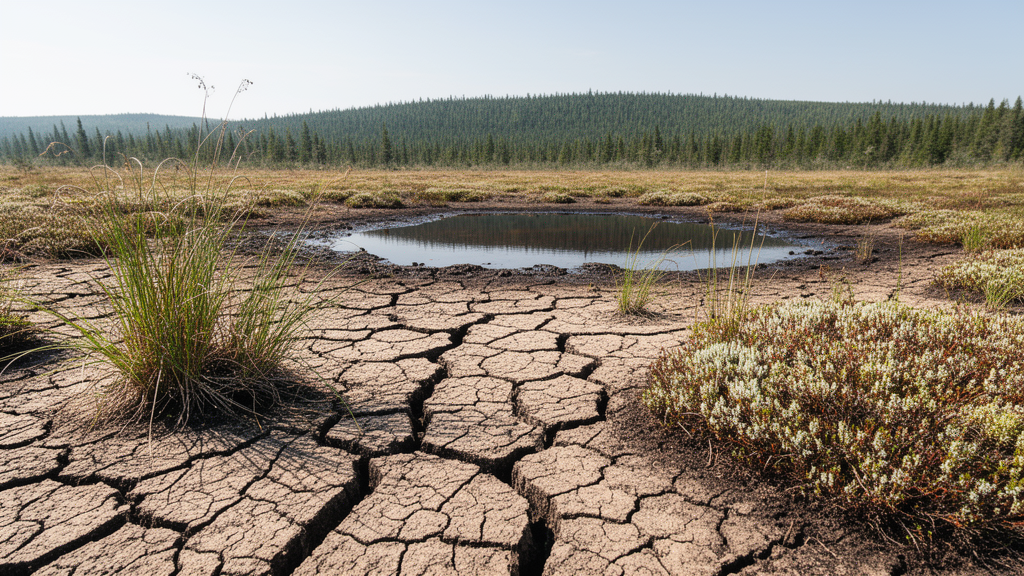
Peatlands punch far above their weight in the global carbon cycle. Although they cover less than 3 percent of Earth’s land surface, they hold roughly 1,055 gigatonnes of soil carbon, about 30 percent of the entire terrestrial stock, built up over millennia as partially decomposed plant material accumulates in waterlogged, oxygen-starved ground. That carbon bank, however, depends on one fragile condition: persistent saturation. When drought drains the water table and lets air into peat soils, the carefully balanced exchange of carbon dioxide and methane between land and atmosphere can shift dramatically. A new study from the Dajiuhu subalpine peatland in Central China has now captured exactly what happens when a historic drought strikes one of these high-elevation carbon vaults, and the numbers are striking.
The research, published in Environmental Earth Sciences, took advantage of a rare natural experiment. In the summer of 2022, the Yangtze River Basin experienced the most severe drought on record in 61 years, with precipitation 26.1 percent below the long-term mean and high temperatures rising by 147.5 percent. The Dajiuhu peatland, sitting at 1,760 meters above sea level in the Shennongjia Forestry District of Hubei Province, lies squarely within that drought zone. Because the site has been equipped with an eddy covariance tower since 2019, the research team led by Nayab Ismaeel and Jiwen Ge of China University of Geosciences could compare a full pre-drought year, 2021, against the drought year itself, combining continuous flux measurements with soil chemistry and microbial DNA sequencing.
The headline finding is a collapse in the peatland’s net carbon sink. Annual net carbon dioxide uptake fell by 81.58 percent, from 1,304 to 240.14 grams of gas per square meter. Methane emissions declined by 20.59 percent, from 12.97 to 10.30 grams of gas per square meter, but that change was not statistically significant. After converting both gases to carbon mass, the magnitude of net ecosystem-atmosphere carbon uptake dropped by 83.32 percent, from 345 to 57.5 grams of carbon per square meter. In other words, in a single extreme drought year, this peatland’s capacity to remove carbon from the atmosphere shrank to less than a fifth of its previous level. The 2022 sink magnitude was also 71 to 83 percent below the reported 2016-2020 baseline for the site, underscoring how anomalous the drought year was.
The technical details of the measurement matter here. The team used an open-path eddy covariance system mounted 3 meters above the ground, combining a three-axis sonic anemometer with infrared gas analyzers for carbon dioxide, water vapor, and methane. Raw data were processed in EddyPro with outlier removal, storage correction, and a friction-velocity threshold, and gaps were filled using marginal distribution sampling. The carbon-mass balance was computed as the sum of the carbon dioxide flux converted by a factor of 12/44 and the methane flux converted by 12/16, with negative values denoting net uptake. One important caveat: because the net carbon dioxide exchange was not partitioned into gross primary productivity and ecosystem respiration, the researchers cannot say whether the collapse came from reduced photosynthetic uptake, increased respiratory loss, or both. The covariation with soil moisture is consistent with known sensitivities, but the component mechanisms remain unresolved.
Seasonal patterns sharpened the picture. Monthly carbon dioxide absorption peaked in July and was lowest in April, while methane release peaked in November. The between-year divergence was strongest during the peak growing season from June to August, when 2022 carbon dioxide uptake fell below 2021 levels and coincided with lower surface soil moisture. Over the 144-day extreme drought period, daily mean carbon dioxide uptake was 1.76 grams of gas per square meter and mean net carbon sink magnitude was just 0.45 grams of carbon per square meter per day. The much larger change in net carbon dioxide exchange, rather than methane, accounted for most of the between-year difference in the combined carbon balance.
The soil chemistry told a parallel story. Across 24 soil samples collected at depths of 0-10, 10-30, and 30-50 centimeters during matched seasonal campaigns, total phosphorus fell by 45.08 percent, from 2.03 to 1.11 grams per kilogram, and total sulfur fell by 62.37 percent, from 3.05 to 1.15 grams per kilogram, both highly significant after Holm correction. Total organic carbon and total nitrogen, by contrast, did not differ significantly between years. Meteorological comparisons over the common May-September window showed higher mean air temperature in 2022, lower soil temperature at 10 centimeters, and lower soil water content at 10 centimeters, all statistically significant. These depth-specific contrasts suggest greater hydrological variability near the surface, though the authors are careful to note that the paired tests identify year-level differences rather than proving drought causation.
Beneath the flux tower, the microbial world was also being reshuffled. Using 16S rRNA amplicon sequencing of the V3-V4 hypervariable region on an Illumina MiSeq platform, the team characterized bacterial communities across all 24 samples. Rarefaction curves confirmed adequate sequencing depth, and alpha diversity indices including Shannon, Simpson, Chao1, and ACE were all lower during the 2022 drought period, a pattern consistent with extreme drought acting as an environmental filter. The dominant phyla were Acidobacteriota, Proteobacteria, Chloroflexi, Nitrospirota, and Planctomycetota. From 2021 to 2022, Acidobacteriota declined from 29.7 to 27.42 percent and Proteobacteria from 17.6 to 15.71 percent, while Chloroflexi rose from 8.54 to 11.34 percent. These directions align with published ecological traits: Acidobacteriota thrive in acidic, waterlogged soils and tend to decline under drying, while metabolically versatile Chloroflexi often rise when aeration improves.
Perhaps the most subtle finding is how the restructuring happened. Of 62 identified phyla, 32 decreased and 30 increased in relative abundance, with six showing strong interannual effect sizes above 0.8. No individual phylum changed significantly on its own, yet overall community structure differed markedly between years, with PERMANOVA yielding P equals 0.006 and clear year-based separation in principal coordinates analysis. Rather than a dramatic replacement of any single lineage, the shift arose from coordinated, modest changes distributed across many taxa. The year effect was stronger than the seasonal effect, and the year-by-depth interaction was not significant, indicating the separation was broadly consistent across the sampled 10-50 centimeter profile.
Functional predictions added another layer. FAPROTAX, which infers metabolic potential from taxonomic assignments, identified 14 putative carbon-cycling groups. Predicted potential for methanotrophy, methylotrophy, cellulolysis, hydrocarbon degradation, and photoautotrophy was higher in 2022, while predicted chemoheterotrophy, aerobic chemoheterotrophy, methanol oxidation, ligninolysis, and phototrophy were lower. The authors emphasize that these profiles describe taxonomically inferred metabolic potential only, not realized process rates, gene expression, or enzyme activity. Higher predicted methanotrophic potential is consistent with a community containing more taxa annotated for methane oxidation, but it does not demonstrate higher methane-oxidation rates in the field.
The statistical dissection of drivers delivered a verdict that challenges a common assumption. Variance partitioning showed that the measured environmental variables, including soil water content at 10 centimeters, vapor pressure deficit, air temperature, and soil temperature, explained 87.96 percent of the modeled methane-flux variation, while the microbial-community fraction explained just 0.13 percent and was not significant. Pairwise Mantel tests found no significant association between any single environmental variable and community dissimilarity, though the full environmental matrix showed a weak overall association. Strong collinearity among variables, with vapor pressure deficit and soil temperature correlated at nearly 0.998, further limited attribution. The evidence therefore supports concurrent, parallel responses to the same extreme drought rather than a demonstrated causal pathway in which microbial restructuring mediated the carbon-flux change. The authors call for multi-year flux partitioning and direct functional measurements to test whether repeated extreme droughts produce cumulative or recoverable changes, a question that grows more urgent as warming continues to accelerate drought severity worldwide.
Subject of Research: Effects of extreme drought on carbon fluxes and soil microbial communities in a subalpine peatland
Article Title: Extreme drought stress diminished soil carbon sequestration and restructured microbial communities at the Dajiuhu subalpine peatland, Central China
Article References: Ismaeel, N., Ge, J., Liu, Z., Ali, A., Yang, S., & Liu, Y. (2026). Extreme drought stress diminished soil carbon sequestration and restructured microbial communities at the Dajiuhu subalpine peatland, Central China. Environmental Earth Sciences, 85(16), Article 431. https://doi.org/10.1007/s12665-026-13158-y
Image Credits: AI Generated
DOI: 10.1007/s12665-026-13158-y
Keywords: peatland, extreme drought, carbon sequestration, soil microbiome, eddy covariance, methane emissions, Dajiuhu, Shennongjia, microbial community, climate change, carbon cycle, 16S rRNA sequencing
Cite Scienmag News
Morgan Morrow. (October 16, 2026). Extreme Drought Cut a Subalpine Peatland’s Carbon Sink by 83 Percent and Rewired Its Soil Microbes. Scienmag. https://scienmag.com/extreme-drought-cut-a-subalpine-peatlands-carbon-sink-by-83-percent-and-rewired-its-soil-microbes/
Morgan Morrow. "Extreme Drought Cut a Subalpine Peatland’s Carbon Sink by 83 Percent and Rewired Its Soil Microbes." Scienmag, 16 October 2026, https://scienmag.com/extreme-drought-cut-a-subalpine-peatlands-carbon-sink-by-83-percent-and-rewired-its-soil-microbes/. Accessed 16 October 2026.
Morgan Morrow. "Extreme Drought Cut a Subalpine Peatland’s Carbon Sink by 83 Percent and Rewired Its Soil Microbes." Scienmag. October 16, 2026. https://scienmag.com/extreme-drought-cut-a-subalpine-peatlands-carbon-sink-by-83-percent-and-rewired-its-soil-microbes/


