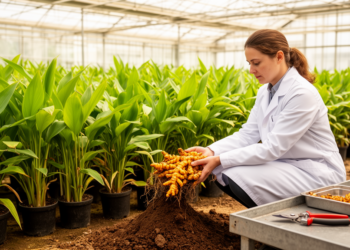
Every year, the perfume industry distills thousands of tons of vetiver roots for their prized earthy fragrance, then discards the spent roots as waste. A new study published in Frontiers in Environmental Chemistry shows that this fragrant leftover can be transformed into a remarkably effective water purifier, capturing toxic heavy metals such as lead, copper, cadmium, and zinc from contaminated water with efficiencies that rival or exceed many conventional adsorbents.
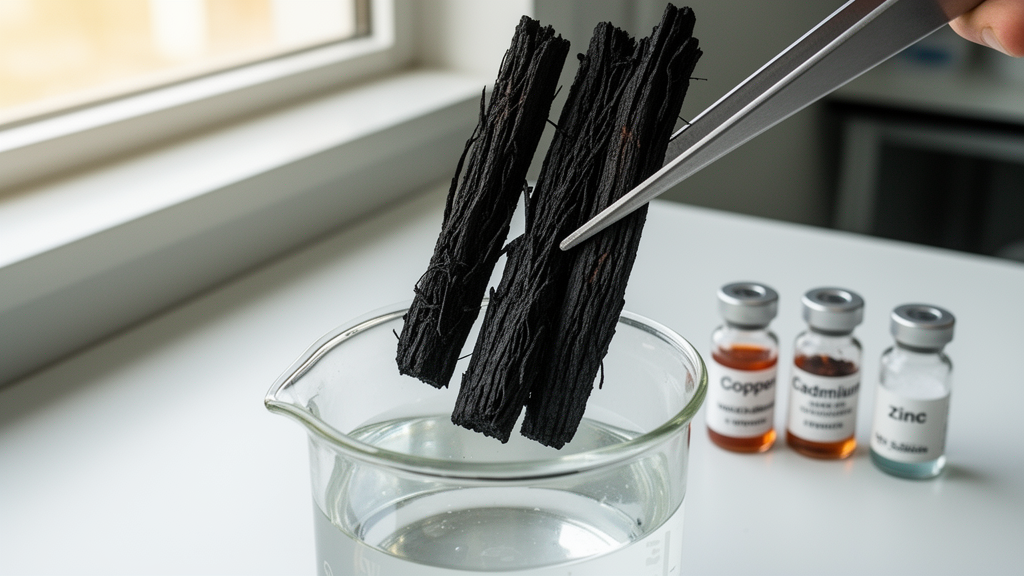
The research, led by Sameer Neve and colleagues at Stevens Institute of Technology with collaborators at Rowan University and Michigan Technological University, converted spent vetiver roots (Chrysopogon zizanioides) into biochar through pyrolysis at 500 degrees Celsius for 60 minutes under a continuous nitrogen purge. The resulting material exhibited a high surface area of 308.2 square meters per gram and a solid yield of 53.8 percent, properties that the team identified as optimal in a prior optimization study for this feedstock.
Heavy metals enter surface waters from industrial effluents, stormwater runoff, and everyday human activities. Lead and cadmium leach from car batteries, zinc wears off tires, and copper accumulates from brake pad degradation. Under the U.S. Comprehensive Environmental Response, Compensation, and Liability Act, lead and cadmium rank among the top ten most toxic substances, while zinc and copper rank 75th and 125th respectively. Lead impairs neurological function and, with long-term accumulation, contributes to anemia and kidney damage. Cadmium, classified as a probable human carcinogen, accumulates in the kidneys and causes oxidative stress, reproductive toxicity, and bone fragility. Even zinc and copper, though essential micronutrients, become harmful at elevated concentrations.
To test the material’s metal-binding prowess, the researchers conducted batch adsorption experiments in triplicate at pH 5.5, in 0.1 M sodium nitrate background electrolyte, at room temperature, using a biochar dose of 10 grams per liter with initial metal concentrations of 100 milligrams per liter. After 24 hours, removal efficiencies reached 100 percent for lead, 99.9 percent for copper, 92.6 percent for zinc, and 77.0 percent for cadmium. The adsorption was strikingly fast: nearly complete removal of lead and copper occurred within the first six minutes, and roughly 60 percent of zinc and cadmium was stripped from solution within 30 minutes.
Because natural and industrial waters rarely contain a single contaminant, the team also ran competitive multi-metal experiments with all four metals present simultaneously. Lead, copper, and zinc removal was not significantly affected by the presence of the other metals. Cadmium, however, was removed faster and more completely in the mixed system than in single-metal tests. The researchers attribute this counterintuitive result to synergistic co-precipitation: the strongly bound lead and copper raise the local surface pH on the biochar and form metal-hydroxide nuclei that create additional binding sites for the weaker-affinity cadmium, rather than the simple site competition one might expect.
Kinetic modeling showed that a pseudo-second-order model best described the data for all metals, with R-squared values above 0.942, indicating that the rate-limiting step involves chemical interactions rather than simple mass transport. The intraparticle diffusion model fit poorly, suggesting a two-step mechanism in which metals first diffuse through the biochar’s porous structure and then bind to surface sites. Adsorption isotherm analysis revealed a maximum single-metal adsorption capacity for lead of 189.58 milligrams per gram, far exceeding most pristine, unmodified biochars such as sesame straw (102 mg/g), oak bark char (13.1 mg/g), and long-root water hyacinth biochar (39.1 mg/g). Only banana stem and leaf biochar, at 302.2 milligrams per gram, surpassed it among the unengineered materials compared.
To probe the underlying mechanism, the team performed adsorption edge experiments across a pH range of 3 to 11 and built surface complexation models using the diffuse-layer formulation. The models, which assumed a single generic surface site undergoing monodentate complexation with each divalent metal, reproduced the observed pH-dependent removal patterns. The results pointed to chemisorption, the formation of strong chemical bonds between metal ions and oxygen-rich functional groups on the biochar surface, as the dominant removal mechanism, though the authors caution that surface precipitation and cation exchange with ash-derived base cations cannot be ruled out, given the biochar’s strongly alkaline nature (pH 10.98).
Critical to any real-world deployment is whether captured metals stay put. In extraction tests, mild washing with deionized water and dilute sodium nitrate solution released less than 3.5 percent of the adsorbed metal. Lead was detected in neither fraction, copper and zinc desorbed at less than 1 percent, and cadmium showed slightly higher but still low release rates of about 3.1 to 3.4 percent. Standard U.S. Environmental Protection Agency leaching tests, the Toxicity Characteristic Leaching Procedure and the Synthetic Precipitation Leaching Procedure, confirmed that all leachate metals from the spent biochar fell well below regulatory thresholds, meaning the loaded material can be safely disposed of in municipal landfills as nonhazardous waste.
The circular-economy appeal of this approach is considerable. The vetiver roots would otherwise be landfilled after essential-oil extraction; instead, they become a value-added adsorbent produced with no chemical activation or surface modification. The spent, metal-laden biochar from this study was even diverted into an ultra-high-performance concrete study as an aggregate, hinting at a second life for the exhausted material. The authors note that future work could explore regeneration and metal recovery from the loaded char.
The researchers are careful to outline the limits of their findings. All experiments used synthetic solutions, and in natural waters, organic matter and hardness cations such as calcium and magnesium would compete for binding sites, meaning the reported capacities represent an upper bound. The high tested concentrations, up to 1,000 milligrams per liter, reflect industrial effluents rather than dilute environmental matrices. Batch results also need validation in continuous-flow column systems before practical deployment. Still, the study demonstrates that a fragrant waste stream from the perfume industry can be converted into a high-performance, environmentally safe scavenger for some of the most dangerous water pollutants, a small but vivid example of how industrial byproducts can be reimagined as solutions rather than burdens.
Subject of Research: Using biochar made from spent vetiver roots to adsorb heavy metals from water
Article Title: Vetiver biochar application for heavy metal sequestration in water treatment: bridging perfumery waste and environmental sustainability
Article References: Vetiver biochar application for heavy metal sequestration in water treatment: bridging perfumery waste and environmental sustainability. (n.d.). https://doi.org/10.3389/fenvc.2026.1912197
Image Credits: AI Generated
DOI: 10.3389/fenvc.2026.1912197
Keywords: vetiver biochar, heavy metal adsorption, water treatment, perfumery waste, lead removal, copper, cadmium, zinc, chemisorption, surface complexation modeling, circular economy, waste valorization
Cite Scienmag News
Violet Maxwell. (October 16, 2026). From Perfume Waste to Water Filter: Vetiver Root Biochar Strips Lead, Copper, Cadmium and Zinc From Water. Scienmag. https://scienmag.com/from-perfume-waste-to-water-filter-vetiver-root-biochar-strips-lead-copper-cadmium-and-zinc-from-water/
Violet Maxwell. "From Perfume Waste to Water Filter: Vetiver Root Biochar Strips Lead, Copper, Cadmium and Zinc From Water." Scienmag, 16 October 2026, https://scienmag.com/from-perfume-waste-to-water-filter-vetiver-root-biochar-strips-lead-copper-cadmium-and-zinc-from-water/. Accessed 16 October 2026.
Violet Maxwell. "From Perfume Waste to Water Filter: Vetiver Root Biochar Strips Lead, Copper, Cadmium and Zinc From Water." Scienmag. October 16, 2026. https://scienmag.com/from-perfume-waste-to-water-filter-vetiver-root-biochar-strips-lead-copper-cadmium-and-zinc-from-water/