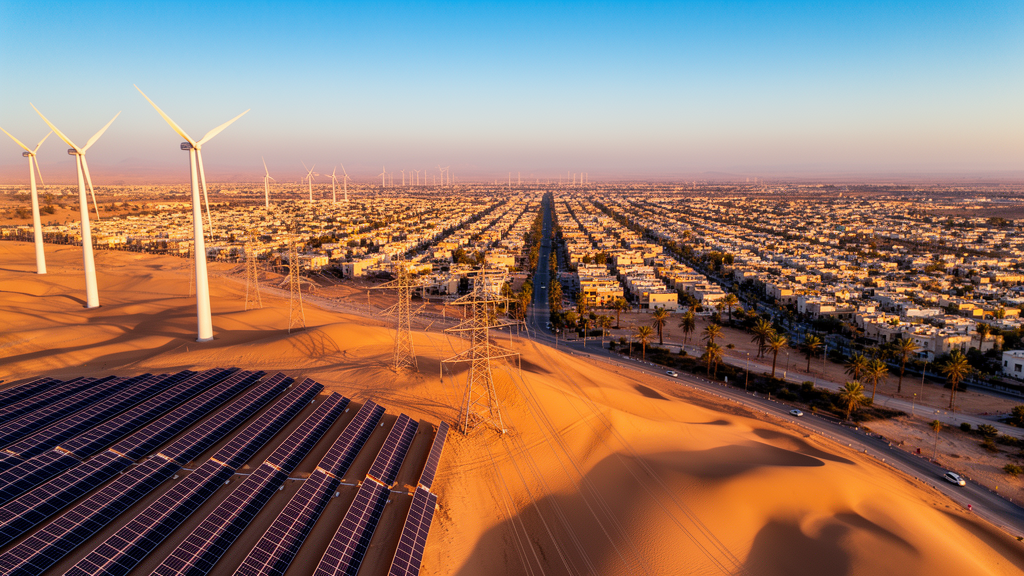
In the vast desert expanses of central Saudi Arabia, the question of where to build a solar farm or wind turbine is no longer just about sunshine and breezes. A new study published in Frontiers in Built Environment presents a spatial framework that treats renewable energy siting as an urban planning problem rather than a purely technical exercise, and its findings reveal a striking picture of where clean energy and future cities could collide or cooperate in one of the world’s most arid regions.
The research, led by Mohamed Salah Ezz of Onaizah Colleges and colleagues from institutions across Saudi Arabia, Egypt, and Bahrain, focused on the Al-Qassim region, a rapidly developing area of roughly 72,000 square kilometers situated between latitudes 24°30′ and 28°30′N and longitudes 41°30′ and 45°00′E. Bordered by Riyadh, Hail, and Madinah, the region is anchored by the Buraydah–Onaizah urban corridor, where population growth and infrastructure demands are intensifying under the national diversification agenda of Saudi Vision 2030. The team asked a deceptively simple question: do the places best suited for solar panels and wind turbines actually line up with the places where cities are expected to grow?
To answer it, the researchers built two separate suitability models within a geographic information system, or GIS. The solar photovoltaic model weighed 13 criteria, ranging from solar irradiation and ambient temperature to slope, aspect, and distances from protected areas, streams, bird migration paths, power lines, roads, railways, airports, water bodies, and cities. The onshore wind model used 12 criteria, substituting wind speed and air density for the solar-specific variables. Each spatial layer was standardized, reclassified onto a common four-point suitability scale from unsuitable to highly suitable, and then synthesized through weighted overlay analysis driven by the Analytic Hierarchy Process, a structured pairwise-comparison technique for assigning relative importance to competing criteria.
The weighting schemes tell their own story about what matters most in desert energy planning. For solar PV, solar irradiation dominated with a priority weight of 27.4 percent, followed by ambient temperature at 17.3 percent, aspect at 11.9 percent, and slope and proximity to power lines at 8.2 percent each. For wind, wind speed led at 23.3 percent, with air density close behind at 18.1 percent, then slope at 12.0 percent and power line proximity at 10.0 percent. The reliability of these expert-driven comparisons was verified through consistency ratios of 0.0094 for the solar model and 0.0083 for the wind model, both far below the accepted threshold of 0.10. A sensitivity analysis confirmed that adjusting selected criterion weights shifted the final suitability rankings by no more than 2.8 percent, suggesting the spatial patterns are robust rather than artifacts of subjective judgment.
The results are remarkable in their scale. Roughly 42 percent of the study area emerged as highly suitable for solar photovoltaic development, concentrated in the northern and western parts of Al-Qassim where solar irradiation is high, terrain is favorable, and land-use restrictions are few. Onshore wind proved more spatially selective, with moderate to high suitability covering about 35 percent of the region, clustered on the western plateau and northern areas where wind speeds exceed 6.5 meters per second across open, unobstructed terrain. Notably, the central urban and agricultural corridor around Buraydah and Onaizah scored lower for both technologies, a reminder that land competition and existing infrastructure can undermine technically viable sites.
The most consequential output, however, is the hybrid layer. By overlaying the two individual suitability maps, the team identified zones where favorable solar and wind conditions coincide, the spatial prerequisite for hybrid solar-wind installations that can smooth power output across day-night and seasonal cycles. The highest-priority category, labeled High Suitable for Solar and Wind, covers 10,920 square kilometers, or 15.2 percent of the region. Areas highly suitable for solar only span 12,960 square kilometers, while wind-only zones cover 6,480 square kilometers. Moderate combined suitability accounts for 27 percent of the land, and 15.8 percent is effectively off-limits due to environmental, topographical, or infrastructural constraints. The narrower footprint of the top hybrid class demonstrates that hybrid planning demands more selective siting than either technology alone.
Crucially, the researchers deliberately kept proposed urban expansion zones out of the weighting models. Instead, they applied these zones in a post-modeling spatial interaction analysis, first establishing renewable energy potential independently and only then testing its overlap with planned growth areas. This separation matters because it prevents future development plans from contaminating the underlying suitability assessment while still allowing planners to see where the two agendas intersect. The analysis found that approximately 18 to 20 percent of the proposed urban development area falls within high-suitability renewable energy zones, with the overlap concentrated in the Buraydah–Onaizah corridor and surrounding villages, precisely where development pressure, infrastructure access, and favorable energy conditions converge.
That overlap cuts both ways. On one hand, it opens opportunities for integrating renewable generation near future demand centers, potentially shortening the distance between electricity production and consumption and supporting coordinated infrastructure corridors. On the other, it signals looming land-use competition, as areas ideal for solar arrays may also be earmarked for housing, agriculture, services, and transport networks. The framework’s value lies in surfacing these conflicts early, before final development decisions lock in either outcome. High-suitability zones outside the expansion areas, meanwhile, remain candidates for utility-scale projects, though they would require dedicated planning for grid connection, road access, and land allocation.
The model’s credibility received a practical boost from validation against reality. All four existing solar photovoltaic projects in Al-Qassim fell within the modeled high-suitability class, a four-for-four spatial agreement that lends quantitative support to the approach, though the authors caution that a sample of four projects is limited and that no documented wind or hybrid projects were available for equivalent validation of those models. The study also acknowledges broader limitations: the solar and wind datasets cover January to October 2023 rather than long-term climatological averages, expert-based AHP weighting could be complemented by machine-learning methods such as fuzzy AHP or TOPSIS, and economic factors like land costs and grid connection expenses were outside the scope of the analysis.
For planners across the arid belt stretching from the Arabian Peninsula to the Sahara, the message is clear: open desert land is not the blank slate it appears to be. Its true planning value depends on infrastructure access, environmental restrictions, land-use competition, and the trajectory of urban growth. By fusing resource assessment with expansion planning in a single decision-support system, the Al-Qassim framework offers a template for regions where energy demand is climbing, cities are sprawling, and the luxury of planning solar farms and suburbs separately no longer exists. As Saudi Arabia and its neighbors push toward low-carbon economies, the maps produced here may prove as important for what they reveal about future conflicts as for what they promise about clean energy potential.
Subject of Research: A GIS–AHP spatial suitability framework for siting solar, wind, and hybrid renewable energy in relation to urban growth planning in arid Saudi Arabia
Article Title: A spatial GIS–AHP framework for integrating hybrid renewable energy suitability with urban growth planning in arid regions
Article References: A spatial GIS–AHP framework for integrating hybrid renewable energy suitability with urban growth planning in arid regions. (n.d.). https://doi.org/10.3389/fbuil.2026.1959364
Image Credits: AI Generated
DOI: 10.3389/fbuil.2026.1959364
Keywords: GIS, AHP, renewable energy, solar photovoltaic, onshore wind, hybrid energy systems, urban expansion, arid regions, Saudi Arabia, Al-Qassim, spatial suitability, urban planning
Cite Scienmag News
Faith Mcneil. (October 16, 2026). Mapping the Sun and Wind: New Framework Aligns Clean Energy With Desert City Growth. Scienmag. https://scienmag.com/mapping-the-sun-and-wind-new-framework-aligns-clean-energy-with-desert-city-growth/
Faith Mcneil. "Mapping the Sun and Wind: New Framework Aligns Clean Energy With Desert City Growth." Scienmag, 16 October 2026, https://scienmag.com/mapping-the-sun-and-wind-new-framework-aligns-clean-energy-with-desert-city-growth/. Accessed 16 October 2026.
Faith Mcneil. "Mapping the Sun and Wind: New Framework Aligns Clean Energy With Desert City Growth." Scienmag. October 16, 2026. https://scienmag.com/mapping-the-sun-and-wind-new-framework-aligns-clean-energy-with-desert-city-growth/