


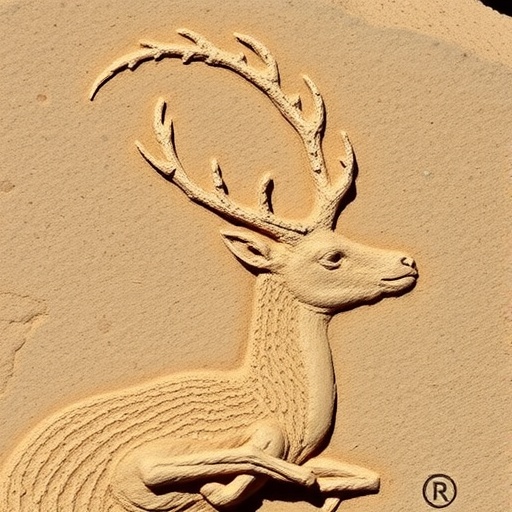
In the rolling hills of Tennessee lies a treasure trove for paleontologists: the Gray Fossil Site and Museum. Recently, researchers unearthed a discovery that bridges a profound evolutionary gap in North America’s prehistoric wildlife — the first fossil evidence of a deer species on the continent, pushing back the known origins of the Cervidae family in this region by millions of years. This finding heralds a monumental advancement in understanding how familiar mammals like the white-tailed deer evolved and adapted to the landscapes they inhabit today.
Unearthed within sediment layers dating back approximately five million years, these newly described fossils belong to a species named Eocoileus gentryorum, documented in the latest issue of Palaeontologia Electronica. The specimens include fragmentary remains such as portions of a juvenile skull, an isolated upper molar, and various limb bones. Collectively, these remnants provide an unprecedented glimpse into the morphology and early evolution of deer during the late Miocene to early Pliocene epoch in North America — a critical period characterized by dynamic environmental shifts and faunal turnovers.
This discovery holds remarkable significance not just for the Gray Fossil Site but for the broader paleontological community seeking to chart the biogeographical dispersal of cervids. Previously, Eocoileus gentryorum had been identified solely from fossil sites in Florida, making the Tennessee find a pivotal data point in tracing the rapid inland spread of these animals from coastal origins. The ability of these early deer to colonize a wide array of North American habitats within a relatively short evolutionary timeframe sheds light on their ecological plasticity and resilience.
One intriguing feature of the Eocoileus gentryorum fossils is their comparatively diminutive size relative to contemporary deer species. Analytical comparisons indicate these ancient cervids were generally smaller than most modern counterparts, linking them more closely in scale to today’s Key deer of Florida and the brocket deer species native to Central and South America. This size discrepancy likely reflects differing ecological pressures and resource availability during the Pliocene, influencing evolutionary trajectories in morphology and behavior.
The Gray Fossil Site research team, led by Dr. Joshua Samuels, embraced rigorous systematic review methods to ensure comprehensive evaluation and contextualization of the finds. Through meticulous comparative anatomy and stratigraphic correlation, they constructed a robust narrative about deer evolution in the Appalachian region. The work was a collaborative effort, incorporating contributions from recent graduate Olivia Williams and Assistant Collections Manager Shay Maden, whose expertise was instrumental in assembling the fossil puzzle from its fragmentary pieces.
Beyond individual species discovery, the fossils underscore the enduring ecological role deer have played in Appalachian forests over millions of years. Deer have not only persisted through dramatic climatic fluctuations but have also occupied similar ecological niches throughout this vast temporal expanse. As Dr. Samuels explains, these animals’ survival contrasts sharply with other large herbivores that disappeared due to environmental upheavals, emphasizing the evolutionary success and adaptability of cervids within temperate forest ecosystems.
Significantly, fossil evidence from geographically distant locations such as Washington State and Florida demonstrates a rapid coast-to-coast dispersal pattern for these early deer following their initial arrival in North America. This widespread distribution highlights their remarkable ability to adapt to diverse ecological settings, from the dense Pacific Northwest forests to the mountainous Appalachian region, further cementing deer as a quintessential component of North American fauna.
The discovery of Eocoileus gentryorum fits into a broader tapestry of extraordinary paleontological finds at the Gray Fossil Site, where species ranging from giant salamanders with powerful jaws to enormous flying squirrels have been cataloged in recent years. These revelations collectively position East Tennessee State University as a key institution championing the exploration and preservation of Appalachia’s natural history, providing critical insights into evolutionary processes and biodiversity changes over deep time.
Institutional voices underscore the wider significance of this work. Dr. Blaine Schubert, executive director of the Gray Fossil Site and Museum, articulates the transformative potential of such discoveries in reshaping our understanding of ancient ecosystems. Meanwhile, Dr. Joe Bidwell, dean of the College of Arts and Sciences at ETSU, emphasizes the role of this research in connecting Appalachia’s past and present, reinforcing the university’s commitment to advancing evolutionary science and regional heritage.
The detailed anatomical analysis of these fossils not only informs lineage relationships within Cervidae but also has implications for reconstructing paleoenvironmental conditions. Examining limb bone morphology and dental structures helps infer aspects of locomotion, diet, and habitat preferences, allowing scientists to carefully reconstruct how these ancestral deer might have lived, moved, and interacted with their ecosystem roughly five million years ago.
Moreover, this discovery invites renewed investigation into how climate change and geological events have sculpted mammalian evolution in North America. The persistence of deer through epochs marked by ice ages and shifting biomes contrasts with extinction patterns observed in other megafauna, offering a living testament to evolutionary resilience. Future research inspired by these findings could broaden understanding of species adaptation mechanisms under environmental stress.
In summary, the fossil deer finds at the Gray Fossil Site redefine the timeline and biogeographic pathways of cervid evolution on the continent. They illuminate the complex history of a lineage that today plays a prominent role in natural and human communities alike. As fossil discoveries continue to accumulate at this remarkable site, they collectively enhance the scientific narrative describing life’s intricate dance across geological epochs in Appalachia and beyond.
Cite Scienmag News
Gavin Prescott. (August 12, 2025). ETSU Scientists Uncover 5-Million-Year-Old Deer Fossils. Scienmag. https://scienmag.com/etsu-scientists-uncover-5-million-year-old-deer-fossils/
Gavin Prescott. "ETSU Scientists Uncover 5-Million-Year-Old Deer Fossils." Scienmag, 12 August 2025, https://scienmag.com/etsu-scientists-uncover-5-million-year-old-deer-fossils/. Accessed 4 September 2026.
Gavin Prescott. "ETSU Scientists Uncover 5-Million-Year-Old Deer Fossils." Scienmag. August 12, 2025. https://scienmag.com/etsu-scientists-uncover-5-million-year-old-deer-fossils/


