


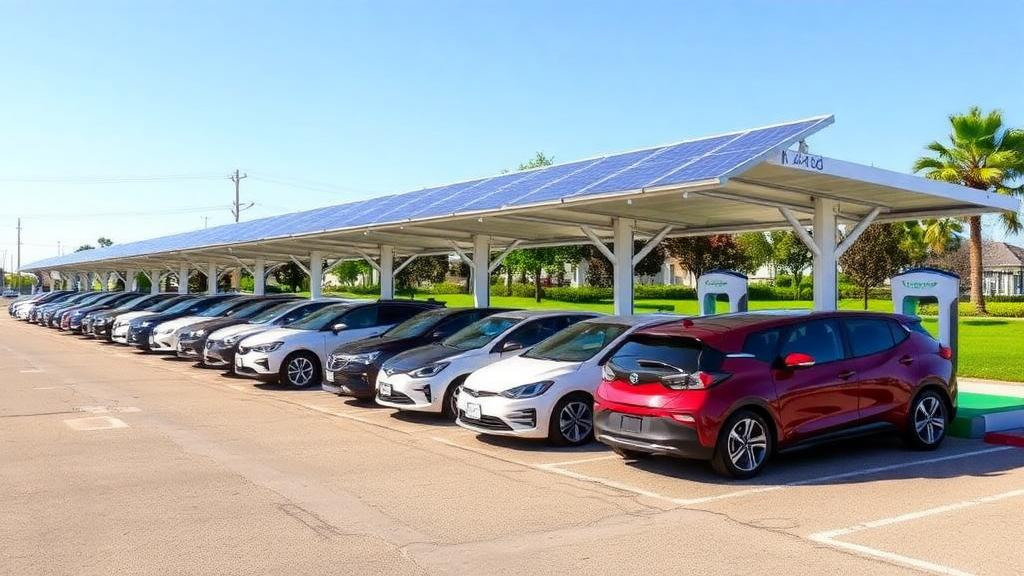
Imagine pulling into a solar-powered charging station, plugging in your car, and instead of simply draining electricity from the grid, your vehicle quietly sells power back to the station during the evening peak, then tops up again overnight when electricity is cheap. That vision is no longer a thought experiment. A new study published in Energy Reports presents a sophisticated two-level scheduling framework that coordinates solar generation, stationary battery storage, and fleets of electric vehicles so that they behave less like passive consumers and more like a single, flexible power plant. The results suggest that when vehicle-to-grid technology is orchestrated intelligently, charging stations can cut their evening grid purchases by a quarter while squeezing more usable energy out of every sunlit hour.
The research, led by Kunhao Niu and colleagues, tackles a problem that has grown increasingly urgent as the world electrifies transport. Photovoltaic-energy storage-charging stations, which combine rooftop or canopy solar arrays with on-site batteries and charging hardware, are a cornerstone of the renewable transition. Yet they face a stubborn trio of challenges: solar output is inherently volatile, stationary storage is expensive to cycle, and the charging behavior of thousands of individual drivers is chaotic and hard to predict. Left unmanaged, these factors produce stations that lean heavily on the grid, waste solar energy they cannot absorb, and operate at razor-thin economic margins.
The core innovation of the study lies in how it tames that chaos. Rather than treating every electric vehicle as an individual decision-maker, the researchers introduce an intermediary called an EV aggregator, which bundles vehicles into clusters based on shared characteristics such as arrival times, departure times, and state-of-charge needs. To sort vehicles into these groups, the team deployed a hybrid algorithm combining particle swarm optimization with fuzzy C-means clustering. The fuzzy clustering approach allows each vehicle to belong partially to multiple groups, capturing the fuzzy reality of driver behavior, while the swarm-based global search prevents the algorithm from getting trapped in poor solutions, a known weakness of conventional fuzzy clustering alone.
Once vehicles are clustered, the framework faces a second mathematical hurdle: how to describe the collective flexibility of dozens or hundreds of cars without tracking each one separately. Here the authors borrow an elegant tool from control theory called the zonotope, a convex geometric object that can represent the full range of feasible charging and discharging schedules for a cluster. Because zonotopes have a remarkable property, their combination under the Minkowski sum is simply the sum of their centers and generators, aggregating many clusters becomes a matter of basic linear algebra rather than a computationally explosive high-dimensional optimization. The zonotope representations are then converted into half-space inequality constraints that standard solvers can handle directly, preserving the essential operational features of the fleet while dramatically reducing the computational burden of dispatch.
With the fleet flexibility captured, the study then structures the economics as a bi-level, leader-follower game. At the upper level, the station acts as the leader, setting dynamic charging prices and vehicle-to-grid discharge subsidies to minimize its total operating cost, which includes grid electricity purchases, solar maintenance, penalties for curtailed solar power, storage usage charges, and compensation for battery degradation in customers’ vehicles. At the lower level, the EV aggregator acts as the follower, responding to those prices by scheduling its clusters to minimize the combined charging and discharging expenses of users. The two levels never merge into a single objective; instead, they are coupled purely through the prices the station announces and the load responses the aggregator returns.
Solving such a nested problem requires care, because a commercial solver cannot simply minimize both objectives at once. The researchers employed an iterative best-response procedure implemented with the CPLEX solver in MATLAB: the station announces prices, the aggregator computes its optimal response, the station re-optimizes given that response, and the loop repeats. The procedure converges when prices and costs stop changing between iterations, with a price tolerance of one thousandth of a yuan per kilowatt-hour and a cost tolerance of 0.1 percent. In the case study, the process reached a fixed point, a Stackelberg equilibrium where neither side can improve its own outcome by unilaterally changing its strategy, by the fourth iteration, demonstrating that the framework is not just theoretically sound but computationally practical.
To test the model, the team simulated a real station with 1,500 kilowatts of installed solar capacity, a 500 kilowatt-hour battery system, and two aggregators each managing five vehicle clusters with distinct grid-connection windows and power limits. The battery, with charging and discharging efficiencies of 0.92, was required to return to its initial state of charge by the end of each 24-hour cycle, a constraint that ensures fair economic comparisons between scenarios and prevents the optimizer from artificially draining the battery to flatter the day’s numbers. Time-of-use tariffs ranged from 0.295 yuan per kilowatt-hour off-peak to 0.804 yuan at peak, with the station selling surplus power back at 75 percent of the purchase price.
The comparison between two operating scenarios delivers the study’s headline finding. In the first scenario, vehicles charge in an orderly, unidirectional fashion alongside storage and solar. In the second, vehicles gain bidirectional capability, discharging back to the station when prices and demand warrant. The difference is striking: during the evening peak from 18:00 to 24:00, the station’s maximum grid purchase drops from 200 kilowatts to 150 kilowatts, a 25 percent reduction, while the solar consumption rate climbs from 90.1 percent to 90.8 percent. Those percentages may look modest, but at scale they translate into substantially less solar energy wasted and materially lower operating costs, all while drivers still get their cars charged on schedule.
The cluster-level dispatch profiles reveal how this coordination actually works. Under uncontrolled charging, sharp demand spikes appear at mid-morning, mid-afternoon, and early evening, worsening the peak-valley disparity that plagues power systems. Under the optimized regime, clusters flip their behavior fluidly: they charge deeply during overnight and midday windows when solar generation is abundant or tariffs are low, then discharge during the evening peak to provide peak regulation. Individual clusters adapt to their own constraints, with one cluster absorbing solar energy in the late afternoon while another charges overnight to meet its demand, showing that the aggregation method preserves the granular realities of driver schedules rather than flattening them into an unrealistic average.
Beyond the immediate numbers, the study points toward a broader reimagining of electric vehicles as distributed energy assets. Millions of car batteries sitting in parking lots represent an enormous, largely untapped reservoir of storage capacity, one that could buffer renewable generation without the capital cost of building new grid-scale batteries. The bi-level pricing mechanism at the heart of this framework offers a market-compatible way to unlock that reservoir, compensating drivers for battery wear while giving stations a dispatchable resource. The authors note that future work could extend the model to formal electricity market participation, allowing aggregators to bid their clustered flexibility into energy and reserve markets. If the gap between solar abundance at noon and demand peaks at dusk is the central problem of the renewable era, this research suggests the solution may already be parked in the garage, waiting for the right price signal to plug in.
Subject of Research: Bi-level optimal scheduling of photovoltaic-energy storage-charging stations with electric vehicle aggregators and vehicle-to-grid dispatch
Article Title: Optimal bi-level scheduling of a PV – energy storage – charging station with consideration for EV aggregators
Article References: Niu, K., Yang, C., Yang, Y., Cheng, Z., & Tang, M. (2026). Optimal bi-level scheduling of a PV – energy storage – charging station with consideration for EV aggregators. Energy Reports, 16, Article 109775. https://doi.org/10.1016/j.egyr.2026.109775
Image Credits: AI Generated
DOI: 10.1016/j.egyr.2026.109775
Keywords: electric vehicles, vehicle-to-grid, photovoltaics, energy storage, bi-level optimization, EV aggregator, fuzzy C-means clustering, particle swarm optimization, zonotope, renewable energy, smart charging, Stackelberg equilibrium
Cite Scienmag News
Faith Mcneil. (September 30, 2026). Electric Vehicle Fleets Turn Into Power Plants in New Solar Charging Station Model. Scienmag. https://scienmag.com/electric-vehicle-fleets-turn-into-power-plants-in-new-solar-charging-station-model/
Faith Mcneil. "Electric Vehicle Fleets Turn Into Power Plants in New Solar Charging Station Model." Scienmag, 30 September 2026, https://scienmag.com/electric-vehicle-fleets-turn-into-power-plants-in-new-solar-charging-station-model/. Accessed 18 October 2026.
Faith Mcneil. "Electric Vehicle Fleets Turn Into Power Plants in New Solar Charging Station Model." Scienmag. September 30, 2026. https://scienmag.com/electric-vehicle-fleets-turn-into-power-plants-in-new-solar-charging-station-model/


