


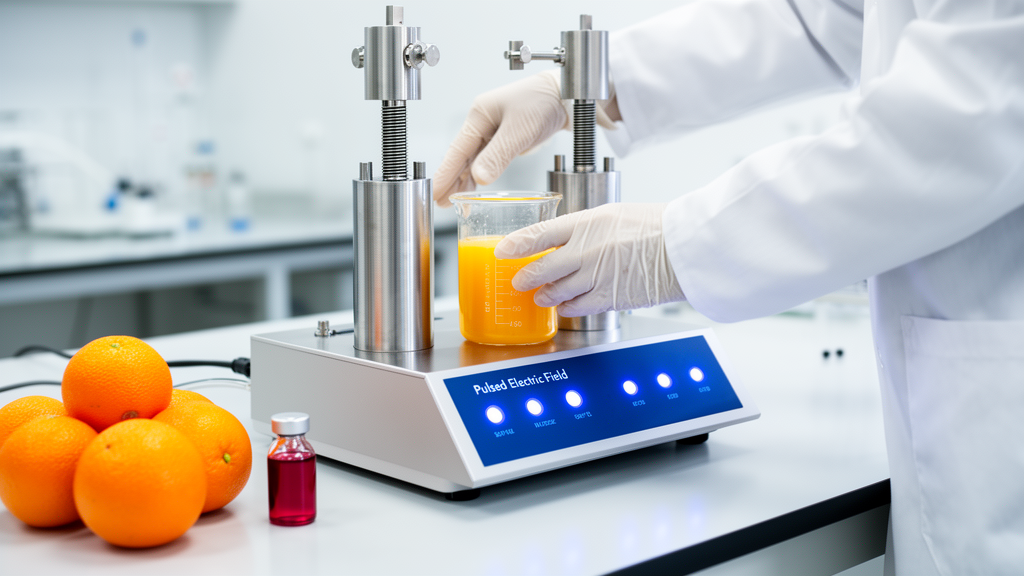
Pulsed electric fields, a non-thermal preservation technology that kills microbes with bursts of high-voltage electricity instead of heat, may be closer to reliable industrial adoption thanks to a new modeling study published in Food Science & Nutrition. Researchers treated pomegranate, tomato, and carrot juices with pulsed electric fields (PEF) and tracked how four different microbial strains responded, then built a mathematical model that captures the entire inactivation process in a single fitting step. Their central finding is striking in its simplicity: the total specific energy delivered by the treatment, rather than the identity of the microorganism or the type of juice, is the primary driver of microbial death, although strain-specific quirks and food matrix effects leave measurable fingerprints on the survival curves.
The appeal of PEF lies in what it avoids. Conventional pasteurization of fruit and vegetable juices relies on intense heat, which effectively eliminates pathogens and spoilage organisms but simultaneously degrades vitamins, polyphenols, flavonoids, and carotenoids, the very compounds that make juices attractive to health-conscious consumers. PEF works differently. When microbial cells are exposed to an electric field strength above roughly 10 kV/cm for micro- to millisecond durations, a phenomenon called electroporation occurs: the cell membrane, normally an insulating barrier, develops pores as the transmembrane potential exceeds a critical threshold. If the pores reseal, the cell survives, injured but alive. If they fail to reseal, the cell dies. The new study tackles both outcomes head-on, quantifying not just how many cells die but how many are left in that dangerous middle state of sub-lethal injury.
The experimental setup was deliberately designed to mimic industrial conditions. The team used a continuous-flow PEF system, the EPULSUS-BM1A-12 pulse generator, pumping juice at 6 liters per hour through a treatment chamber with parallel titanium electrodes separated by a 0.4-centimeter gap. Square-wave pulses of 4 microseconds were applied at a field strength of 20 kV/cm, with repetition frequencies ranging from 4 to 78 Hz. This produced treatment times between 0 and 112.3 microseconds and total specific energies from 0 up to 139.2 kJ/kg, with outlet temperatures held between 20 and 55.8 degrees Celsius, well below what conventional pasteurization would require. Three juices with sharply different chemistries served as the test matrices: acidic pomegranate juice at pH 3.1, moderately acidic tomato juice at pH 4.4, and nearly neutral carrot juice at pH 6.1, each with distinct conductivity and soluble solids content.
Four microbial strains were put through this gauntlet: two strains of Escherichia coli, the laboratory strain K12 and the foodborne isolate FAM 21843 originally recovered from raw milk cheese, and two strains of the spoilage yeast Saccharomyces cerevisiae, AD1890 isolated from fruit and 130.0014 from the food industry. The results met and in some cases exceeded the benchmark that matters most for commercialization. The U.S. Food and Drug Administration requires a 5-log reduction, meaning a 100,000-fold decrease in the most resistant foodborne pathogen, before PEF can be approved for commercial juice pasteurization. In pomegranate and carrot juices, both E. coli strains achieved greater than 5-log reductions at the highest treatment intensities. Tomato juice proved more challenging, yielding reductions above 3.85 logs, a shortfall the authors attribute to its intermediate acidity and composition.
One of the most technically important aspects of the study is its modeling approach. Traditional kinetic modeling proceeds in two stages: a primary model is fitted to each survival curve individually, and then the resulting parameters are linked to process variables through a secondary model. This stepwise procedure propagates errors and wastes information. Instead, the researchers fitted primary and secondary models simultaneously to the full dataset, combining a log-linear primary model with a second-order polynomial secondary model that describes how the maximum specific inactivation rate, k-max, depends on total specific energy. The polynomial captures three things at once: a baseline inactivation constant C1, a linear sensitivity coefficient C2, and a quadratic coefficient C3 that accounts for nonlinear acceleration or deceleration of killing as energy accumulates. Model performance was excellent, with regression coefficients ranging from 0.965 to 0.998 across all twelve strain-juice combinations.
The survival curves themselves were anything but the simple straight lines that early PEF studies reported. Those earlier log-linear observations, the authors note, likely reflected limited inactivation levels below 4 logs achieved at low field strengths or short durations. At the intensities tested here, the curves were distinctly multiphasic. In pomegranate juice, the E. coli strains showed concave downward kinetics, a slow initial decline that accelerated sharply after 47.12 microseconds of treatment. In carrot juice, the pattern inverted: a pronounced shoulder of resistance persisted up to about 44.64 microseconds, followed by a rapid collapse in viability beyond 61.92 microseconds. Tomato juice produced near log-linear behavior with slight tailing. The yeast strains followed similar matrix-dependent patterns, with S. cerevisiae showing particularly sharp sensitivity in tomato juice beyond 38.48 microseconds of treatment.
Statistical analysis of the fitted parameters revealed a satisfying hierarchy of effects. The linear coefficient C2 did not differ significantly across any strain or juice, suggesting a conserved, universal linear response of microbial populations to increasing energy input. In contrast, the baseline inactivation constant C1 and the quadratic coefficient C3 both varied significantly, clustering strains into distinct statistical groups. E. coli K12 in pomegranate juice showed one of the highest baseline inactivation rates, while S. cerevisiae 130.0014 in carrot juice showed the lowest. Notably, E. coli FAM 21843 displayed no matrix dependence in its baseline rate, meaning its initial susceptibility to PEF was unaffected by which juice it was suspended in. The predicted inactivation rates climbed steeply for all strains at total specific energies above 80 kJ/kg, with S. cerevisiae 130.0014 showing the highest rate at high energies in pomegranate and tomato juices, marking it as the most energy-sensitive organism tested.
Strain heterogeneity, the bane of predictive food microbiology, showed up in the details. The two E. coli strains behaved nearly identically across all juices, with one exception: in the most acidic matrix, pomegranate juice, FAM 21843 proved more resistant than K12, showing a 1.71-log reduction versus K12’s 2.36-log reduction at 72.32 kJ/kg. Among the yeasts, AD1890 was consistently more resistant than 130.0014 at high energy levels, a pattern that echoes earlier findings from the same laboratories under high-pressure processing and ultrasound, hinting at cross-resistance to multiple preservation stresses in the AD1890 strain. Sub-lethal injury, assessed by plating on selective versus nonselective media, was minimal in tomato and carrot juices but pronounced in pomegranate juice at medium energy levels, where the gap between counts on the two media widened, indicating a pool of membrane-damaged cells that could potentially recover during storage.
Crucially for consumers, the treatment left the juices’ nutritional chemistry untouched. Measurements of total phenolic content, total flavonoid content, total orthodiphenol content, and CUPRAC antioxidant capacity showed no statistically significant differences between untreated and PEF-treated samples for any of the three juices. This aligns with prior reports that PEF preserves anthocyanins in pomegranate juice, carotenoids in tomato juice, and antioxidant capacity in carrot juice, sometimes through twelve weeks of refrigerated storage. The combination of FDA-relevant microbial reductions and intact bioactive compounds is precisely the value proposition that has kept PEF on the industry’s wish list for decades.
The study’s authors are candid about what remains to be done. Future models should explicitly account for strain and matrix variability, other quality attributes such as color, volatile compounds, and flavor deserve investigation, and the capital cost of PEF equipment remains a significant barrier to widespread adoption. But the message of this work is clear and commercially resonant: under realistic continuous-flow conditions, total specific energy is the master variable controlling microbial inactivation by PEF, a well-fitted polynomial model can predict it across organisms and juices, and the technology can deliver pathogen-killing performance without sacrificing the antioxidants that sell fresh juice in the first place.
Subject of Research: Kinetic modeling of microbial inactivation in fruit and vegetable juices treated with pulsed electric fields
Article Title: Kinetic Modeling of Microbial Inactivation in Juices Treated With Pulsed Electric Fields (PEF): A Comparative Study on Microbial Heterogeneity and Food Matrix Effects
Article References: Lytras, F., Psakis, G., Xuereb, M., Lia, F., Gatt, R., Raso, J., & Valdramidis, V. (2026). Kinetic Modeling of Microbial Inactivation in Juices Treated With Pulsed Electric Fields ( PEF ): A Comparative Study on Microbial Heterogeneity and Food Matrix Effects. Food Science & Nutrition, 14(10), Article e72408. https://doi.org/10.1002/fsn3.72408
Image Credits: AI Generated
DOI: 10.1002/fsn3.72408
Keywords: pulsed electric fields, food safety, microbial inactivation, kinetic modeling, juice processing, electroporation, non-thermal processing, Escherichia coli, Saccharomyces cerevisiae, sublethal injury, antioxidants, food matrix effects
Cite Scienmag News
Alan Morgan. (October 9, 2026). Electric Pulses Zap Juice Pathogens While Preserving Antioxidants, Study Finds. Scienmag. https://scienmag.com/electric-pulses-zap-juice-pathogens-while-preserving-antioxidants-study-finds/
Alan Morgan. "Electric Pulses Zap Juice Pathogens While Preserving Antioxidants, Study Finds." Scienmag, 9 October 2026, https://scienmag.com/electric-pulses-zap-juice-pathogens-while-preserving-antioxidants-study-finds/. Accessed 9 October 2026.
Alan Morgan. "Electric Pulses Zap Juice Pathogens While Preserving Antioxidants, Study Finds." Scienmag. October 9, 2026. https://scienmag.com/electric-pulses-zap-juice-pathogens-while-preserving-antioxidants-study-finds/


