


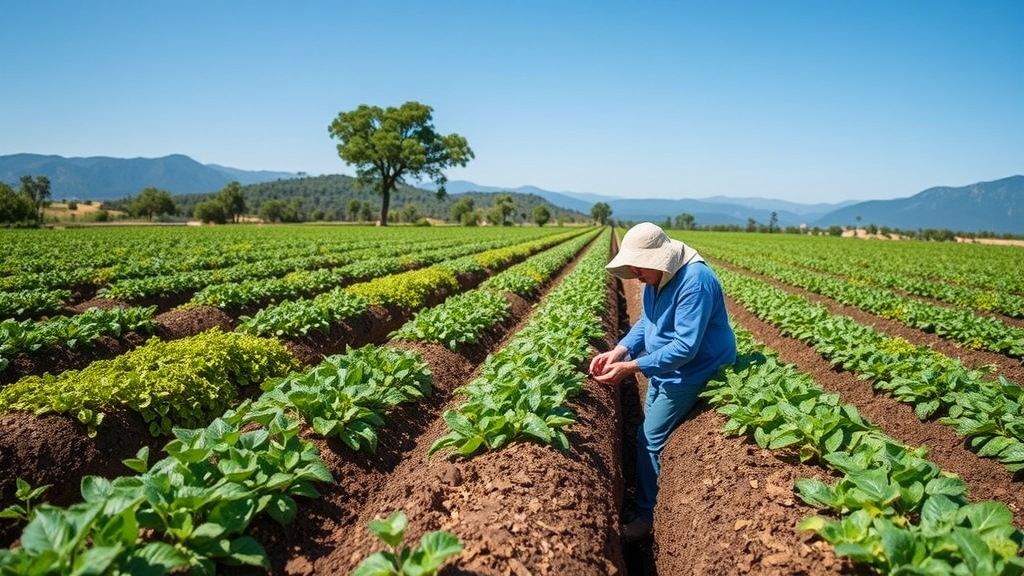
On the steep hillsides of northern Albania, farmers who harvest sage, oregano, lavender and dozens of other medicinal and aromatic plants are watching the weather change in ways their parents never did. These crops, which anchor one of the country’s most important export-oriented agricultural sectors and sustain rural livelihoods across its mountainous regions, are increasingly exposed to shifting rainfall patterns, temperature extremes and ecological disruption. A new study published in Regional Environmental Change offers one of the most detailed portraits yet of how these specialized farmers perceive climate change and what actually determines whether they respond to it. The findings carry implications far beyond Albania’s borders, because medicinal and aromatic plant systems worldwide sit at a precarious intersection of ecological sensitivity, market demand and smallholder vulnerability.
The research team, led by Drini Imami of the Agricultural University of Tirana together with colleagues from the University of Prishtina, Rhine-Waal University of Applied Sciences, Weihenstephan-Triesdorf University of Applied Sciences and Corvinus University of Budapest, surveyed 183 farmers engaged in medicinal and aromatic plant production across Albania. Rather than simply cataloguing who had adopted which practice, the researchers applied a statistical technique known as partial least squares structural equation modeling, or PLS-SEM. This approach allows scientists to test an entire chain of hypothesized relationships simultaneously, linking farm characteristics to climate awareness, and climate awareness in turn to concrete adaptation behavior. It is a method well suited to questions where the underlying drivers, such as awareness or perceived risk, cannot be observed directly but must be inferred from multiple survey responses.
The results reveal a clear and consequential pathway. Farmers with higher levels of education and those who had acquired medicinal and aromatic plant-specific skills or training were significantly more likely to be aware of climate change and its potential consequences for their operations. That awareness, in turn, emerged as a strong predictor of adaptation. Farmers who recognized the climate threat were markedly more likely to adopt measures such as diversifying their crop portfolio, switching to certified seeds and seedlings, and adjusting the mix of plant varieties they cultivate. In statistical terms, awareness functions as a mediating variable: it translates external pressures and personal capabilities into deliberate on-farm change.
Farm size also mattered. Larger operations were more likely to implement adaptation measures, a pattern consistent with a well-documented dynamic in agricultural economics. Bigger farms typically command more land, labor and capital, and they can absorb the short-term costs and risks of trying something new, whether that means investing in certified planting material or experimenting with alternative species. Smaller holders, by contrast, often face resource constraints that make even low-cost adjustments difficult. The study’s authors point to this asymmetry as a warning sign: if adaptation is concentrated among better-endowed farms, climate change may widen existing inequalities within rural communities rather than simply imposing uniform losses.
Perceived climate impacts played a distinct role in the causal chain. Farmers who reported experiencing or observing climate-related damage, such as reduced yields or stressed plants, showed elevated awareness, and that awareness indirectly encouraged adaptation. This finding aligns with a growing body of international evidence suggesting that direct experience with climate extremes is one of the most powerful motivators of farmer response. Yet the Albanian data also imply that waiting for experience to accumulate is a risky strategy. By the time impacts are severe enough to register universally, the options for graceful adaptation may have narrowed considerably, particularly for perennial and wild-harvested species that cannot be replanted or relocated easily.
Perhaps the most striking number in the study is thirteen. Only 13 percent of the surveyed farmers reported receiving regular training related to their crop systems. For a sector that is export-oriented and ecologically delicate, this represents a substantial information and capacity gap. Medicinal and aromatic plants are not commodity grains; their market value depends heavily on quality standards, phytochemical profiles and compliance with certification requirements in destination markets. Climate change can alter essential oil content and terpene composition in these plants, meaning that both the agronomic and the commercial dimensions of production are climate-sensitive. Without structured extension services and training programs, most farmers are left to interpret a shifting environment on their own, relying on tradition and trial rather than science.
The export dimension sharpens the stakes considerably. Albania’s medicinal and aromatic plant sector supplies international buyers who demand consistent quality and traceable production. A climate-driven failure in this chain would not remain a local problem; it would ripple through value chains and into the livelihoods of the mountain households that depend on harvesting and cultivation. The study’s authors argue that strengthening extension services, improving access to farmer training, and easing resource constraints are essential for supporting adaptive land-use decisions. They call for targeted policy interventions that integrate advisory services, climate risk management, and improved access to land and finance, a package designed to enhance the resilience of both production systems and the rural livelihoods they sustain.
The Albanian case also resonates with a broader scientific conversation about medicinal plants and climate change. Researchers have documented climate-induced shifts in essential oil production and chemical composition in alpine aromatic species, and global assessments have warned that many medicinal plant species face range contractions and population declines as temperatures rise. In mountain regions from the Himalaya to the Balkans, these plants often occupy narrow ecological niches, which makes them particularly sensitive indicators of environmental change. When the farmers who cultivate or gather them lack access to climate information and adaptive resources, the risk is not only economic but also a quiet erosion of botanical knowledge and biodiversity that has accumulated over generations.
What makes the study methodologically notable is its use of structural equation modeling on a relatively modest sample, an approach that requires careful validation of the measurement instruments but yields insights that simple cross-tabulations cannot provide. By confirming that awareness mediates the relationship between education, training and adaptation, the analysis gives policymakers a concrete lever to pull. Investments in education and targeted training do not merely inform farmers; they measurably increase the likelihood of adaptive behavior. Conversely, policies that focus solely on subsidizing inputs or technologies, without building the underlying awareness and capacity, may fail to achieve durable change.
For Albania’s medicinal and aromatic plant farmers, the message of the research is ultimately one of conditional optimism. The adaptive pathway exists: awareness leads to action, and awareness can be built. But the current infrastructure supporting that pathway is thin, reaching roughly one farmer in eight with regular training. Closing that gap, the authors conclude, is not a luxury but a necessity for a sector whose products, markets and communities all sit on the front line of a changing climate. As climate pressures intensify across the Mediterranean and Balkan regions, the Albanian experience offers a replicable lesson: resilience in specialized agricultural systems begins not in the field, but in the flow of knowledge to the people who work it.
Subject of Research: Climate change awareness and adaptation strategies among medicinal and aromatic plant farmers in Albania
Article Title: Cultivating resilience: climate awareness and adaptation among Albanian medicinal and aromatic plant farmers
Article References: Imami, D., Miftari, I., Zhllima, E., van Bruggen-Wichern, J., & Darr, D. (2026). Cultivating resilience: climate awareness and adaptation among Albanian medicinal and aromatic plant farmers. Regional Environmental Change, 26(4), Article 202. https://doi.org/10.1007/s10113-026-02683-y
Image Credits: AI Generated
DOI: 10.1007/s10113-026-02683-y
Keywords: climate change adaptation, medicinal and aromatic plants, Albania, smallholder farmers, PLS-SEM, climate awareness, agricultural extension, rural livelihoods, crop diversification, export agriculture, mountain farming, farm training
Cite Scienmag News
Sloane Callahan. (September 24, 2026). Education and Training Drive Climate Adaptation in Albania’s Medicinal Plant Farms. Scienmag. https://scienmag.com/education-and-training-drive-climate-adaptation-in-albanias-medicinal-plant-farms/
Sloane Callahan. "Education and Training Drive Climate Adaptation in Albania’s Medicinal Plant Farms." Scienmag, 24 September 2026, https://scienmag.com/education-and-training-drive-climate-adaptation-in-albanias-medicinal-plant-farms/. Accessed 5 October 2026.
Sloane Callahan. "Education and Training Drive Climate Adaptation in Albania’s Medicinal Plant Farms." Scienmag. September 24, 2026. https://scienmag.com/education-and-training-drive-climate-adaptation-in-albanias-medicinal-plant-farms/


