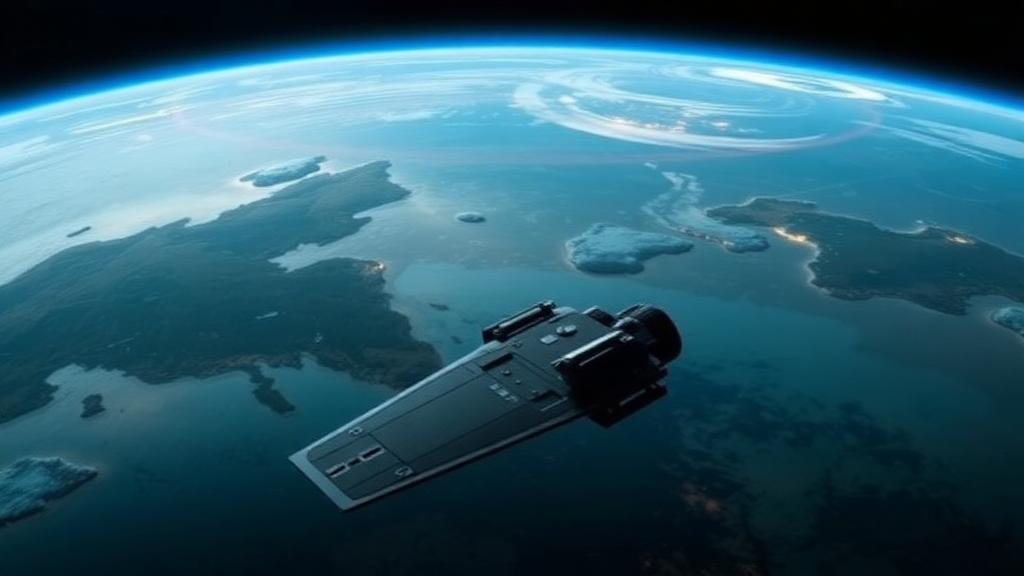
When the European Space Agency’s Jupiter Icy Moons Explorer, known as Juice, swung past Earth one last time in September 2024 before beginning its long cruise to the outer solar system, mission scientists saw an unplanned opportunity hiding in the farewell images. The Ganymede Laser Altimeter, or GALA, the instrument designed to chart the icy shells of Jupiter’s largest moons, had failed to fire its laser during the spacecraft’s earlier lunar flyby because of an unexpected reboot. That failure cost the team their primary chance to check whether the instrument’s telescope still pointed exactly where engineers had measured it before launch. Now, a team led by Gaku Nishiyama of the German Aerospace Center’s Institute of Space Research in Berlin has shown that a completely passive observation of Earth from 5.65 million kilometers away can do much of the same job, and in the process the researchers have uncovered evidence that GALA’s receiving telescope may have drifted significantly from its pre-launch alignment.
The findings, published in the Annales Geophysicae as part of a special issue devoted to Juice’s first-ever lunar and Earth flybys, are remarkable for what they accomplish without a single laser pulse. Laser altimeters measure distance by timing how long a laser pulse takes to travel to a planetary surface and back. To convert those timings into accurate footprint positions on a moon’s surface, scientists must know precisely where the instrument’s line of sight points relative to the spacecraft’s reference frame. Launch vibrations and the thermal environment of space can shift that alignment after launch, so in-flight calibration is standard practice for such instruments. The plan for GALA had been to use the lunar flyby of the Lunar Earth Gravity Assist maneuver in August 2024, during which JANUS, Juice’s scientific camera, might even have caught flashes of GALA’s laser reflected off the lunar nightside. The instrument reboot ended that hope.
The Earth-farewell campaign on 9 September 2024 offered a creative alternative. Juice stared at Earth between roughly 09:39 and 10:08 UTC, adjusting its pointing intermittently without rotating, while JANUS captured 168 images of the planet through all of its filters. GALA, too far away to receive any return pulses, was instead operated in a passive mode, functioning as a single-pixel telescope. In this configuration, the instrument’s noise level, recorded as the root-mean-square of electrical signals in each range window, serves as a sensitive proxy for the amount of sunlight reflected from Earth that reaches its avalanche photodiode detector. Because the noise contribution from incoming photons grows with the square root of the photon flux, every shift in the telescope’s field of view across the bright disk of Earth, its clouds, continents, and oceans, leaves a distinct signature in the noise record.
The technical challenge was to connect two very different kinds of measurements. GALA detects photons in a narrow band of roughly three nanometers around 1064 nanometers, while JANUS’s filter-12, the best match, spans a much broader range from 949 to 1081 nanometers. The team computed a conversion ratio between the radiance measured by JANUS and the radiance collected by GALA by incorporating the transmittance of the GALA bandpass filter, arriving at a value of 0.0326. Tests with realistic Earth spectra for continents, seawater, and clouds showed that this flat-spectrum assumption introduces systematic errors of at most about 9 percent, small compared with the enormous natural variation in Earth’s reflectance, where clouds can be an order of magnitude brighter than seawater. The team then translated the photon flux arriving at the detector into a predicted noise level using a theoretical model that accounts for the avalanche photodiode’s quantum efficiency, multiplication gain, bandwidth, and transimpedance, alongside the constant contributions of surface and bulk dark current.
One further obstacle was the coarse temporal resolution of the spacecraft attitude data, which were available only at one-minute intervals during the campaign. To bridge the gaps, the team tested three interpolation methods for the quaternions defining the spacecraft’s orientation: linear interpolation, Piecewise Cubic Hermite Interpolating Polynomial interpolation, which preserves monotonicity, and Akima interpolation, which estimates derivatives locally from neighboring samples. Other spline methods were rejected because they produced unrealistic overshooting between coarse attitude points. The team also propagated measurement errors by adding random perturbations with a standard deviation of 15 microradians to the attitude samples before interpolation.
The comparison between observation and simulation produced a striking result. If GALA still pointed where pre-launch measurements said it should, the noise level should have risen and fallen at specific times as the field of view slid across the Earth. Instead, the observed noise rose gradually over about 20 seconds but dropped rapidly within about 5 seconds, an asymmetry reflecting faster attitude motion at the end of the overlap, and none of the simulated timings under any interpolation method matched the observations. At the end of the overlap, every simulation predicted the noise should fall more than 13 seconds earlier than it actually did. Earth’s atmosphere could not explain the discrepancy: the bright atmospheric halo visible in images from satellites such as Himawari-8/9 alters the overlap timing by less than 0.3 seconds, far too small to matter. The absolute magnitude of the noise also disagreed, with simulations based on the pre-launch alignment predicting levels about 0.1 millivolts too high, and the fine structure of the noise disagreed too, with observed local maxima around 09:39 to 09:40 and 09:42 to 09:43 where the simulation predicted local minima.
To find where the instrument actually pointed, the team searched systematically across possible boresight directions, comparing simulated and observed start and end times of the noise increase, the absolute noise magnitude, and the correlation between the temporal patterns of noise variation. The most-likely solutions clustered more than 700 microradians away from the pre-launch boresight vector, with estimation errors below 100 microradians within each method. Notably, the alignment of JANUS itself cannot be blamed for the shift: the Earth’s position predicted in the JANUS image matches its observed position with an error of less than 2 pixels, corresponding to only about 30 microradians, and the predicted boresight offset for JANUS from thermal effects is an order of magnitude smaller than the GALA discrepancy. Nor can known pre-launch behavior easily account for the result. Thermal-vacuum cycling tests before launch showed boresight offsets below 100 microradians across operational temperatures from minus 7 to plus 41 degrees Celsius, and launch vibration effects were expected to be smaller than 700 microradians by roughly an order of magnitude.
Such large shifts are not unprecedented. The LIDAR instrument on Japan’s Hayabusa2 asteroid mission showed variations of approximately one milliradian in its line of sight when comparing different calibration methods, crossover analysis of the NEAR Laser Rangefinder revealed boresight shifts exceeding one milliradian, and the Lunar Orbiter Laser Altimeter on the Lunar Reconnaissance Orbiter exhibited comparable variations between dayside and nightside operations caused by thermal distortion. The authors caution, however, that their conclusion for GALA is not yet definitive. Discrepancies between the best simulations and the observations remain, and the limited attitude sampling during the staring observation means the influence of interpolation and attitude uncertainty cannot be fully excluded. Additional cruise-phase data will be needed to confirm the offset and identify its cause, which remains unidentified at present.
The study delivers more than a diagnosis. It establishes a radiometric calibration of the GALA receiver, an empirical relationship between the photon flux incident on the detector and the observed noise level, which is a prerequisite for GALA’s planned passive reflectance measurements of Jupiter and the Galilean moons. The authors estimate that during icy moon flybys the GALA noise level should rise by 21 to 66 percent above its background of 1.12 millivolts, large enough to serve both as a boresight check under the cold operating conditions near Ganymede and as a signal for surface reflectance measurements, though Jupiter’s harsh radiation environment may increase the detector’s dark noise and complicate interpretation. Future opportunities loom soon: Earth Gravity Assist maneuvers in September 2026 and January 2029, and lunar observations around those flybys, where the Moon’s predictable brightness and lack of atmosphere make the noise-based method especially clean, could push the expected noise increase above 110 percent. The framework, the authors note, extends beyond GALA, offering an independent alignment-calibration approach for other planetary laser altimeters, including the BepiColombo Laser Altimeter headed to Mercury, and complementing traditional crossover and topographic methods as Juice continues toward its 2031 arrival in the Jovian system.
Subject of Research: In-flight receiver calibration and boresight alignment of the Ganymede Laser Altimeter aboard the Juice spacecraft using passive Earth observations.
Article Title: In-flight receiver calibration of the Ganymede Laser Altimeter (GALA) by passive Earth observations
Article References: Nishiyama, G., Stark, A., Matz, K.-D., Hüttig, C., Wickhusen, K., Agostini, L., Althaus, C., Binger, J., Enya, K., George, J., Lingenauber, K., Kimura, J., Kobayashi, M., Macrì, G., Neumann, W., Penasa, L., Portyankina, G., Tubiana, C., Willner, K., … Hussmann, H. (2026). In-flight receiver calibration of the Ganymede Laser Altimeter (GALA) by passive Earth observations. Annales Geophysicae, 44(2), 1075-1092. https://doi.org/10.5194/angeo-44-1075-2026
Image Credits: AI Generated
DOI: 10.5194/angeo-44-1075-2026
Keywords: GALA, Juice, laser altimeter, Ganymede, in-flight calibration, boresight offset, JANUS, Earth flyby, avalanche photodiode, radiometric calibration, icy moons, Jupiter system
Cite Scienmag News
Grant Pearson. (October 14, 2026). Earth’s Fading Light Reveals a Hidden Misalignment on Europe’s Jupiter Probe. Scienmag. https://scienmag.com/earths-fading-light-reveals-a-hidden-misalignment-on-europes-jupiter-probe/
Grant Pearson. "Earth’s Fading Light Reveals a Hidden Misalignment on Europe’s Jupiter Probe." Scienmag, 14 October 2026, https://scienmag.com/earths-fading-light-reveals-a-hidden-misalignment-on-europes-jupiter-probe/. Accessed 14 October 2026.
Grant Pearson. "Earth’s Fading Light Reveals a Hidden Misalignment on Europe’s Jupiter Probe." Scienmag. October 14, 2026. https://scienmag.com/earths-fading-light-reveals-a-hidden-misalignment-on-europes-jupiter-probe/