


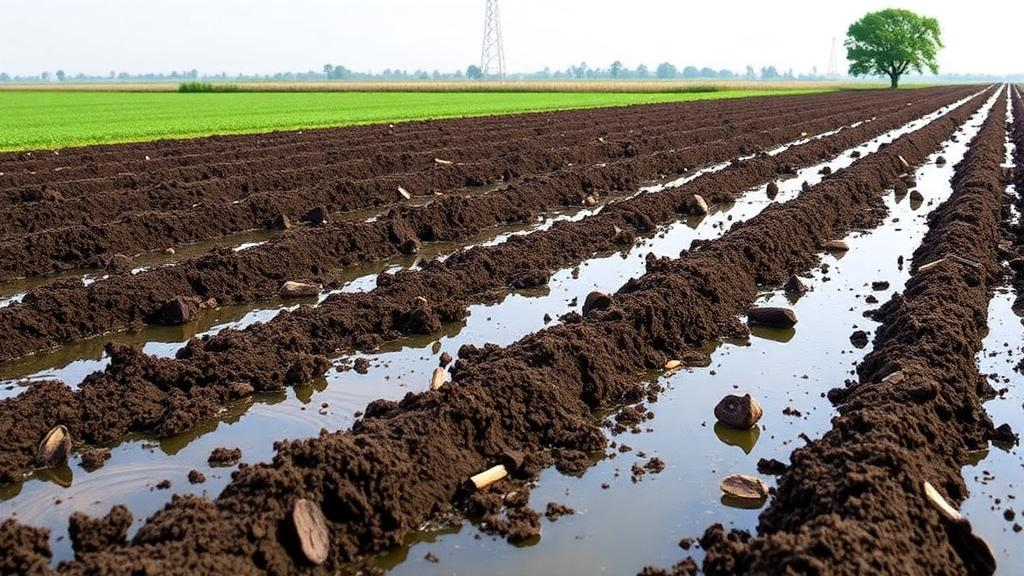
Every time a wastewater treatment plant finishes its work, it produces a dark, nutrient-rich solid known as sewage sludge, or biosolids. Spreading this material on farmland is one of the world’s most common strategies for recycling the nitrogen, phosphorus, and organic matter it contains, and it diverts enormous volumes of waste from landfills and incinerators. But a new comparative review published in Environmental Monitoring and Assessment warns that the same sludge that feeds crops also delivers an invisible cargo of persistent synthetic contaminants into agricultural soil. Berkin Üstünyıldız of Düzce University systematically compared three of the most worrying contaminant classes — microplastics, per- and polyfluoroalkyl substances (PFAS), and pharmaceutical residues — and found that each travels a fundamentally different route from treatment plant to farm field, a finding with major consequences for how we regulate and manage sludge.
The scale of the pathway is hard to overstate. Wastewater treatment plants are remarkably efficient at scrubbing pollutants from the water column, but efficiency for the effluent comes at a price: nearly everything the plant captures — from plastic fibers shed by synthetic clothing to drug metabolites excreted in urine — becomes concentrated in the sludge. When that sludge is land-applied, these captured contaminants are released directly into soils where food crops grow, where earthworms and microbes churn through the profile, and where rain can carry dissolved compounds toward groundwater. In effect, the treatment train that cleans the water writes a check that the soil may spend for decades.
Microplastics illustrate the physical end of the spectrum. Because they are solid particles, they are retained in sludge mainly through physical association with the solids themselves; they do not dissolve, degrade into benign products on any useful timescale, and they survive the conventional biological treatments — anaerobic and aerobic digestion — that stabilize sludge before land application. Once in soil, their environmental relevance stems from extreme persistence and a tendency to fragment. Field studies cited in the review, including investigations of soils decades after sludge application, show that ultraviolet exposure and tillage abrasion break larger plastic fragments into ever smaller particles, driving a size-dependent redistribution through the soil profile that makes older contamination increasingly difficult to detect and even harder to remove.
PFAS behave according to entirely different rules. These thousands of related chemicals, used for decades in water repellents, firefighting foams, and surface coatings, partition into sludge in compound-specific ways. The review emphasizes that the highly persistent perfluoroalkyl acids (PFAAs) endure essentially indefinitely, while polymeric and other precursor compounds can transform in soil or during treatment into the very PFAAs that regulators measure. Critically, many shorter-chain PFAAs are more mobile than their long-chain cousins, meaning that sludge-derived PFAS can migrate downward through soil under certain conditions and reach groundwater. Landmark studies at long-term biosolids application sites — including soils near Decatur, Alabama, amended decades ago — have documented PFAS persistence in soil and uptake into crop plants, with wheat and other edible species accumulating perfluoroalkyl acids in roots, shoots, and grain.
Pharmaceutical residues occupy a third regime, defined by chemical variety and biological activity. Each drug compound exhibits its own balance of sorption to soil particles, microbial degradation, transformation into metabolites, mobility in soil water, and uptake by plants. Antibiotics, painkillers, antidepressants, and hormones all behave differently, and their behavior shifts with soil pH, organic content, and moisture. Field experiments following biosolids application have detected pharmaceuticals in groundwater, subsurface drainage, and even wheat grain, though concentrations and persistence vary enormously between compounds. The review also flags a concern that extends beyond the parent compounds themselves: the environmental dimension of antibiotic resistance, since sludge-derived pharmaceuticals can exert selective pressure on soil microbial communities, shaping the resistome of agricultural soils.
Perhaps the most sobering thread running through the review concerns what treatment actually accomplishes. Conventional sludge processes — digestion, dewatering, composting, lime stabilization — generally redistribute contaminants or alter the measured profile rather than destroying them. Anaerobic digestion can even make plastic particles bio-aged and more fragmented, while thermal hydrolysis of sludge partially removes some organic micropollutants without enhancing their subsequent biotransformation. In the PFAS realm, precursor transformation during conventional treatment means that standard target analysis can underestimate the total PFAS burden in biosolids, because unmeasured precursors convert to PFAAs after application.
High-temperature thermal processes offer a more destructive option, but with caveats. Pyrolysis of biosolids can eliminate microplastics, PFAS, and pharmaceutical residues under suitable operating conditions, producing biochar as a potentially safer product. Yet the review stresses that destruction is not automatically complete: studies have shown that pyrolysis can transport and transform PFAS into the pyrolysis liquid rather than fully mineralizing it. What is needed, the author argues, are transformation-aware whole-process mass balances that track every contaminant atom through the entire treatment chain, rather than single-point measurements that can mask the conversion of one problem compound into another.
Regulation, meanwhile, lags badly behind the science. The European Union’s main sludge directive, Council Directive 86/278/EEC, dates from 1986 and remains centered on conventional pollutants such as heavy metals, with a 2023 evaluation acknowledging that emerging contaminants fall outside its scope. In the United States, the 40 C.F.R. Part 503 standards governing sludge use and disposal similarly focus on traditional parameters. Change is stirring, however: the U.S. EPA has published Method 1633A for quantifying PFAS in biosolids, released a draft sewage sludge risk assessment for PFOA and PFOS, and issued draft guidance for reducing risk from these compounds in biosolids, while PFAS-related monitoring and management frameworks continue to develop in Europe and elsewhere.
The review’s central intellectual contribution is its argument that occurrence alone does not establish risk, and that no single, uniform monitoring or management framework can adequately govern all three contaminant classes. Microplastics demand particle counting, polymer identification, and fragmentation-aware assessment; PFAS require class-specific target and precursor-inclusive analysis, including tools like the total oxidizable precursor assay; pharmaceuticals call for compound-by-compound evaluation of sorption, degradation, and biological activity. Applying a heavy-metals-style regulatory template to any of them would miss the essential physics and chemistry that govern their fate.
What emerges is a call for environmentally defensible land application rather than a blanket prohibition. Class-specific monitoring programs, treatment evaluation grounded in whole-process mass balances, and — above all — long-term field evidence of how these contaminants behave in real agricultural soils over decades are the foundations the review says must underpin future policy. As societies push harder toward circular economies and nutrient recovery, the invisible passengers in sewage sludge will only grow more consequential. The soil, unlike the wastewater plant, offers no second treatment step; whatever we spread there is, in many cases, there to stay.
Subject of Research: Land application of sewage sludge as a pathway for microplastics, PFAS, and pharmaceutical contaminants entering agricultural soil
Article Title: Land application of sewage sludge as a pathway for emerging contaminants: a comparative review of microplastics, PFAS, and pharmaceuticals
Article References: Land application of sewage sludge as a pathway for emerging contaminants: a comparative review of microplastics, PFAS, and pharmaceuticals. (n.d.). https://doi.org/10.1007/s10661-026-16027-0
Image Credits: AI Generated
DOI: 10.1007/s10661-026-16027-0
Keywords: sewage sludge, microplastics, PFAS, pharmaceuticals, biosolids, soil contamination, wastewater treatment, environmental fate, soil-plant transfer, PFAS regulation, pyrolysis, circular economy
Cite Scienmag News
Alan Morgan. (October 14, 2026). Sewage Sludge on Farmland Carries Microplastics, PFAS, and Drugs Into Soil. Scienmag. https://scienmag.com/sewage-sludge-on-farmland-carries-microplastics-pfas-and-drugs-into-soil/
Alan Morgan. "Sewage Sludge on Farmland Carries Microplastics, PFAS, and Drugs Into Soil." Scienmag, 14 October 2026, https://scienmag.com/sewage-sludge-on-farmland-carries-microplastics-pfas-and-drugs-into-soil/. Accessed 14 October 2026.
Alan Morgan. "Sewage Sludge on Farmland Carries Microplastics, PFAS, and Drugs Into Soil." Scienmag. October 14, 2026. https://scienmag.com/sewage-sludge-on-farmland-carries-microplastics-pfas-and-drugs-into-soil/


