


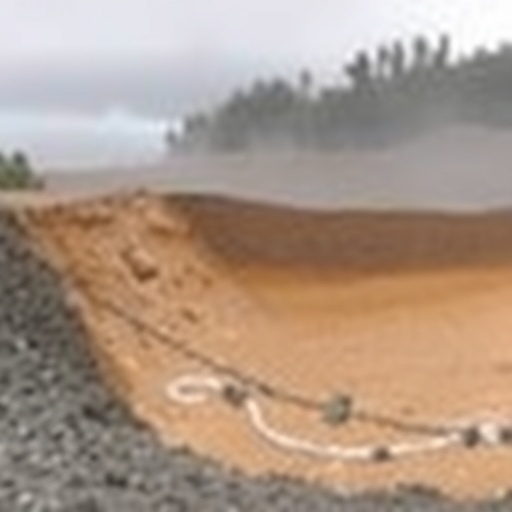
In a groundbreaking study, researchers have delved into the intricate mechanisms and evolutionary processes of a deep-seated liquefaction-induced flow slide disaster chain. This investigation is particularly significant in the context of the Jishishan earthquake, which registered a magnitude of 6.2 and struck Gansu, China. The potential implications of this research extend beyond the regional impact of the earthquake, offering critical insights into landslide dynamics, risk mitigation, and the geological challenges posed by seismic events.
At the core of the study lies a detailed analysis of the liquefaction phenomenon, which occurs when saturated soil substantially loses strength and stiffness in response to applied stress, typically during an earthquake. This process is especially critical in areas with loose, water-saturated sand, where shaking can transform solid ground into a fluid-like state. The research elucidates how this mechanism played a pivotal role in triggering a series of destructive flow slides following the Jishishan earthquake, resulting in cascading failure events that posed significant risks to nearby communities and infrastructure.
Furthermore, the researchers outline the evolution of this disaster chain, starting from the initial seismic tremors that unleashed the liquefaction events. Using advanced modeling techniques and on-site observations, the team was able to trace a sequence of failures that began with localized liquefaction. As the stress waves propagated, they caused further ground instability, leading to extended geological collapse in vulnerable areas, ultimately culminating in massive flow slides that buried everything in their path.
One of the remarkable aspects of this study is its interdisciplinary approach, combining geology, engineering, and environmental science to create a comprehensive understanding of the disaster dynamics. The researchers used a combination of field surveys, laboratory tests, and numerical simulations to analyze the properties of the affected soils. This multi-faceted methodology allowed the team to validate their findings against actual data collected from the earthquake zone, ensuring the robustness and reliability of their conclusions.
The implications of this research are vast. With urbanization encroaching on geologically active areas, understanding the behavior of liquefaction and flow slides is crucial for disaster preparedness and mitigation strategies. The Jishishan case study serves as a clarion call for policymakers and urban planners to prioritize geological assessments in their development plans. By recognizing the conditions that lead to liquefaction and flow slides, communities can better prepare themselves for potential disasters.
Moreover, this study also highlights the importance of public awareness in earthquake-prone regions. Most residents remain unaware of the risks associated with liquefaction and the potential for flow slides; educational initiatives could significantly reduce casualties and property damage. By spreading knowledge about the warning signs and safety measures, communities can enhance their resilience against future seismic events.
Another critical finding of the research pertains to the role of water levels and soil composition in the likelihood of liquefaction. Variations in groundwater levels can greatly affect soil stability; hence, monitoring these changes becomes vital, especially in the lead-up to and following seismic events. The researchers argue for the implementation of comprehensive groundwater management practices, which could serve as a mitigation measure against liquefaction susceptibility.
The study also discusses the potential for using machine learning algorithms in predicting the likelihood of liquefaction in different geological contexts. By harnessing the power of big data and predictive modeling, researchers can better anticipate areas at risk and devise suitable engineering solutions. The integration of technology into geotechnical assessments offers a promising avenue for advancing our understanding and response to natural disasters.
Despite the significance of the findings, challenges remain in translating scientific insights into practical applications. The authors emphasize the need for collaboration across disciplines and sectors to achieve meaningful adaptations in civil engineering and urban planning frameworks. Interdisciplinary dialogue can bridge gaps between scientific research, policy development, and community engagement, ultimately fostering a holistic approach to disaster risk reduction.
In conclusion, Li, Wang, and Yuan’s research serves as an essential contribution to the field of earthquake engineering and soil mechanics. As the world grapples with increasing seismic activity, studies like these remain vital for safeguarding lives and properties against the unpredictable forces of nature. The knowledge gained from the Jishishan earthquake can pave the way for innovative solutions, enhancing resilience in vulnerable regions across the globe.
Understanding and preparing for liquefaction-induced flow slides is an urgent priority, one that requires immediate attention from researchers, engineers, and policymakers alike. By learning from the past and applying this knowledge to future planning efforts, communities can better equip themselves to withstand and recover from the inevitable challenges posed by earthquakes.
The comprehensive nature of this study not only sheds light on the specific disaster triggered by the Jishishan earthquake but also sets a precedent for future research aimed at understanding the complex relationships between seismic activity, soil behavior, and land-use planning. As the science evolves, continued exploration into these mechanisms will undoubtedly yield essential benefits for the safety and well-being of communities worldwide.
Li, Z., Wang, Z. & Yuan, J. Mechanism and evolution of a deep-seated liquefaction-induced flow slide disaster chain triggered by the M 6.2 Jishishan earthquake, Gansu, China.
Earthq. Eng. Eng. Vib. (2025). https://doi.org/10.1007/s11803-026-2361-9
Cite Scienmag News
Violet Maxwell. (January 18, 2026). Earthquake Triggers Deep Liquefaction Flow Slide Disaster. Scienmag. https://scienmag.com/earthquake-triggers-deep-liquefaction-flow-slide-disaster/
Violet Maxwell. "Earthquake Triggers Deep Liquefaction Flow Slide Disaster." Scienmag, 18 January 2026, https://scienmag.com/earthquake-triggers-deep-liquefaction-flow-slide-disaster/. Accessed 4 September 2026.
Violet Maxwell. "Earthquake Triggers Deep Liquefaction Flow Slide Disaster." Scienmag. January 18, 2026. https://scienmag.com/earthquake-triggers-deep-liquefaction-flow-slide-disaster/


