


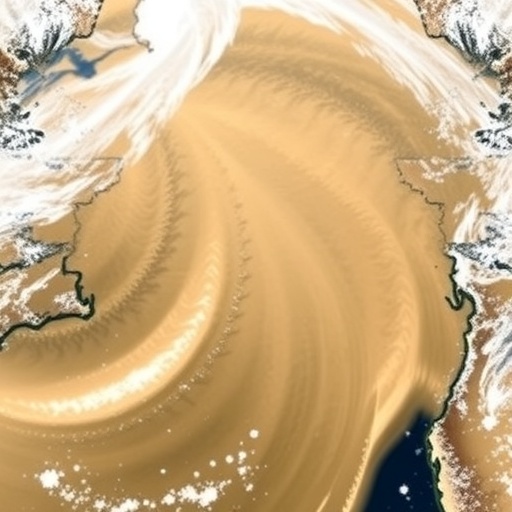
Marine clouds play a crucial role in Earth’s climate system by influencing the planet’s energy balance through their interaction with solar radiation. Aerosols, tiny particles suspended in the atmosphere, are known to affect cloud properties and, consequently, climate processes. A groundbreaking study led by Pandey, S.K. and colleagues, recently published in Communications Earth & Environment, presents compelling evidence that dust aerosols suppress the first indirect effects of aerosols in marine warm clouds over the North Atlantic Ocean. This finding challenges long-standing assumptions in atmospheric science and opens fresh avenues for climate research and modelling.
The first aerosol indirect effect, also known as the cloud albedo effect, occurs when aerosols serve as cloud condensation nuclei (CCN), leading to the formation of more numerous but smaller cloud droplets. Smaller droplets increase cloud reflectivity, or albedo, thereby reflecting more sunlight back into space and producing a cooling effect on the Earth’s surface. Traditionally, this effect is considered one of the primary drivers behind the climate cooling impact of anthropogenic aerosols. However, the latest research suggests that this mechanism is less straightforward when natural dust aerosols are involved, particularly over vast marine areas like the North Atlantic.
Atmospheric dust originates from arid and semi-arid regions, often lofted high into the atmosphere before being transported over oceans by prevailing winds. Unlike anthropogenic particles, dust particles possess distinct physical and chemical characteristics, such as larger size, irregular shape, and mineralogical complexity. These intrinsic properties significantly influence how dust interacts with cloud microphysics. The study by Pandey et al. deployed advanced satellite observations coupled with in-situ measurements and state-of-the-art modeling approaches to investigate how dust aerosols modify cloud droplet formation and cloud optical properties in this critical climate region.
One of the key revelations of the research is that dust aerosols suppress the formation of numerous small droplets and instead favor the development of fewer, larger droplets in marine warm clouds. This suppression leads to a reduction in cloud reflectivity, opposing the expected enhancement from aerosol loading. The physical underpinning of this phenomenon lies in dust particles’ propensity to act as giant CCN or ice-nucleating particles under certain conditions, which alters cloud microstructure and phase dynamics. Consequently, dust interferes with the classical aerosol-cloud interaction paradigm, attenuating the first indirect effect in an important marine environment.
This suppression has profound climatic implications. Since marine warm clouds cover extensive areas of the ocean and strongly regulate the Earth’s radiation budget, even subtle alterations in their microphysical properties can amplify or counterbalance aerosol-driven climate impacts. The study stresses that dust haze episodes lead to reduced aerosol cloud albedo effects, which may induce localized warming rather than cooling. Such feedbacks are crucial for improving climate model predictions, particularly in regions downwind of major dust sources where marine clouds dominate.
To unravel the complex interplay between dust and marine clouds, the researchers leveraged multiple satellite datasets, including cloud droplet size and cloud optical depth measurements, alongside aerosol composition data. By integrating remote sensing with ground-based and airborne instrumentation, they achieved unprecedented resolution and accuracy in characterizing aerosol-cloud interactions. Furthermore, using sophisticated atmospheric chemistry and cloud microphysics models, the team simulated cloud responses to varying dust concentrations, confirming that dust suppresses droplet number concentrations and alters the cloud albedo effect.
The findings expose a critical gap in current climate models, which often oversimplify aerosol-cloud interactions and underestimate the role of natural aerosols like dust. The dusty atmosphere of the North Atlantic was conventionally thought to enhance cloud reflectivity via aerosol first indirect effects, yet the study reveals a more nuanced reality. Incorporating these insights into predictive climate models is essential for accurately assessing aerosol radiative forcing and evaluating future climate scenarios, especially in a warming world where dust emissions and transport patterns might change.
A deeper understanding of dust-cloud interactions also holds major ecological and environmental significance. Marine warm clouds influence regional precipitation and oceanic heat exchange processes. By modulating cloud properties, dust aerosols indirectly affect marine ecosystems and biogeochemical cycles tied to sunlight and temperature regulation. Potential shifts in cloud cover and albedo could cascade through atmospheric circulation, with broader repercussions beyond the North Atlantic to global climate systems.
Importantly, the research highlights variability in dust’s indirect effects, influenced by factors such as dust particle mineralogy, ambient humidity, and the cloud lifecycle stage. These parameters complexify the aerosol-cloud system and underscore the necessity for high-resolution, multidimensional observational strategies and improved microphysical parameterizations in predictive models. The study acts as a clarion call for the atmospheric science community to integrate interdisciplinary approaches that encompass aerosol chemistry, physical climatology, and remote sensing innovations.
The work of Pandey and colleagues exemplifies how advancements in technology and scientific collaboration enable breakthroughs that challenge established climate paradigms. Their comprehensive methodological framework sets a new standard for studying aerosol-cloud interactions in other regions affected by dust, such as the tropical Atlantic, Mediterranean, or parts of Asia. Similar investigations could pave the way to a globally coherent understanding of dust impacts on cloud processes and climate forcing.
Moreover, the research underscores the complex role of natural aerosols in the Earth system amid anthropogenic climate change. While anthropogenic emissions continue to be major drivers of aerosol-cloud effects, natural aerosols like mineral dust can modulate or obfuscate these impacts in regionally significant ways. This duality complicates climate attribution studies and demands refined attribution tools to disentangle natural variability from human influence on cloud and climate dynamics.
In summary, this seminal research fundamentally reshapes our understanding of aerosol indirect effects by demonstrating that dust suppresses first order aerosol-cloud interactions over a climatically critical marine region. The revelations delivered by Pandey et al. challenge prevailing assumptions and highlight the need for nuanced climate models incorporating dust-specific cloud microphysics. These advances will significantly enhance the fidelity of climate predictions and inform climate mitigation and adaptation policies tailored for diverse atmospheric environments.
As the scientific community continues to explore the multifaceted relationships between aerosols, clouds, and climate, this study stands as a pivotal contribution. It not only elucidates a vital subsystem within the Earth’s atmospheric engine but also exemplifies how natural phenomena intersect with anthropogenic influences in shaping our planet’s future. The dust-cloud nexus in the marine atmosphere, once considered an ancillary detail, now emerges as a critical determinant of climate feedback mechanisms with global significance.
With ongoing technological progress and international cooperation, further high-resolution observational campaigns and model refinements are poised to decode the full spectrum of dust effects on clouds. The screening of aerosol radiative impacts must duly reflect dust’s suppressive role in the first indirect effect to avoid misestimations in projected climate trajectories. This transformative insight heralds a new era in atmospheric science that promises greater precision, predictive power, and actionable knowledge in understanding our planet’s intricate climate machinery.
Cite Scienmag News
Russell Cooper. (May 29, 2026). Dust Weakens Aerosol Cooling in North Atlantic Clouds. Scienmag. https://scienmag.com/dust-weakens-aerosol-cooling-in-north-atlantic-clouds/
Russell Cooper. "Dust Weakens Aerosol Cooling in North Atlantic Clouds." Scienmag, 29 May 2026, https://scienmag.com/dust-weakens-aerosol-cooling-in-north-atlantic-clouds/. Accessed 7 September 2026.
Russell Cooper. "Dust Weakens Aerosol Cooling in North Atlantic Clouds." Scienmag. May 29, 2026. https://scienmag.com/dust-weakens-aerosol-cooling-in-north-atlantic-clouds/


