


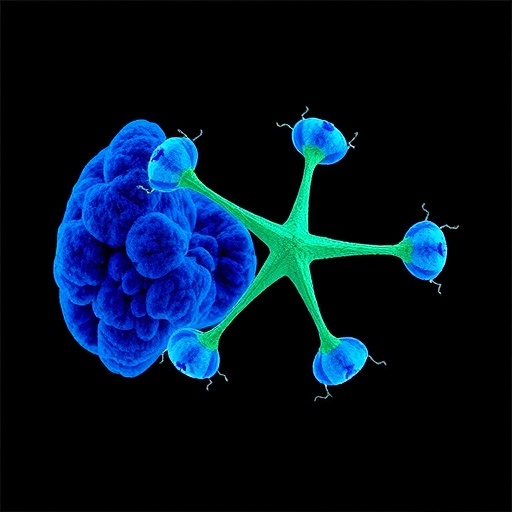
In a groundbreaking advancement that could redefine the landscape of cancer immunotherapy, researchers have unveiled a bold strategy that dramatically enhances the potency of CAR T-cell therapy against solid tumors. This innovation hinges on the precise genetic ablation of prostaglandin E2 (PGE2) signaling through the knockout of its dual receptors in the engineered immune cells themselves, circumventing one of the most stubborn obstacles in the fight against solid malignancies.
While CAR T-cell therapy has revolutionized treatment for certain blood cancers, its application to solid tumors has faced significant challenges due to the hostile, immunosuppressive microenvironment these tumors create. PGE2, a bioactive lipid mediator prevalent in the tumor milieu, plays a pivotal role in dampening immune responses by engaging its receptors on immune cells, effectively muffling the anti-tumor activity of CAR T cells. Recognizing this, the research team embarked on a meticulous genetic engineering approach to disable both major PGE2 receptors on CAR T cells, thereby liberating them from this inhibitory cascade.
The dual receptor knockout was engineered using state-of-the-art gene editing tools that ensure both accuracy and durability of receptor ablation within the CAR T-cell genome. This precise gene editing approach was followed by rigorous functional assays to confirm that the modified CAR T cells were not only free from PGE2-mediated signaling but also retained their vital cytotoxic functions and proliferative capacity. Strikingly, these reprogrammed immune cells exhibited a marked resistance to the immunosuppressive forces typically present in the tumor microenvironment.
In preclinical models of notoriously resistant solid tumors, the modified CAR T cells demonstrated a significantly enhanced ability to infiltrate tumor masses and sustain their anti-cancer activity over extended periods. This translated into a profound delay in tumor progression and, in some cases, complete regression, effects seldom seen with conventional CAR T therapies. The results suggest that by cutting off PGE2 signaling at the receptor level, CAR T cells can overcome one of the critical molecular brakes imposed by solid tumors.
Beyond their improved efficacy, these receptor-deficient CAR T cells also showed a surprising reduction in systemic inflammatory side effects, a common complication of cellular immunotherapies. This suggests not only a better therapeutic index but also raises hopes for improved patient tolerability and safety profiles in eventual clinical applications. The dual receptor ablation may thus represent a critical balancing act, enhancing tumor targeting while mitigating collateral immune activation.
The strategy emerges from an extensive understanding of PGE2’s multifaceted role in tumor biology and immune evasion. By disabling two distinct receptors, the approach assures a more comprehensive blockade of PGE2’s immunosuppressive signals, which might otherwise bypass single receptor-targeted interventions. This dual knockout thus reflects a sophisticated approach to target redundancy and compensatory pathways that cancers often exploit.
Importantly, the research also addressed concerns about potential alterations in CAR T-cell homing and survival mechanisms due to receptor ablation. Detailed phenotypic analyses revealed that the dual receptor knockout did not impair essential receptor signaling pathways responsible for normal T-cell function and navigation, preserving the therapeutic cells’ fitness and resilience in vivo.
Further in-depth molecular profiling illuminated how disabling PGE2 receptors recalibrates the CAR T-cell transcriptome towards a more activated and persistent state, characterized by upregulation of effector molecules and resistance to exhaustion, a chronic dysfunction state that often limits CAR T efficacy. These gene expression changes resonate with improved functional outputs observed upon tumor challenge.
The translational implications of these findings cannot be overstated. By providing a robust methodology to empower CAR T cells against formidable solid tumor defenses, this research paves the way for new clinical trials aiming to extend CAR T-cell therapy beyond hematological malignancies. It also highlights the potential of combinatorial genetic targeting strategies to overcome intrinsic tumor immune resistance.
Moreover, these advances may open doors for integrating dual PGE2 receptor deletion with other CAR T modifications such as co-stimulatory domain optimization or checkpoint blockade to create next-generation cellular therapies that synergize multiple mechanisms for maximal eradication of solid tumors.
While further studies are warranted to assess long-term efficacy, safety, and potential off-target effects in humans, this seminal work lays a critical foundation for future CAR T-cell engineering. It signals a significant leap towards harnessing the full therapeutic potential of cellular immunotherapies against the stubborn challenge posed by solid cancers.
The successful application of dual receptor knockout in this context also invigorates interest in the broader field of tumor microenvironment modulation. It underscores the importance of understanding and intervening in the complex signaling networks that tumors exploit to evade immune destruction.
Ultimately, this research exemplifies the fusion of molecular biology, immunotherapy, and gene editing technologies to surmount formidable clinical challenges. It heralds a promising era where engineered T cells can be fine-tuned with unprecedented precision to achieve durable, potent responses in patients battling solid tumors, a goal long sought but rarely realized in oncology.
As the scientific community eagerly watches the progression of these engineered cellular therapies into clinical settings, hopes are high that such innovations will translate to meaningful improvements in patient outcomes, offering renewed optimism in the relentless fight against cancer.
Cite Scienmag News
Nathaniel Bowman. (February 28, 2026). Dual Receptor Knockout Boosts CAR T Solid Tumor Therapy. Scienmag. https://scienmag.com/dual-receptor-knockout-boosts-car-t-solid-tumor-therapy/
Nathaniel Bowman. "Dual Receptor Knockout Boosts CAR T Solid Tumor Therapy." Scienmag, 28 February 2026, https://scienmag.com/dual-receptor-knockout-boosts-car-t-solid-tumor-therapy/. Accessed 3 September 2026.
Nathaniel Bowman. "Dual Receptor Knockout Boosts CAR T Solid Tumor Therapy." Scienmag. February 28, 2026. https://scienmag.com/dual-receptor-knockout-boosts-car-t-solid-tumor-therapy/


