


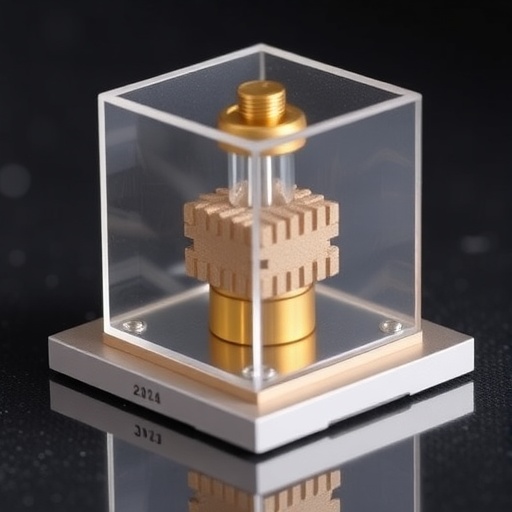
In a modest laboratory shared by the University of Central Florida (UCF) and the University of Florida (UF), something remarkable is silently taking shape—a coin-sized black plate floating effortlessly above a meticulously arranged grid of permanent magnets. This levitating plate isn’t suspended by hidden wires, spinning rotors, or intricate electronic feedback systems. Instead, it remains suspended purely by diamagnetic levitation, an elegant physical phenomenon allowing it to hover quietly and stably in place, while a laser beam continuously monitors its minute vibrations. This floating structure is much more than a scientific curiosity; it inaugurates a new class of gram-scale mechanical resonators that serve as ultra-sensitive sensors for acceleration, gravitational fields, and magnetic forces, potentially transforming navigation technologies, space exploration instruments, and precision metrology.
Traditional microelectromechanical systems (MEMS) resonators, the cornerstone of modern-day sensing solutions, operate as tiny silicon-based mechanical oscillators. They deliver exceptional performance in devices ranging from smartphone inertial measurement units (IMUs) to high-precision gyroscopes used in navigation. However, despite their sophistication, these resonators invariably suffer from a critical limitation: the physical anchors that connect them to a substrate act as conduits for energy dissipation. Mechanical vibrations within the resonator leak energy via clamping losses into the supporting structure, sharply constraining their oscillation lifetime and frequency stability. Innovations such as strain-engineered soft-clamping and phononic crystal structures have attempted to alleviate this, but the fundamental presence of physical supports inherently limits ultimate performance. The team at UCF and UF has decisively transcended this barrier by eliminating mechanical contacts altogether.
The innovation traces back to exploiting diamagnetic levitation—a remarkable force exerted on materials possessing negative magnetic susceptibility, which causes them to be repelled by magnetic fields. Graphite is a prime example of a potent diamagnet known for its robust levitation capability. Unfortunately, graphite’s electrical conductivity introduces significant eddy current damping when it interacts with magnetic gradients, rapidly quenching resonant oscillation. Addressing this challenge, the researchers engineered a composite material blending millions of graphite microparticles homogeneously dispersed within an insulating epoxy matrix. This ingenious design preserves the strong magnetic repulsion essential for levitation while effectively suppressing electrical currents that would otherwise degrade mechanical quality, thus crafting a “designer diamagnet” optimized for high-Q resonance.
The levitating resonator itself is a flat composite plate roughly a few centimeters in width and around a millimeter in thickness, floating a mere 50 micrometers above a checkerboard-patterned array of cubic neodymium magnets magnetized alternately. This alternating polarity arrangement produces a three-dimensional magnetic potential well that traps the plate stably in place, preventing both vertical fall and lateral drift without requiring any active stabilization measures. The setup is truly passive yet remarkably stable, achieving an equilibrium state solely as a result of balancing gravitational forces and diamagnetic repulsion. The scale of the levitated mass—about 1.5 grams—dramatically surpasses previous microscopic levitated systems and ventures into mass domains relevant for diverse real-world sensing applications.
By employing laser interferometric techniques, the team characterized mechanical resonance frequencies centered around 20 to 23 Hertz, a relatively low frequency field that nonetheless demonstrates extremely high performance. The quality factors (Q) for these modes peaked at an impressive 32,000 when tested under moderately high vacuum conditions (~25 microtorr). Such Q values are extraordinary for levitated mechanical systems of this size, indicative of minimal energy loss through all dissipation channels except internal material damping. Residual velocity fluctuations of the plate’s residual motion were detected to be under 0.5 micrometers per second, effectively rendering the system quiescent at the nanoscale. This quietness ensures that frequency measurements remain stable and that the device’s responses can be reliably extracted over long periods.
The researchers implemented a phase-locked loop system to track frequency shifts with exquisite precision, observing frequency drifts below one millihertz over meaningful timescales with a corresponding Allan deviation reaching 1.5 × 10⁻⁶ at a 20-second integration window. These results translate into thermomechanical acceleration sensitivities on the order of 2.4 × 10⁻¹¹ g per square root Hertz, far exceeding the performance of conventional MEMS accelerometers commercially available today. This remarkable sensitivity opens new possibilities for compact, low-power inertial sensors that can operate with unprecedented accuracy without complex cryogenics or active control.
Interestingly, the versatile levitated composite also functions as a magnetometer. By introducing a small external permanent magnet near the resonator, the team demonstrated changes in frequency resonances with a high responsivity of 0.45 Hz per millitesla of magnetic field, confirming dual-mode operation capabilities. This dual sensing ability is highly attractive for applications demanding simultaneous measurement of inertial and magnetic vectors, such as precision navigation in GPS-denied environments or space missions where both gravimetric and magnetic anomalies require accurate monitoring.
This innovative platform amalgamates the best attributes of two traditionally disconnected fields: the macroscopic mass and mechanical quality characterizing engineered MEMS resonators, and the ambient temperature, contactless isolation advanced by levitated opto- and magneto-mechanics. Larger mass not only benefits from enhanced signal-to-noise ratios for sensing but also couples favorably with environmental vibrations that can be suppressed via future system level isolation. The passive, room-temperature operation removes substantial barriers related to cooling or vacuum packaging that limit practical deployment of many levitated devices, making this a promising step toward real-world industrial designs.
Looking ahead, the researchers aim to push the envelope by increasing operational resonance frequencies, improving isolation from external environmental noise, and miniaturizing compact optical readout systems. Higher frequencies generally improve sensor bandwidth and reduce susceptibility to low-frequency drift phenomena. Moreover, as levitation technology matures, integrating readout optics on-chip or in compact modules could unleash powerful, portable sensor suites usable across disciplines from precision engineering to fundamental physics experiments.
The overarching lesson from this work is clear: ultimate minimization of mechanical energy loss requires elimination of all physical attachments. By letting the resonator float completely free in a stable diamagnetic trap, traditional sources of dissipation such as clamping and mechanical friction vanish, establishing a new paradigm for ultra-stable, high-Q sensors. Such anchor-less mechanical platforms signal an exciting future where precision measurement harnesses pure physics rather than complex engineering crutches.
Silently hovering atop its magnetic array, this levitated graphite-epoxy composite device embodies a poetic union of material science, magnetics, and mechanical engineering. It offers a glimpse into a new generation of sensors where performance and stability arise not from clamping down, but from graceful floating—in the delicate sweet spot between gravity and magnetic repulsion. This breakthrough resonates beyond MEMS, promising transformative impacts on navigation, metrology, space instrumentation, and the broader landscape of precision device engineering.
Cite Scienmag News
Denise Maddox. (May 26, 2026). Diamagnetically Levitated Mechanical Resonators Achieve Exceptional Stability with Masses Over 1.5 Grams. Scienmag. https://scienmag.com/diamagnetically-levitated-mechanical-resonators-achieve-exceptional-stability-with-masses-over-1-5-grams/
Denise Maddox. "Diamagnetically Levitated Mechanical Resonators Achieve Exceptional Stability with Masses Over 1.5 Grams." Scienmag, 26 May 2026, https://scienmag.com/diamagnetically-levitated-mechanical-resonators-achieve-exceptional-stability-with-masses-over-1-5-grams/. Accessed 3 September 2026.
Denise Maddox. "Diamagnetically Levitated Mechanical Resonators Achieve Exceptional Stability with Masses Over 1.5 Grams." Scienmag. May 26, 2026. https://scienmag.com/diamagnetically-levitated-mechanical-resonators-achieve-exceptional-stability-with-masses-over-1-5-grams/


