


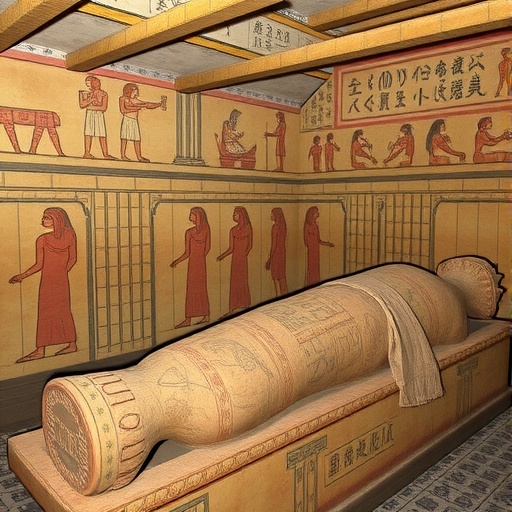
The ancient dead of Egypt are revealing a surprisingly modern story: even in a tomb reused for centuries, burial space was not necessarily chaotic. A new study of Theban Tomb 209, located in the necropolis opposite present-day Luxor, suggests that successive generations carefully adapted the chamber to accommodate new bodies, objects, and rituals while preserving traces of what came before. Rather than treating the tomb as a forgotten storage place for human remains, the researchers interpret it as a continually reactivated social and ritual environment—one in which every new burial had to negotiate with an already crowded past.
The Theban Necropolis contains more than 400 known tombs, but the detailed excavation of Side Chamber 3 in Tomb 209 has provided an unusually close look at how funerary customs changed over time. The chamber was first constructed during Egypt’s Twenty-fifth Dynasty, between approximately 754 and 656 BCE, and remained in use until the Ptolemaic period, which ended around 30 BCE. Across that span, archaeologists identified nine funerary deposits containing at least 16 mummified human individuals, a mummified dog, and a disturbed concentration of remains representing at least four additional people. The findings come from a study in Frontiers in Environmental Archaeology led by researchers from the University of La Laguna in Spain.
To reconstruct the history of the chamber, the team combined excavation with detailed archaeological recording. Researchers photographed the mummies in situ and documented the orientation of each body, the position of the limbs, the relationship between individuals, and the way remains interacted with walls, floors, coffins, jars, and other structures. This approach, known as archaeothanatology, focuses on what happens to a body from the moment it is placed in a burial environment. By examining disarticulation, compression, overlap, and spatial relationships, specialists can distinguish between bodies deliberately positioned together and remains that were later shifted by collapse, flooding, fire, or human disturbance. In Tomb 209, these observations allowed the researchers to reconstruct changing patterns of burial even where the original sequence was no longer perfectly preserved.
The earliest burials in the chamber appear to have been relatively individualized. Bodies were placed in coffins and separated from one another, suggesting that the tomb initially offered enough space for formal, self-contained funerary arrangements. Several individuals were accompanied by funerary nets, amulets, and other objects associated with protection and the afterlife. The assemblage also included costly materials and the contents of Phoenician amphorae, imported ceramic vessels that point to long-distance trade and the considerable resources available to at least some of the people buried there. These details indicate that the chamber’s first occupants may have held elevated social positions and that their burials were planned around individual identities, possessions, and ritual needs.
That pattern changed as the chamber was reused. By the end of the Twenty-fifth Dynasty and during the Persian period, roughly 680 to 404 BCE, available space had become increasingly limited. New bodies were inserted wherever room remained, often requiring adjustments to their posture. The researchers observed examples in which an arm was folded inward rather than extended, a seemingly small alteration that can reveal how the living negotiated the physical presence of earlier burials. Instead of removing older individuals to make room, later users appear to have worked around them. The resulting density was not simply the product of careless accumulation; it reflected a practical and ritual response to a chamber whose previous occupants remained part of the environment.
The team also identified a broader transition from individual burial deposits to vertical arrangements in which bodies were placed one above another. Superposition occurred in approximately two-thirds of the chamber’s deposits, demonstrating how dramatically the use of the space evolved. Bodies arranged in these later layers generally lacked coffins but had been carefully mummified, showing that the reduction in architectural space or burial equipment did not necessarily mean a decline in attention to the dead. Mummification continued to protect and transform the body for the afterlife, even as the physical organization of the tomb became more collective. The contrast between earlier coffin burials and later stacked deposits therefore reflects changing strategies rather than a simple collapse of funerary standards.
One of the most striking discoveries came from the southeastern part of the chamber, where four mummies and a mummified dog were placed in vertical superposition during the Ptolemaic period. The dog rested directly above the mummies of a man and a woman, creating an arrangement that is both archaeologically unusual and emotionally resonant. The researchers suggest that the animal may have been closely associated with the two humans, perhaps reflecting a relationship that continued beyond death. At the same time, the dog may have served a symbolic role as a psychopomp, an animal guide helping the deceased travel toward the afterlife. Upright jars found alongside the bodies may point to a ritual practice specific to this later phase, further distinguishing it from the earlier burials in the chamber.
Other changes in body position provide additional evidence that the tomb remained ritually meaningful. In some later deposits, individuals were placed with both arms folded across the chest, a posture Egyptologists describe as the Osirian position. The gesture associated the deceased with Osiris, the god of resurrection and regeneration, and visually connected the body with established ideas about rebirth. Such positioning suggests that later users were not merely disposing of bodies in the nearest available space. They continued to communicate religious ideas through posture, mummification, and the selection of accompanying objects, even while adapting those practices to a chamber already filled with earlier remains.
The researchers emphasize that the sequence cannot be reconstructed with absolute precision. The chamber flooded several times, fires damaged parts of the interior, and people re-entering the tomb moved debris and remains. These processes blurred the original boundaries between individual deposits and made it difficult to determine the exact order or intention behind every placement. Nevertheless, the overall pattern is clear: Tomb 209 was repeatedly reorganized rather than abandoned to disorder. Its occupants, and the people who buried them, treated the chamber as a place with a history. Each new deposition accommodated previous bodies, reused existing space, and added another layer of meaning. The study challenges the assumption that dense or disturbed burials represent a loss of ritual control, suggesting instead that what looks disordered to modern eyes may preserve a complex form of funerary memory.
News Publication Date: 18-Aug-2026
Cite Scienmag News
Courtney Benton. (August 18, 2026). Ancient Egyptian Tomb Reveals Burial Customs Evolving Across Centuries. Scienmag. https://scienmag.com/ancient-egyptian-tomb-reveals-burial-customs-evolving-across-centuries/
Courtney Benton. "Ancient Egyptian Tomb Reveals Burial Customs Evolving Across Centuries." Scienmag, 18 August 2026, https://scienmag.com/ancient-egyptian-tomb-reveals-burial-customs-evolving-across-centuries/. Accessed 4 September 2026.
Courtney Benton. "Ancient Egyptian Tomb Reveals Burial Customs Evolving Across Centuries." Scienmag. August 18, 2026. https://scienmag.com/ancient-egyptian-tomb-reveals-burial-customs-evolving-across-centuries/


