


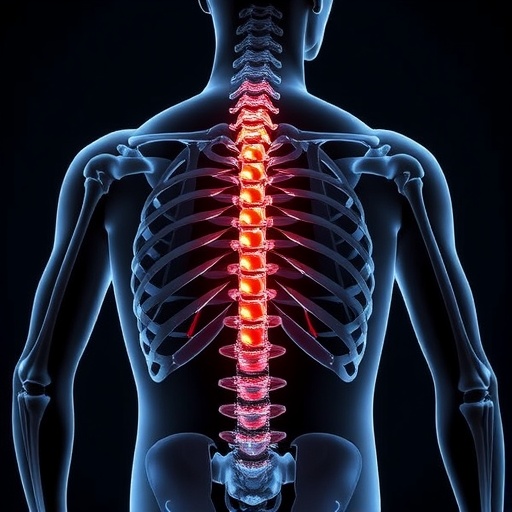
Researchers at Houston Methodist and the University of Cambridge have developed a flexible neural interface that could change how scientists approach paralysis and other consequences of spinal cord injury. Designed to wrap around the spinal cord, the device can simultaneously read electrical signals associated with movement, sensation and the activity of internal organs. In preclinical experiments, the technology distinguished several classes of neural information, suggesting that a single implant may eventually help restore multiple lost functions rather than targeting only one pathway at a time.
The advance addresses a major limitation in current neuroprosthetic research. More than 2.5 million people worldwide are living with spinal cord injuries, which can interrupt communication between the brain and the body and lead to paralysis, loss of sensation and impaired autonomic functions. These autonomic effects may include disruptions in bladder and bowel control, sexual function, blood pressure regulation and other processes that operate largely outside conscious awareness. Existing approaches have often been developed around one objective, such as moving a robotic limb or delivering sensory feedback. The new system is intended to interpret several categories of information through one flexible platform.
The study, published in Nature Communications, was co-led by Damiano Barone, M.D., Ph.D., assistant professor of neurosurgery in the Department of Neurosurgery at Houston Methodist, and George Malliaras, Ph.D., the Prince Professor of Technology in the Department of Engineering at the University of Cambridge. Their central strategy is not to repair the damaged section of the spinal cord directly, but to create an alternative route through which neural information could be recorded, decoded and eventually transmitted around the injury. This approach could allow signals generated above or below a damaged region to be connected through an electronic system.
“Our goal is different,” Barone said. “Rather than fixing the injury itself, we want to bypass it completely and create an alternative route for signals to travel.” The concept is broadly aligned with the architecture of a neural bridge. In such a system, sensors collect electrical activity from the nervous system, computational algorithms identify the meaning of those signals and an output device delivers commands to muscles, stimulation electrodes or external machines. By placing the recording interface around the spinal cord, researchers aim to access information distributed across multiple neural pathways without relying on a single exposed surface or a single signal type.
In preclinical testing, the device detected patterns associated with intended movement and classified different kinds of sensory information. Neural signals related to movement are not simple on-and-off commands. They are represented by changes in electrical activity across populations of neurons, with information encoded in timing, frequency and coordinated patterns. Sensory signals are similarly complex and may reflect touch, pressure, position or other forms of feedback. The researchers reported that the system could separate multiple signal categories, an important requirement for a neuroprosthetic intended to coordinate movement and sensation simultaneously.
The platform also distinguished activity originating from internal organs, a finding that expands the potential applications beyond limb control. Signals associated with the body’s internal state, sometimes called visceral or autonomic signals, can be weaker, more variable and more difficult to interpret than signals linked to voluntary movement. Identifying them could eventually support technologies designed to monitor or influence functions such as bladder control, cardiovascular regulation or other organ-related processes affected by spinal cord injury. The present work does not demonstrate clinical restoration of these functions, but it indicates that the spinal cord contains information that may be accessed through a single multi-purpose interface.
A key feature of the system is its flexibility. Conventional neural implants may be rigid, while the spinal cord is soft, curved and constantly subject to movement. A device designed to conform to the cord can potentially maintain closer contact with neural tissue and reduce mechanical mismatch between the implant and the body. The researchers’ approach uses a wraparound configuration intended to record activity from different regions around the spinal cord rather than relying on a single narrow contact area. That geometry may help capture a broader map of neural signals while supporting the development of smaller, more adaptable implants.
Additional experiments tested whether the approach could function in larger anatomy, an essential step before any consideration of human trials. Results obtained in small laboratory models do not automatically translate to people, because the size, structure and electrical environment of the spinal cord can vary substantially across species. Larger-anatomy testing can provide information about surgical access, device placement, signal quality and the practical challenges of scaling the technology. Even so, the researchers emphasize that the system remains preclinical and that further work is needed before it can be evaluated as a treatment for people with spinal cord injuries.
The next phase will focus on testing whether the device can help restore function in laboratory models with chronic spinal cord injuries. Chronic injuries are particularly important because long-term damage can produce extensive changes in neural circuits, muscles and surrounding tissue. Demonstrating signal detection in an uninjured or acute setting is only an early milestone; a therapeutic system must also operate reliably after injury and connect its decoded information to an effective output. Future versions may need to integrate real-time computing, stimulation technologies and control algorithms capable of adapting to changing neural signals over time.
“This could represent a paradigm change in how we think about spinal cord injuries,” Malliaras said. “Instead of starting from the idea that what is lost is gone forever, this approach asks whether we can restore function by carrying the signal around the injury.” The researchers envision the device as a foundation for next-generation neuroprosthetics that connect directly to the nervous system to bypass or replace lost motor, sensory or cognitive functions. Its ability to interpret several kinds of neural activity through one flexible interface could ultimately support more coordinated systems, although clinical translation will depend on long-term safety, stable signal quality, surgical feasibility and successful demonstrations of functional recovery. The work was supported by the National Institutes of Health, the Houston Methodist Katz Investigator Award, the Helaers Research Award and the Engineering and Physical Sciences Research Council.
Web References: Nature Communications study
References: Nature Communications; Houston Methodist; University of Cambridge.
Keywords
Spinal cord injury, neural interface, neuroprosthetics, neural decoding, biomedical engineering, paralysis, sensory restoration, motor restoration, autonomic control, spinal cord bypass, brain-computer interface, medical technology
Cite Scienmag News
Cassandra Pierce. (August 18, 2026). Implantable Device May Restore Function After Spinal Cord Injury. Scienmag. https://scienmag.com/implantable-device-may-restore-function-after-spinal-cord-injury/
Cassandra Pierce. "Implantable Device May Restore Function After Spinal Cord Injury." Scienmag, 18 August 2026, https://scienmag.com/implantable-device-may-restore-function-after-spinal-cord-injury/. Accessed 3 September 2026.
Cassandra Pierce. "Implantable Device May Restore Function After Spinal Cord Injury." Scienmag. August 18, 2026. https://scienmag.com/implantable-device-may-restore-function-after-spinal-cord-injury/


