


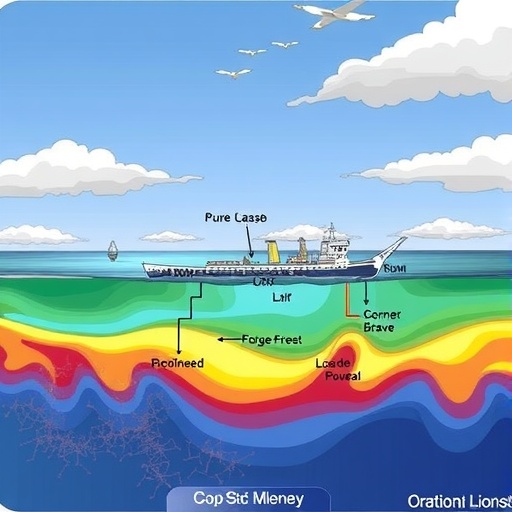
Marine carbon dioxide removal has often been presented as a vast, blue opportunity: use the ocean’s chemistry and circulation to pull greenhouse gases from the atmosphere, then store the carbon for decades, centuries or longer. But a new study argues that one of the most important limits may occur before carbon ever reaches the open ocean. The research, published in Communications Earth & Environment, examines how quickly carbon dioxide can cross the thin, turbulent boundary between coastal seawater and the atmosphere—and finds that air–sea gas exchange rates may sharply constrain the amount of carbon dioxide coastal removal strategies can actually capture.
The study by L. Gerke, D.T. Ho, U.K. Heede and colleagues focuses on a process that is easy to overlook because it happens at the ocean’s surface. Carbon dioxide removal techniques may alter seawater chemistry, allowing the water to absorb additional carbon dioxide from the atmosphere. Yet chemically prepared water cannot remove atmospheric carbon simply because it has the capacity to do so. The gas must physically move across the air–sea interface. That transfer depends on wind, waves, turbulence, temperature, bubbles, surface films and the difference in carbon dioxide concentration between the atmosphere and ocean. If the transfer is too slow, the theoretical removal potential of a coastal project can be far greater than its real-world performance.
At the heart of the problem is a narrow layer of water next to the ocean surface. This boundary layer acts like a microscopic traffic bottleneck. Carbon dioxide molecules must diffuse through it before entering seawater, where they can participate in a sequence of chemical reactions. The rate at which this occurs is commonly described using a gas-transfer velocity, often called the piston velocity. Strong winds and breaking waves generally make the boundary layer thinner and increase transfer. Calm conditions can do the opposite. Coastal waters are especially complicated because tides, currents, freshwater discharge, sediment, biological activity and changing weather continually reshape the surface environment.
Many proposed marine carbon dioxide removal approaches rely on manipulating the ocean’s carbonate system. One possible pathway is ocean alkalinity enhancement, in which alkaline materials are added to seawater. Alkalinity changes the balance among dissolved carbon dioxide, bicarbonate and carbonate ions. In simplified terms, increasing alkalinity can reduce the concentration of dissolved carbon dioxide in seawater and create a chemical opportunity for the ocean to draw more carbon dioxide from the air. But that opportunity is not the same as immediate removal. The atmosphere and ocean must first move toward a new equilibrium, and the speed of that adjustment depends on gas exchange as well as chemistry.
This distinction could transform how coastal carbon removal projects are evaluated. A calculation based only on the amount of alkaline material added, or the chemical capacity of the treated water, may imply a large quantity of carbon dioxide removal. A calculation that also includes the local gas-transfer rate may produce a considerably smaller figure, particularly when water remains near the coast for only a limited time. If a water parcel is carried away, diluted or mixed before it absorbs the expected amount of atmospheric carbon dioxide, the claimed removal can be delayed, reduced or shifted to another region. The research therefore places physical transport alongside chemistry as a central part of the carbon accounting.
The coastal zone is not merely a convenient place to deploy removal technologies; it is also one of the most dynamic parts of the ocean. Estuaries and continental shelves receive nutrients and organic matter from land, experience intense tidal mixing and can show dramatic changes in temperature and salinity over short distances. These factors influence both carbonate chemistry and the speed of air–sea exchange. Biological production can temporarily consume dissolved carbon dioxide, while respiration can return it to the water. Sediments may alter alkalinity and carbon storage. Such processes make it difficult to treat a coastline as a single, uniform removal machine, even when the underlying chemical principle appears straightforward.
The study’s central message reaches beyond one technology. It challenges the habit of treating the ocean as if it instantly equilibrates with the atmosphere. In many simplified carbon-cycle calculations, seawater chemistry is adjusted and atmospheric carbon uptake is inferred from the resulting chemical state. In reality, the ocean’s surface is constantly being stirred, transported and replaced. The time required for carbon dioxide to cross the interface may compete with the time available for a treated water mass to remain exposed to the atmosphere. This creates a rate limitation: the ocean may possess the chemical capacity to absorb carbon, but the atmosphere cannot supply that carbon quickly enough under local conditions.
That rate limitation also matters for monitoring and verification, two of the most difficult challenges facing marine carbon dioxide removal. A project must demonstrate not only that it changed seawater chemistry, but also that atmospheric carbon dioxide entered the ocean and remained stored rather than quickly returning to the air. Measuring this requires observations of dissolved inorganic carbon, alkalinity, pH, temperature, salinity, currents and air–sea carbon dioxide differences. Researchers may also need to track water masses as they move through coastal systems. Without reliable estimates of gas-transfer rates, measurements of chemical change could be mistaken for evidence of actual atmospheric removal.
The findings arrive as interest in marine carbon dioxide removal accelerates. Governments, start-ups and research institutions are investigating alkalinity enhancement, direct ocean capture, seaweed cultivation and other approaches because emissions reductions alone may not eliminate all climate-warming gases. Yet the new analysis underscores why scale-up cannot be judged from laboratory chemistry or global ocean averages alone. A strategy that appears highly effective in a controlled tank may behave differently in a windy shelf sea, a sheltered bay or a freshwater-influenced estuary. Environmental impacts, material dispersion, ecological responses and energy requirements must be assessed together with the rate at which carbon dioxide crosses the surface.
The broader lesson is both sobering and useful: in the ocean, potential is not performance. Carbon removal depends on a chain of linked steps—chemical preparation, atmospheric contact, gas transfer, water movement, long-term storage and accurate verification. A weakness in any one of those steps can limit the final result. By highlighting coastal air–sea exchange as a governing constraint, Gerke, Ho, Heede and their co-authors provide a warning against overly optimistic estimates, while also offering a clearer target for future research. Better measurements of coastal gas-transfer velocities, more realistic circulation models and transparent carbon accounting could reveal where marine removal is genuinely effective—and where the ocean’s restless surface quietly sets the limit.
Cite Scienmag News
Violet Maxwell. (August 18, 2026). Coastal Air-Sea Gas Exchange Limits Marine Carbon Dioxide Removal Potential. Scienmag. https://scienmag.com/coastal-air-sea-gas-exchange-limits-marine-carbon-dioxide-removal-potential/
Violet Maxwell. "Coastal Air-Sea Gas Exchange Limits Marine Carbon Dioxide Removal Potential." Scienmag, 18 August 2026, https://scienmag.com/coastal-air-sea-gas-exchange-limits-marine-carbon-dioxide-removal-potential/. Accessed 4 September 2026.
Violet Maxwell. "Coastal Air-Sea Gas Exchange Limits Marine Carbon Dioxide Removal Potential." Scienmag. August 18, 2026. https://scienmag.com/coastal-air-sea-gas-exchange-limits-marine-carbon-dioxide-removal-potential/


