


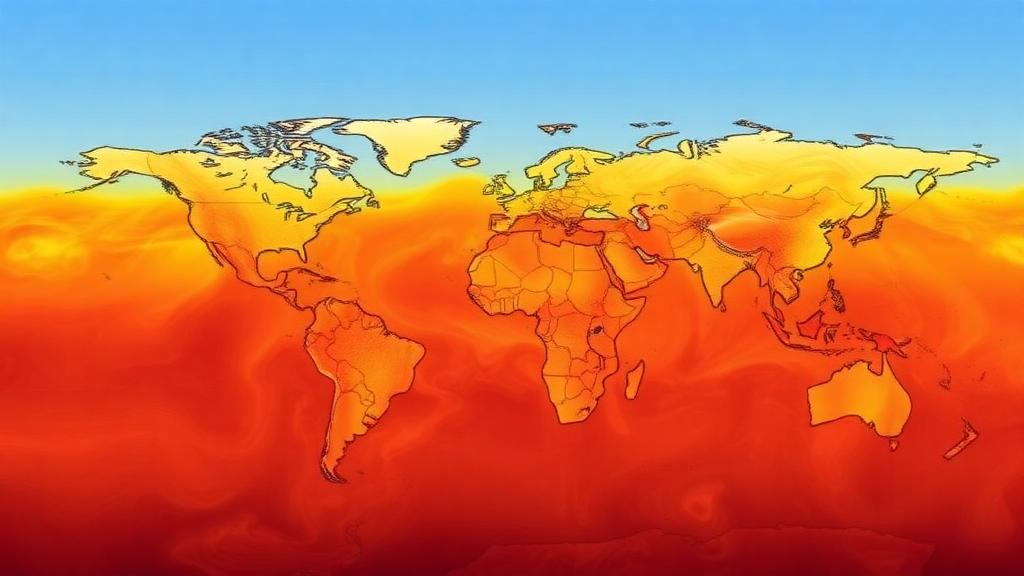
Roughly fifteen million years ago, during a stretch of Earth history known as the Miocene Climatic Optimum, the planet slipped into one of the warmest states of the entire Cenozoic era. Ice sheets shrank, sea levels rose, and subtropical life pushed toward the poles. Yet for all its importance as a natural laboratory for warm-climate dynamics, the true magnitude of that ancient warmth has remained stubbornly uncertain. A new study published in Nature Communications by Feng Zhu of the NSF National Center for Atmospheric Research and colleagues argues that the Miocene world was considerably hotter than most previous estimates have suggested, with a global mean surface temperature approximately 7.5 degrees Celsius above preindustrial levels.
The finding matters far beyond paleoclimate circles. The Miocene Climatic Optimum, abbreviated MCO and centered around fifteen million years ago, is one of the best available analogues for understanding how Earth’s climate system behaves when greenhouse gas concentrations and temperatures sit well above those of the modern era. If the MCO was warmer than previously believed, then the climate system’s long-term sensitivity to carbon dioxide, a quantity known as Earth system sensitivity, is likely higher than reconstructions based on the same interval have implied. That has direct consequences for how scientists project the planet’s response to ongoing fossil fuel emissions.
The central obstacle has long been the gap between what deep-sea sediments record and what climate models predict. The workhorse of deep-time temperature reconstruction is the oxygen isotope ratio, denoted δ18O, measured in the calcium carbonate shells of benthic foraminifera, single-celled organisms that live on or within seafloor sediments. Because foraminifera incorporate oxygen isotopes from seawater into their shells in a temperature-dependent way, the ratio preserved in fossil shells encodes information about the temperature of the deep ocean where the organisms lived. But the signal is confounded: the isotopic composition of seawater itself changes with global ice volume and with the hydrological cycle, so a single δ18O measurement cannot cleanly separate temperature from water-mass chemistry.
Earlier benthic δ18O-based reconstructions of the MCO typically handled this ambiguity with simplified assumptions, often subtracting an ice-volume correction from the isotope record and converting the remainder into temperature using linear calibrations. Those approaches suggested a Miocene world that was warm but, by some estimates, only modestly hotter than preindustrial conditions at the global mean. Surface proxy records, however, including those based on organic molecules and other temperature-sensitive indicators, frequently painted a picture of much greater warmth, particularly at high latitudes. The tension between deep-ocean and surface estimates has been one of the persistent puzzles of Miocene science.
Zhu and his coauthors, drawn from the NSF National Center for Atmospheric Research, Brown University, the University of Arizona, George Mason University, and the University of Southampton, attacked the problem by refusing to treat models and data as separate enterprises. Instead, they built a probabilistic inference framework that fuses the two. On the modeling side, they ran long simulations of the Community Earth System Model, or CESM, configured for Miocene boundary conditions and, crucially, run long enough for the deep ocean to reach full equilibrium with the imposed forcing. Deep-ocean equilibration is a technical but decisive requirement: the abyssal ocean adjusts to climate change on timescales of many thousands of years, and simulations that stop short of equilibrium can misstate deep-ocean temperatures by large margins, corrupting any subsequent comparison with benthic records.
The second modeling innovation was water isotope capability. The CESM simulations tracked the full cycle of oxygen isotopes through evaporation, atmospheric transport, precipitation, and ocean mixing, allowing the researchers to predict not just temperature fields but the isotopic composition of seawater at every location and depth. This matters because the δ18O of a benthic foraminiferal shell reflects both the temperature of the surrounding water and the δ18O of that water. By simulating both quantities explicitly, the model can generate synthetic benthic isotope values that can be compared, like for like, against the real sedimentary measurements, without relying on the simplifying assumptions that plagued earlier conversions.
On the data side, the team assembled a global compilation of benthic foraminiferal δ18O spanning the Miocene Climatic Optimum, drawing on deep-sea sediment cores from multiple ocean basins. The probabilistic framework then asked a deceptively simple question: given the ensemble of model simulations and their uncertainties, which combination of global mean surface temperature and other climate parameters is most likely to have produced the observed pattern of benthic isotope values across the globe? Because different climate states produce distinct spatial fingerprints in both deep-ocean temperature and seawater isotopes, the global pattern of measurements carries far more information than any single core, and the statistical framework exploits that structure to narrow the range of plausible climates.
The answer that emerged was striking. The maximum likelihood estimate placed MCO global mean surface temperature 7.5 degrees Celsius above preindustrial, a value significantly warmer than previous benthic δ18O-based reconstructions had delivered. The corresponding surface temperature field, the full geographic map of Miocene warmth implied by that best-fit climate state, ranked among the best agreements with independent surface temperature proxies, the very records that had previously seemed at odds with the deep-sea data. In other words, the framework did not merely split the difference between conflicting datasets; it found a climate state consistent with both, resolving the apparent contradiction by showing that earlier deep-ocean temperature estimates had been biased cold.
The implications ripple outward in two directions. First, a warmer MCO implies a higher MCO-derived estimate of Earth system sensitivity, the total warming the planet eventually delivers in response to a given change in radiative forcing once ice sheets, vegetation, and other slow feedbacks have fully adjusted. Earth system sensitivity inferred from warm paleoclimate intervals is one of the key benchmarks used to evaluate the long-term tail of future warming projections, and a higher Miocene value suggests that slow feedbacks may amplify greenhouse warming more strongly than some estimates allow. Second, the study demonstrates a methodological template. The authors emphasize that deep-ocean equilibration and proxy-model integration are both essential for accurately estimating deep-ocean and surface temperatures, and they present their inference framework as an approach applicable to improving global climate reconstructions across other time intervals, from older greenhouse episodes to the more recent glacial cycles.
The research also reflects the growing maturity of isotope-enabled climate modeling as a bridge between the geologic record and the physics of the climate system. Computing support came from the Derecho system at the NSF National Center for Atmospheric Research, and the work was funded by the U.S. National Science Foundation and the Heising-Simons Foundation, with additional support to coauthor David Evans from the Royal Society. As climate scientists confront a future that is pushing the Earth system toward states not seen in millions of years, studies like this one sharpen the only real experiments the planet has ever run on itself. Fifteen million years ago, the deep ocean was recording the signature of a world far hotter than the sediments had seemed to admit. Reading that signature correctly, with models and data speaking the same isotopic language, suggests the Miocene Climatic Optimum was warmer than we thought, and that the climate system’s memory of high carbon dioxide runs deeper than previous reconstructions allowed.
Subject of Research: Reconstructing the global warmth of the Miocene Climatic Optimum by integrating isotope-enabled climate model simulations with benthic foraminiferal oxygen isotope records
Article Title: Model-data synthesis of benthic isotopes suggests a warmer Miocene Climatic Optimum
Article References: Zhu, F., Zhu, J., Si, W., Nirenberg, J. E., Herbert, T., Tierney, J. E., Acosta, R. P., Burls, N. J., & Evans, D. (2026). Model-data synthesis of benthic isotopes suggests a warmer Miocene Climatic Optimum. Nature Communications. https://doi.org/10.1038/s41467-026-77980-5
Image Credits: AI Generated
DOI: 10.1038/s41467-026-77980-5
Keywords: Miocene Climatic Optimum, paleoclimate, benthic foraminifera, oxygen isotopes, Earth system sensitivity, climate modeling, CESM, deep-ocean equilibration, proxy-model integration, Nature Communications, global mean surface temperature, paleoceanography
Cite Scienmag News
Violet Maxwell. (October 10, 2026). Deep-Sea Isotopes and Climate Models Reveal a Surprisingly Hot Miocene Warm Period. Scienmag. https://scienmag.com/deep-sea-isotopes-and-climate-models-reveal-a-surprisingly-hot-miocene-warm-period/
Violet Maxwell. "Deep-Sea Isotopes and Climate Models Reveal a Surprisingly Hot Miocene Warm Period." Scienmag, 10 October 2026, https://scienmag.com/deep-sea-isotopes-and-climate-models-reveal-a-surprisingly-hot-miocene-warm-period/. Accessed 10 October 2026.
Violet Maxwell. "Deep-Sea Isotopes and Climate Models Reveal a Surprisingly Hot Miocene Warm Period." Scienmag. October 10, 2026. https://scienmag.com/deep-sea-isotopes-and-climate-models-reveal-a-surprisingly-hot-miocene-warm-period/


