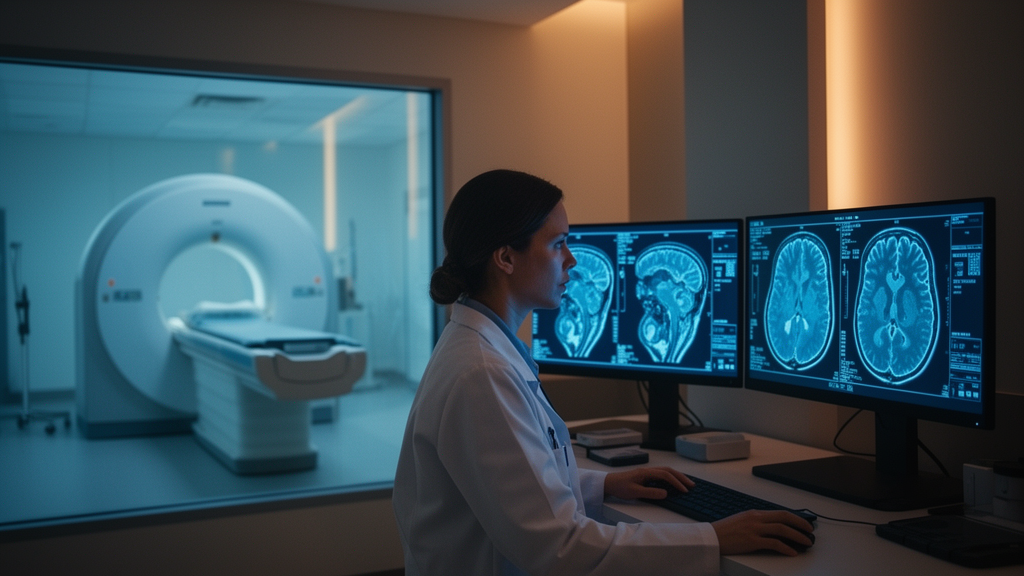
A deep learning model can dramatically improve the quality of PET/MR images acquired at a tiny fraction of the standard radiation dose, according to a technical feasibility study in Alzheimer’s disease published in EJNMMI Physics. The retrospective study developed a Dual-Branch Dense Wavelet Attention Network, or DDWAN, to enhance simulated ultra-low-dose multi-tracer PET imaging covering amyloid-beta, tau and FDG tracers, with full-dose images acquired under the same protocol serving as the reference standard.
The researchers trained the network to generate high-quality images from simulated ultra-low-dose PET data ranging from 1/100 to 1/5 of the standard dose, using co-registered T1-weighted MRI as anatomical guidance. Image quality was quantified with Peak Signal-to-Noise Ratio and the Structural Similarity Index Measure, while quantitative agreement was assessed by comparing Standardized Uptake Value Ratios and Centiloid values between the enhanced low-dose images and the standard-dose references. Nuclear medicine physicians also scored the images on a five-point Likert scale, and diagnostic performance was evaluated against standard-dose visual interpretation.
The results showed substantial gains across all three tracers and every dose level tested. The improvements were most striking at the lowest dose: PSNR rose by 7.11 dB for amyloid imaging, 11.75 dB for tau imaging and 4.82 dB for FDG, with all comparisons reaching statistical significance after Bonferroni correction. Quantitative agreement was equally strong, with minimal bias in SUVR and Centiloid values between the enhanced low-dose images and their standard-dose counterparts.
Qualitative assessment mirrored the quantitative findings. Physicians rated the DDWAN-enhanced images significantly better than the original low-dose images and comparable to the standard-dose references, with the majority of images at one-twentieth of the standard dose judged diagnostically acceptable, scoring at least three on the five-point scale. Diagnostic agreement remained high across all tracers, with sensitivity and specificity exceeding 90 percent even at the 1/100 dose level for the tau tracer 18F-APN-1607 and for FDG.
The authors conclude that DDWAN improved both image quality and quantitative consistency of the simulated ultra-low-dose multi-tracer PET/MR images compared with full-dose references acquired under the same protocol. They emphasize that these findings support technical feasibility only, and that further validation using standard tracer-specific acquisition windows is required before any clinical application. As an early-access, peer-reviewed accepted article, the study is citable with a permanent DOI, though the final version of record is still subject to further edits.
Subject of Research: Deep learning enhancement of ultra-low-dose multi-tracer PET/MR imaging in Alzheimer's disease
Article Title: Deep learning-based enhancement of ultra-low-dose multi-tracer PET/MR: a technical feasibility study in Alzheimer’s disease
Article References: Qi, N., Pan, B., Yuan, Z., Chen, X., Zhou, Z., Chen, X., Xu, L., Wang, Z., Ding, J., Gong, N.-J., & Zhao, J. (2026). Deep learning-based enhancement of ultra-low-dose multi-tracer PET/MR: a technical feasibility study in Alzheimer’s disease. EJNMMI Physics. https://doi.org/10.1186/s40658-026-00954-5
Image Credits: AI Generated
DOI: 10.1186/s40658-026-00954-5
Keywords: deep learning, PET/MR, ultra-low-dose PET, Alzheimer's disease, amyloid PET, tau PET, FDG PET, image enhancement, Centiloid, SUVR, technical feasibility, EJNMMI Physics
Cite Scienmag News
Diana Fleming. (October 28, 2026). Deep learning sharpens ultra-low-dose PET/MR scans in Alzheimer’s disease feasibility study. Scienmag. https://scienmag.com/deep-learning-sharpens-ultra-low-dose-pet-mr-scans-in-alzheimers-disease-feasibility-study/
Diana Fleming. "Deep learning sharpens ultra-low-dose PET/MR scans in Alzheimer’s disease feasibility study." Scienmag, 28 October 2026, https://scienmag.com/deep-learning-sharpens-ultra-low-dose-pet-mr-scans-in-alzheimers-disease-feasibility-study/. Accessed 28 October 2026.
Diana Fleming. "Deep learning sharpens ultra-low-dose PET/MR scans in Alzheimer’s disease feasibility study." Scienmag. October 28, 2026. https://scienmag.com/deep-learning-sharpens-ultra-low-dose-pet-mr-scans-in-alzheimers-disease-feasibility-study/