


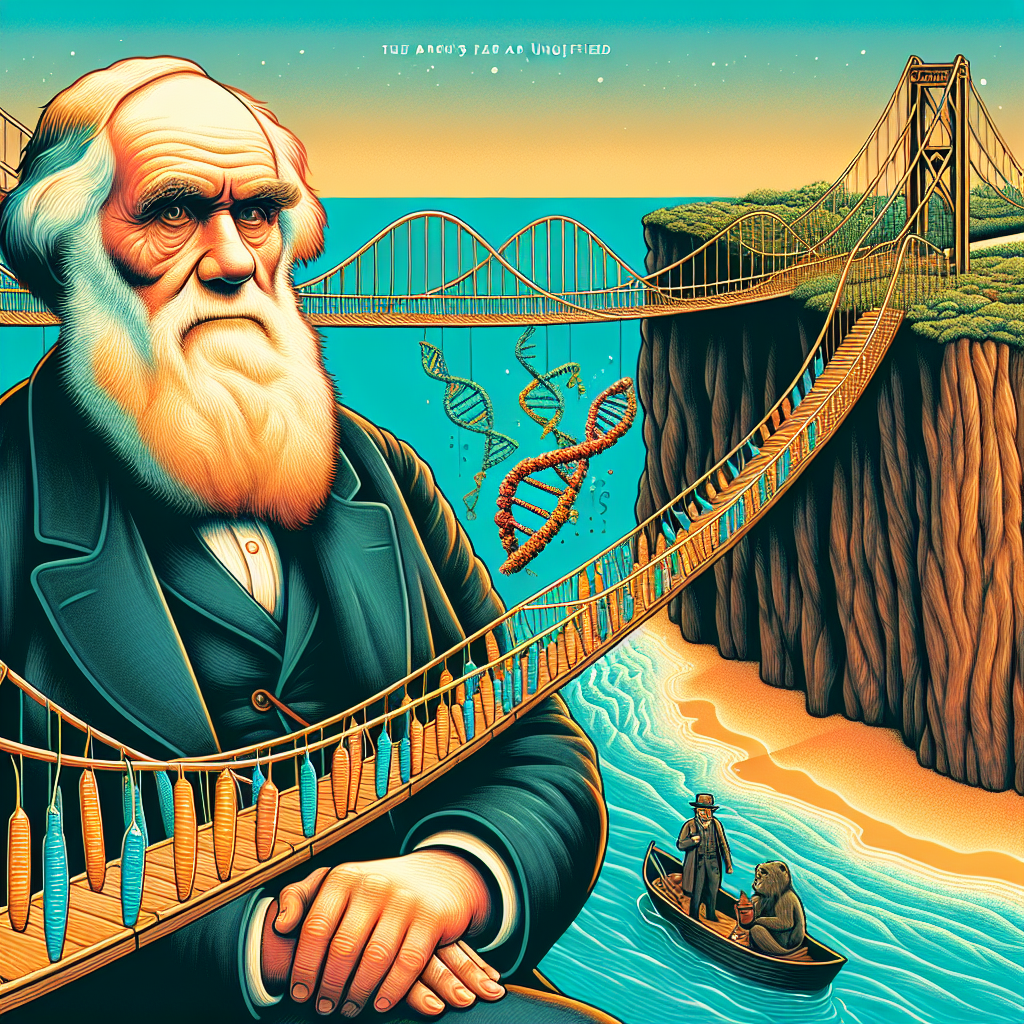
Fossils are used to reconstruct evolutionary history, but not all animals and plants become fossils and many fossils are destroyed before we can find them (e.g., the rocks that contain the fossils are destroyed by erosion). As a result, the fossil record has gaps and is incomplete, and we’re missing data that we need to reconstruct evolutionary history. Now, a team of sedimentologists and stratigraphers from the Netherlands and the UK examined how this incompleteness influences the reconstruction of evolutionary history. To their surprise, they found that the incompleteness itself is actually not such a big issue. “It’s as if you are missing half of a movie. If you are missing the second half, you can’t understand the story, but if you are missing every second frame, you can still follow the plot without problems.”
Fossils are used to reconstruct evolutionary history, but not all animals and plants become fossils and many fossils are destroyed before we can find them (e.g., the rocks that contain the fossils are destroyed by erosion). As a result, the fossil record has gaps and is incomplete, and we’re missing data that we need to reconstruct evolutionary history. Now, a team of sedimentologists and stratigraphers from the Netherlands and the UK examined how this incompleteness influences the reconstruction of evolutionary history. To their surprise, they found that the incompleteness itself is actually not such a big issue. “It’s as if you are missing half of a movie. If you are missing the second half, you can’t understand the story, but if you are missing every second frame, you can still follow the plot without problems.”
“The regularity of the gaps, rather than the incompleteness itself, is what determines the reconstruction of evolutionary history,” explains Niklas Hohmann of Utrecht University’s Faculty of Geosciences, who led the study. “If a lot of data is missing, but the gaps are regular, we could still reconstruct evolutionary history without major problems, but if the gaps get too long and irregular, results are strongly biased.”
Darwin
Since Charles Darwin published his theory of evolution, the incompleteness of the fossil record has been considered problematic for reconstructing evolutionary history from fossils. Darwin feared that the gradual change that his theory predicted would not be recognizable in the fossil record due to all the gaps. “Our results show that this fear is unjustified. We have a good understanding of where the gaps are, how long they are and what causes them. With this geological knowledge, we can reconstruct evolution hundreds of millions of years ago at an unprecedented temporal resolution,” says Niklas Hohmann.
Simulations
Computer simulations of geological processes at timescales longer than any historical records can be used to examine the effects of the incompleteness. To that end, Hohmann and his team combined simulations of different modes of evolution with depositions of carbonate strata to examine how well the mode of evolution can be recovered from fossil time series, and how test results vary between different positions in the carbonate platform and multiple stratigraphic architectures generated by different sea level curves. “If Darwin could read the article, he would certainly be relieved: his theory has proven robust to the vagaries of the rock record. Deep-time fossil data – however incomplete – supports our understanding of the mode and tempo of evolution.”
Article
Hohmann, Niklas; Koelewijn, Joël R.; Burgess, Peter; Jarochowska, Emilia, ‘Identification of the mode of evolution in incomplete carbonate successions’, BMC Ecology and Evolution 24, 113 (2024),
Journal
BMC Ecology and Evolution
Method of Research
Computational simulation/modeling
Subject of Research
Not applicable
Article Title
Identification of the mode of evolution in incomplete carbonate successions
Article Publication Date
23-Aug-2024
COI Statement
No COI applies
Cite Scienmag News
Gavin Prescott. (August 26, 2024). Darwin’s fear was unjustified: Writing evolutionary history by bridging the gaps. Scienmag. https://scienmag.com/darwins-fear-was-unjustified-writing-evolutionary-history-by-bridging-the-gaps/
Gavin Prescott. "Darwin’s fear was unjustified: Writing evolutionary history by bridging the gaps." Scienmag, 26 August 2024, https://scienmag.com/darwins-fear-was-unjustified-writing-evolutionary-history-by-bridging-the-gaps/. Accessed 3 September 2026.
Gavin Prescott. "Darwin’s fear was unjustified: Writing evolutionary history by bridging the gaps." Scienmag. August 26, 2024. https://scienmag.com/darwins-fear-was-unjustified-writing-evolutionary-history-by-bridging-the-gaps/


