


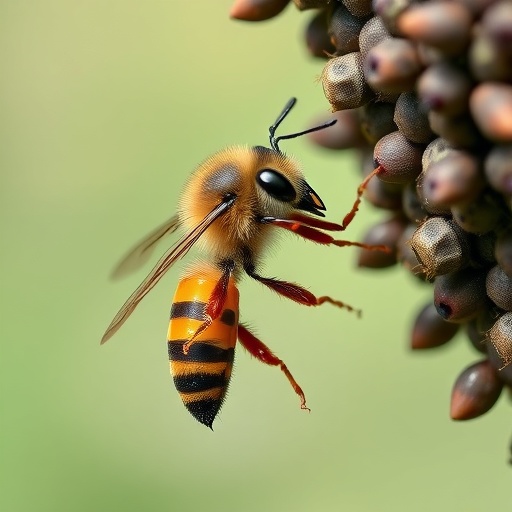
In the quiet meadows of the Sierra Nevada, a remarkable story of survival and intellect unfolds each spring, centered around the solitary lives of queen bumblebees. Unlike their social worker counterparts who thrive within bustling colonies, these queens face the daunting challenge of starting new colonies entirely on their own. With no team to assist, the queen’s success hinges on her ability to forage effectively, build intricate wax chambers, and nurture her first generation of workers. Recent research emerging from the University of California, Davis, reveals that these queens possess a cognitive edge: they are remarkably swift learners, particularly in assimilating floral scents, an ability that may underpin their solitary success and the survival of their species.
The bumblebee queen’s journey begins in the late Fall when new queens emerge, venturing out to mate and find a solitary hibernation spot, often beneath the snow’s cold blanket. Unlike honeybee colonies, which persist year-round with complex social structures, bumblebee colonies exist only for a single season. This seasonal life cycle makes each queen’s survival essential: she is the sole lineage bearer, tasked with founding a new colony come spring. When winter retreats, these queens embark on extensive flights, tirelessly sourcing nectar and pollen to nourish their developing brood. The solitary nature of this period mandates exceptional learning and memory skills to optimize foraging strategies and adapt to shifting environmental cues.
Dr. Melanie Kimball, a postdoctoral researcher in neurobiology at UC Davis, emphasizes the stakes involved: “If the queen fails in her solitary efforts, the entire colony fails.” This high-risk phase, lacking the division of labor seen in mature colonies, requires queens to master complex tasks ranging from nest construction to brood warming via specialized buzz vibrations. Collaborating with Felicity Muth, assistant professor at the same institution, Kimball has delved into the neurological underpinnings of this solitary phase, discovering that queen bumblebees outperform workers in olfactory learning tasks. Their experiments indicate that queen bees not only learn to associate specific scents with rewards faster but also detect these odor cues at lower concentrations, hinting at heightened sensory sensitivity.
This enhanced olfactory acuity and learning speed were demonstrated through carefully controlled experiments involving both field-caught and captive bumblebees. Previous work led by Muth showed queens outperform workers in visual learning tests using color-reward associations, yet lingering questions about other sensory modalities remained. Kimball extended these findings by focusing on scent-based learning, a critical skill in nature where flower selection depends heavily on olfactory cues. The queen’s ability to rapidly learn and discriminate these scents could translate into more efficient foraging, pivotal in the early colony-building phase when energy intake must balance high expenditure.
The implications of this research extend well beyond understanding bumblebee behavior. Bumblebees are vital pollinators for numerous crops and native plants, especially those requiring “buzz pollination.” Plants such as tomatoes, potatoes, and blueberries depend on the vigorous vibrations produced exclusively by large pollinators like bumblebees to release pollen effectively. Unfortunately, bumblebee populations face escalating threats from habitat loss, pesticide use, and competition with introduced species like honeybees. By unraveling the cognitive tools queens use to survive and propagate their species, scientists hope to inform conservation strategies that safeguard these crucial ecological players.
The cognitive comparisons drawn between queens and workers also provide a unique window into how natural selection shapes brain function in relation to ecological demands. Queens operate in a context where failure is catastrophic, likely driving selection for rapid learning and heightened sensory sensitivity. Workers, benefiting from social support structures and division of labor, might not require such acute learning capabilities. Investigating these intraspecies differences could pinpoint neural adaptations and biochemical pathways responsible for cognitive variation, offering broader insights into the evolution of intelligence across taxa.
Moreover, this research dovetails with a growing scientific discourse on the origins of cognition throughout the animal kingdom. The presence of sophisticated learning behaviors in insects, distant relatives of humans on the evolutionary tree with vastly different neural architectures, challenges assumptions about the uniqueness of intelligent processes. By studying bumblebee queens and their enhanced olfactory learning, the research contributes to understanding how diverse species employ convergent mechanisms to solve similar survival challenges, shedding light on the fundamental nature of learning, memory, and decision-making.
Beyond its scientific significance, the study carries a poignant conservation message. North America’s native bumblebees have adapted over millennia to regional ecosystems, forming tightly knit relationships with native flora. Their decline threatens to disrupt these ecosystems and agricultural productivity. The research team notes that pesticides not only reduce bee populations but can impair bees’ learning capabilities, compounding the threats. Understanding and mitigating these effects are vital for maintaining pollinator health and, by extension, global food security.
The fascinating life-history of bumblebee queens—regaining their sensory and cognitive edge after surviving winter in solitude—reminds us of nature’s intricate balances. Their ability to quickly adapt to a seasonal, solitary life-stage before transitioning to a social one illustrates an extraordinary example of ecological and neurological specialization. This dual lifestyle offers researchers a unique natural experiment in how brain function can be flexibly tailored to specific environmental pressures and life-history stages.
Supported by grants from the National Geographic Society and the Templeton World Charity Foundation, this work underscores the importance of interdisciplinary approaches integrating behavior, ecology, neurobiology, and conservation science. The Wildlife Intelligence Project, under which this research is conducted, aims to unravel the cognitive landscapes of wild animals, highlighting how intelligence shapes survival in natural environments. The findings published in the Proceedings of the Royal Society B Biological Sciences on May 13, 2026, mark a significant advance in both pollinator biology and the broader field of animal cognition.
As bumblebee queens demonstrate sharper olfactory learning than workers, these findings invite further exploration into how sensory systems evolve under varying ecological demands. The study opens avenues for research into neural plasticity, sensory processing, and the molecular bases of learning. Such insights are critical not only for biology but for conservation efforts seeking to bolster pollinator populations amidst environmental challenges. Ultimately, these small yet remarkable insects provide a striking example of intelligence and resilience, vital to ecosystems and agriculture alike, deserving increased attention and protection.
Cite Scienmag News
Gavin Prescott. (May 15, 2026). Single mother must adapt swiftly — the survival of her colony depends on it. Scienmag. https://scienmag.com/single-mother-must-adapt-swiftly-the-survival-of-her-colony-depends-on-it/
Gavin Prescott. "Single mother must adapt swiftly — the survival of her colony depends on it." Scienmag, 15 May 2026, https://scienmag.com/single-mother-must-adapt-swiftly-the-survival-of-her-colony-depends-on-it/. Accessed 4 September 2026.
Gavin Prescott. "Single mother must adapt swiftly — the survival of her colony depends on it." Scienmag. May 15, 2026. https://scienmag.com/single-mother-must-adapt-swiftly-the-survival-of-her-colony-depends-on-it/


