


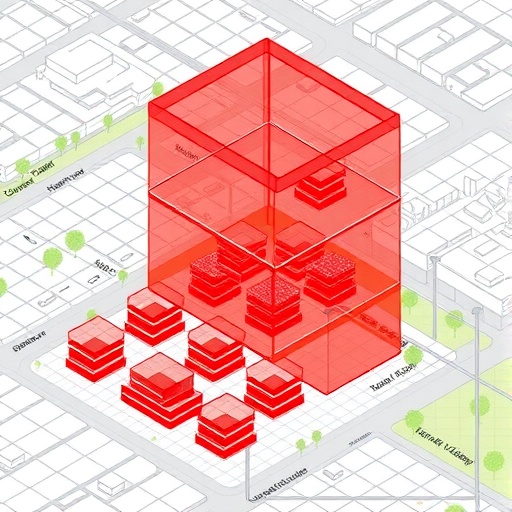
In an era defined by an insatiable demand for data processing and storage, the placement of data centers has emerged as a critical strategic and technical challenge. The forthcoming study by Kim, Dong, and Xie, published in Nature Communications in 2026, introduces a revolutionary approach titled the “flexibility-aware framework for efficient planner-initiated siting of data centers,” promising to reshape how infrastructure planners assess and decide on data center locations. This paradigm shifts away from traditional rigidity in site selection towards a dynamic, adaptable model that integrates flexibility as a core design element, offering far-reaching implications for energy usage, sustainability, and operational efficiency in the tech industry.
Data centers are the epicenters of the digital economy, housing the servers that store, manage, and disseminate vast quantities of information across the globe. However, these facilities are massive energy consumers and require complex planning related to geographic, environmental, and logistical variables. Typically, data centers have been sited based on fixed criteria such as proximity to power grids, cooling infrastructure, real estate costs, and network latency considerations. Yet, these traditional criteria often lack responsiveness to future uncertainties including energy market volatility, climate change impacts, and technological evolution. The flexibility-aware framework addresses this lacuna by embedding adaptability into the initial planning stages.
At its core, the framework developed by Kim and colleagues integrates advanced mathematical modeling and real-time data analytics to create a dynamic decision-making environment. This environment allows planners to simulate and evaluate multiple scenarios accounting for unpredictable variables like fluctuating renewable energy availability, evolving computing demands, and regulatory changes. By incorporating a flexibility metric into the site selection process, the framework facilitates choices that are not only optimal under current conditions but are also robust against a spectrum of future changes.
One of the pivotal technical innovations underlying this framework is its utilization of stochastic optimization algorithms. Unlike deterministic models that operate under fixed parameters, stochastic models embrace randomness and uncertainty, enabling the incorporation of probabilistic distributions for key factors impacting data center performance. This allows planners to minimize risk exposure and potential cost overruns that stem from unanticipated shifts in energy prices or climatic conditions. The authors designed these algorithms to be compatible with large-scale datasets and to run efficiently on modern high-performance computing platforms, ensuring practical applicability in real-world planning operations.
To validate their approach, the researchers conducted comprehensive case studies using data from various geographic regions characterized by diverse energy profiles and climatic conditions. These case studies demonstrated that flexibility-aware siting could reduce projected operational costs by an average of 15-20% over a 10-year horizon when compared with conventional siting strategies. Furthermore, the ability to pivot in response to renewable energy availability fluctuations resulted in measurable reductions in carbon emissions, underscoring the environmental benefits of the framework.
The study goes beyond cost-efficiency and environmental metrics to consider the evolving landscape of regulatory policies and energy markets. As decentralized energy resources and smart grids become more prevalent, the demand-side flexibility of data centers is increasingly recognized as a valuable asset. The framework incorporates models of demand response potential, allowing the data center to act as a flexible load within the broader energy system. This integration aligns data center operations with grid stability objectives and can potentially unlock new revenue streams through participation in ancillary service markets.
Another compelling dimension of the research is its foresight into emerging technologies such as liquid cooling, energy storage, and edge computing, all of which influence optimal siting criteria. Liquid cooling, for example, substantially reduces energy consumption compared to traditional air-cooling methods but requires access to specific water resources and imposes environmental constraints. Similarly, embedding onsite energy storage solutions demands consideration of space, safety, and maintenance factors. The flexibility framework incorporates these elements, enabling planners to evaluate trade-offs holistically.
The framework also acknowledges the critical importance of connectivity and latency, particularly as data center applications expand to include latency-sensitive services like autonomous vehicles, augmented reality, and real-time AI inference. By integrating network topology and traffic flow data into its decision matrix, the system ensures that chosen sites are not only flexible and energy-efficient but also capable of meeting stringent performance requirements for emerging digital applications.
Implementation pathways suggested by the authors emphasize the importance of collaboration among utility providers, urban planners, technology vendors, and policy makers. Such multidisciplinary coordination is essential to leverage the full capabilities of the framework. The study also advocates for the integration of the framework into existing planning tools and workflows, facilitating adoption without disrupting current industry practices.
This novel approach aligns closely with global sustainability goals, particularly as data centers worldwide are projected to consume an expanding share of electricity. By embedding flexibility into the foundational stages of infrastructure development, the framework contributes directly to the reduction of both economic and environmental risks. It empowers stakeholders to future-proof their investments, promote greater grid resilience, and enhance the overall sustainability profile of digital infrastructure.
In addition to its immediate practical applications, the framework opens new avenues for academic research. It invites further exploration into the intersection of operational flexibility, infrastructure planning, and sustainability science. The methodological innovations introduced by Kim et al. provide a template that can be adapted to other sectors where site selection under uncertainty is a critical concern, such as renewable energy generation, transportation hubs, and urban logistics.
One of the groundbreaking insights from this study is the recognition that data centers, often viewed purely as consumers, can increasingly act as active participants in energy ecosystems. The integration of demand response capabilities provides a compelling example of how digital infrastructure can contribute to grid balancing and the smooth integration of intermittent renewable sources. This shift in perspective marks a step toward smarter, more interactive energy systems.
The authors also critically examine potential limitations and challenges in deploying their framework. Data quality and availability remain significant hurdles, as accurate modeling demands comprehensive and up-to-date datasets spanning climate, energy prices, grid stability metrics, and technology cost trajectories. The paper underscores the need for improved data-sharing protocols and the possible roles of government and industry consortia in standardizing data inputs.
Moreover, the computational complexity of stochastic optimization at scale presents operational challenges. While the study demonstrates efficient algorithmic designs, real-world implementations will require continuous enhancements in computational infrastructure and algorithmic efficiency. The researchers suggest ongoing advancements in AI and machine learning as promising solutions to enhance predictive capabilities and help manage complexity.
Looking ahead, the study projects that this flexibility-aware siting framework will gain increasing relevance as data center proliferation expands beyond traditional concentration zones. Emerging markets and regions with nascent digital infrastructure stand to benefit enormously from adopting flexible planning methodologies early, enabling leapfrogging of conventional constraints and ultimately fostering sustainable digital growth worldwide.
In conclusion, the flexibility-aware framework presented by Kim, Dong, and Xie represents a landmark advancement in the strategic planning of data center infrastructure. By embedding flexibility into the core of siting decisions, it transcends the limitations of static models, offering a resilient, efficient, and sustainable pathway for accommodating the relentless growth of digital services. As organizations and societies grapple with the twin imperatives of digital transformation and environmental stewardship, this framework provides a crucial tool to navigate the complexities and uncertainties of the decades ahead.
Cite Scienmag News
Denise Maddox. (May 16, 2026). Flexible Framework Optimizes Data Center Site Planning. Scienmag. https://scienmag.com/flexible-framework-optimizes-data-center-site-planning/
Denise Maddox. "Flexible Framework Optimizes Data Center Site Planning." Scienmag, 16 May 2026, https://scienmag.com/flexible-framework-optimizes-data-center-site-planning/. Accessed 3 September 2026.
Denise Maddox. "Flexible Framework Optimizes Data Center Site Planning." Scienmag. May 16, 2026. https://scienmag.com/flexible-framework-optimizes-data-center-site-planning/


