


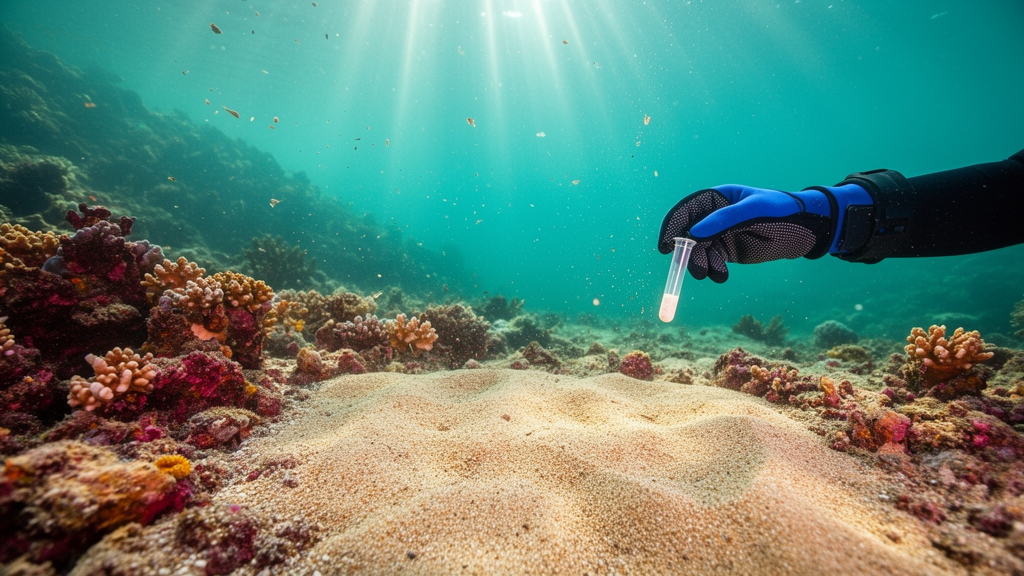
Beneath the postcard image of a coral reef lies a vast, largely invisible engine: the sediment. Sand and silt lagoons surrounding patch reefs teem with bacteria that drive nitrogen cycling, decompose organic matter, and set the chemical stage on which corals and their algae either flourish or collapse. A new study published in the journal Microbial Ecology has now mapped, with unusual precision, how these sediment bacterial communities are arranged across a real reef seascape, and the answer challenges a common assumption in reef microbiology. It is not the fine-grained local conditions around each individual patch reef that dominate the picture, but the broader geography of the lagoon itself.
The research, led by Stephanie G. Gardner of the University of Sydney together with Matthew R. Nitschke of the Australian Institute of Marine Science, Raphael F. Burkart-Radtke, the late Emma L. Johnston, and Graeme F. Clark, was conducted at One Tree Island, a research station perched on the southern Great Barrier Reef. The team worked under permit from the Great Barrier Reef Marine Park Authority and acknowledged the Bailai, Gurang, Gooreng Gooreng and Taribelang Bunda Peoples as Traditional Custodians of the Sea Country where the fieldwork took place. Their study, published open access on 9 October 2026, is titled Scale-Dependent Structuring of Sediment Bacterial Communities on Coral Reefs.
The methodological core of the study was 16S rRNA gene metabarcoding, a technique that reads short, diagnostic regions of the bacterial genome to inventory which taxa are present in an environmental sample. Rather than sampling a single reef in isolation, the researchers designed a deliberately multi-scale survey. They characterised sediment bacterial communities across 21 sites spanning the lagoonal habitats surrounding coral patch reefs, capturing variation at the scale of the whole lagoon. At 13 of those sites, they then zoomed in, comparing sediments from different microhabitats within each site to test whether local conditions, such as the immediate neighbourhood of a patch reef, left a detectable signature on the bacterial assemblages.
The environmental variables the team measured were chosen to represent the plausible drivers of microbial distribution. Sediment granulometry, the size distribution of sand and silt particles, shapes pore space, water flow and oxygen penetration, all of which matter to bacteria. Nutrient composition reflects the food available to microbial communities and often varies with proximity to bird colonies, algal patches or water circulation patterns. Distance from the island itself served as a proxy for spatial structure, capturing gradients in water residence time, terrigenous influence and lagoonal circulation that operate at scales far larger than any single patch reef.
The headline finding is stark: sediment bacterial communities were strongly structured by spatial context, and site-level variation exceeded microhabitat effects. In other words, two samples taken hundreds of metres apart in different parts of the lagoon differed more from each other than samples taken centimetres apart in different microhabitats within the same site. The researchers found that environmental gradients, particularly nutrient availability and distance-related spatial structure, contributed meaningfully to the composition of sediment bacterial communities. Microhabitat differences were present, but they were comparatively weak and inconsistent, appearing at some sites and not others rather than forming a reliable, repeatable pattern.
One of the more intriguing results concerns diversity. Overall alpha diversity, the number and evenness of bacterial taxa within individual samples, remained stable across reef zones. The lagoon did not contain microbial hotspots of exceptional local richness. Instead, the compositional differences between sites were driven by shifts in the relative abundance of specific taxa. The same broad cast of bacterial characters was present throughout the lagoon, but their proportions changed from place to place, like a symphony in which the same instruments play different melodies depending on the movement. This pattern suggests that environmental filtering, rather than the presence or absence of species, is the dominant force sculpting these communities.
The study also delivered a clear verdict on the contrast between benthic and pelagic microbial life. Sediment communities were more diverse than the adjacent seawater and contained a substantially higher proportion of habitat-exclusive taxa, species found in the sediment and nowhere else in the sampled system. This points to strong environmental filtering between the sea floor and the water column. The sediment is not simply a passive sink for whatever drifts down from above; it hosts a distinct, self-organised microbial ecosystem with its own specialists, shaped by the physical and chemical realities of life between sand grains.
Why does this matter beyond the lagoon at One Tree Island? Sediment-associated microbiomes play key roles in coral reef biogeochemistry, including the cycling of nitrogen and carbon that ultimately feeds or starves the reef’s larger inhabitants. Yet, as the authors note, the drivers of spatial variability in these tropical sediment communities have remained poorly understood. Many reef microbiome studies rely on limited spatial replication, sampling one or a few sites and extrapolating to the whole reef. The new findings demonstrate that coral reef sediment microbiomes are highly structured across lagoonal scales, which means that under-sampled studies risk mistaking local noise for the true signal, or missing the broader gradients that actually organise the system.
The practical implication for future research is a call for spatially explicit designs. If nutrient availability and distance-related spatial structure are the dominant drivers, then monitoring programmes and experiments need to replicate across the seascape, not just within a single site. This becomes especially urgent as reefs face warming waters, changing nutrient loads and increasing sedimentation from coastal development. The authors frame their results as a valuable baseline for understanding how bacterial community composition may respond to future environmental change. Because alpha diversity is stable while composition shifts, the most sensitive early-warning indicators of environmental stress may be changes in the relative abundance of particular taxa rather than any loss of local richness.
The study also carries a human story. The authors dedicated the research to the late Professor Emma L. Johnston AO, who died in December 2025 and was a co-author on the work, a distinguished Australian ecologist whose career spanned estuarine and marine contamination ecology. The fieldwork was supported logistically by the One Tree Island Research Station and funded through the Australian Research Council’s Securing Antarctica’s Environmental Future programme, with open access funding organised by the Council of Australian University Librarians and its member institutions. Published under a Creative Commons Attribution 4.0 licence, the paper invites other researchers to build on its dataset. For a field racing to understand how reef ecosystems will fare under climate change, knowing where the microbial structure lives, in the map of the lagoon rather than in the shadow of each reef, is a compass correction that could redirect years of future sampling.
Subject of Research: Spatial and environmental drivers of sediment bacterial community structure in coral reef lagoons
Article Title: Scale-Dependent Structuring of Sediment Bacterial Communities on Coral Reefs
Article References: Gardner, S. G., Nitschke, M. R., Burkart-Radtke, R. F., Johnston, E. L., & Clark, G. F. (2026). Scale-Dependent Structuring of Sediment Bacterial Communities on Coral Reefs. Microbial Ecology. https://doi.org/10.1007/s00248-026-02908-x
Image Credits: AI Generated
DOI: 10.1007/s00248-026-02908-x
Keywords: coral reefs, sediment microbiome, 16S rRNA metabarcoding, bacterial communities, One Tree Island, Great Barrier Reef, spatial structure, nutrient availability, sediment granulometry, environmental filtering, microbial ecology, patch reefs
Cite Scienmag News
Morgan Morrow. (October 9, 2026). Coral Reef Sediment Bacteria Obey the Map, Not the Microhabitat. Scienmag. https://scienmag.com/coral-reef-sediment-bacteria-obey-the-map-not-the-microhabitat/
Morgan Morrow. "Coral Reef Sediment Bacteria Obey the Map, Not the Microhabitat." Scienmag, 9 October 2026, https://scienmag.com/coral-reef-sediment-bacteria-obey-the-map-not-the-microhabitat/. Accessed 9 October 2026.
Morgan Morrow. "Coral Reef Sediment Bacteria Obey the Map, Not the Microhabitat." Scienmag. October 9, 2026. https://scienmag.com/coral-reef-sediment-bacteria-obey-the-map-not-the-microhabitat/


