


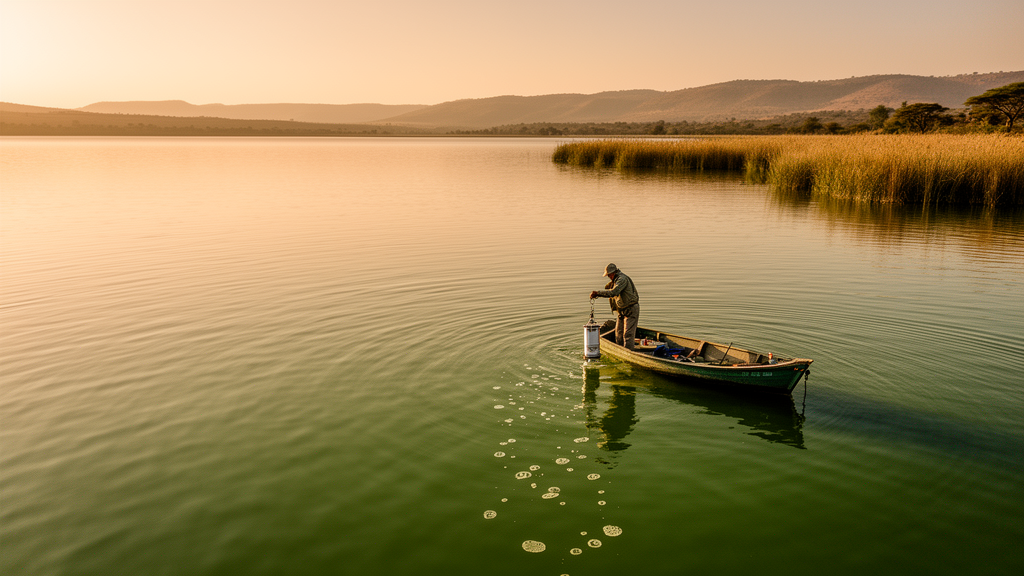
Lakes have long carried a reputation as quiet climate villains. Beneath their surfaces, microbes break down organic matter in oxygen-starved sediments and release methane, a greenhouse gas that traps heat far more effectively than carbon dioxide over short timescales. Yet the full picture of what happens to that methane before it reaches the atmosphere has remained stubbornly incomplete. Now, a large-scale study of 79 African lakes, published in Nature Communications by Alberto V. Borges of the University of Liège, Cédric Morana of KU Leuven and their colleagues, offers one of the most comprehensive assessments to date of the processes that govern methane’s fate in lake surface waters. The findings challenge a growing assumption in limnology and suggest that the microbial communities living in productive lakes may be far better at destroying methane than scientists had appreciated.
The central puzzle the researchers set out to address is often called the methane paradox. Methane is classically produced in the anoxic depths of lakes, where archaea ferment organic material in the absence of oxygen. For decades, the prevailing view held that surface waters, being well oxygenated, should contain little methane and that any methane found there must have simply diffused upward from below. But measurements kept revealing supersaturated methane in oxygen-rich surface layers, implying that methane was somehow being generated in place. One proposed mechanism is oxic methane production, or OMP, in which methane is created as a by-product of microbial metabolism in the light. In particular, some cyanobacteria and other phytoplankton convert methylphosphonate and other methylated compounds into methane during photosynthesis, meaning that algal blooms could, in principle, be manufacturing greenhouse gas right at the lake surface.
If that photosynthesis-driven production were large enough, eutrophication, the over-enrichment of waters with nutrients that fuels algal blooms worldwide, would make lakes progressively worse methane emitters. The new study puts that worry in a broader and more nuanced context. Across the 79 lakes, which span enormous gradients in size, depth, nutrient status and productivity, Borges and colleagues found that the single largest fate of dissolved methane in the sunlit mixed layer is not emission to the atmosphere but microbial methane oxidation, known as MOX. More than 70 percent of the dissolved methane in the mixed layer is consumed by methane-oxidizing bacteria before it can escape, dwarfing the fraction that diffuses across the water surface into the air.
The technical logic behind this conclusion rests on careful budgeting of the mixed layer, the uppermost, wind-stirred portion of the lake where most exchange with the atmosphere occurs. The team compared the rates at which methane entered the mixed layer from deeper anoxic waters and from in situ production against the rates at which it left, either by diffusive emission across the air-water interface or by consumption by methanotrophs. Methane-oxidizing bacteria, or methanotrophs, use methane as their carbon and energy source, converting it first to methanol and ultimately to carbon dioxide and microbial biomass. Because carbon dioxide is a far weaker greenhouse agent per molecule than methane over century-scale horizons, this microbial conversion effectively downgrades the climate impact of the gas. The study’s mass balance shows that this biological filter is the dominant sink, not a marginal correction.
Perhaps the most striking pattern in the data is that methane oxidation rates are highest in the most productive lakes, those teeming with phytoplankton. This seems counterintuitive at first glance, because productive lakes are also the settings where photosynthesis-driven oxic methane production is expected to be strongest. The authors propose a mechanism that reconciles the two observations: methanotrophs appear to attach themselves to phytoplankton cells and colonies. In nutrient-rich waters, algae provide physical surfaces and perhaps exuded organic substrates that methanotrophic bacteria can exploit, allowing dense methanotroph populations to develop in exactly the waters where methane concentrations are elevated. In other words, the very blooms that may generate methane in the light also cultivate the bacteria that devour it, and the consumption side of the ledger grows faster than the production side.
Geography added a second, independent control on oxidation rates. The team found that methane oxidation was also elevated in lakes that drain the vast wetlands of the Congo Basin, a landscape of flooded forests and seasonally inundated plains. The likely explanation is that these lakes receive regular inputs of methanotrophic bacteria exported from the waterlogged forest soils upstream. Flooded soils are hotspots of both methane production and methane consumption, and the microbial communities adapted to living there appear to be carried into the receiving lakes, seeding them with oxidation capacity. This hydrological subsidy means that the microbial composition of a lake’s catchment, not just its internal chemistry, shapes how much methane survives to reach the atmosphere.
To evaluate the importance of photosynthesis-driven oxic methane production, the researchers drew on estimates compiled from the published literature and compared them against their own measurements of methane oxidation and diffusive emissions across the African lake dataset. The result was unambiguous: photosynthesis-driven OMP represents only a small fraction of both MOX and the diffusive methane emission, and that fraction shrinks as lake productivity and emission intensity increase. In other words, in the lakes where algal production is most vigorous and where methane cycling is most intense, the methane made in the light is a minor term in the budget, easily overtaken by the methane destroyed by bacteria. The fraction of OMP relative to the other fluxes is largest only in the least productive, most dilute systems, where all methane fluxes are small in absolute terms.
This scaling has direct implications for how scientists project the climate consequences of eutrophication. Freshwater ecosystems contribute a substantial share of global natural methane emissions, and as agricultural runoff and warming continue to fertilize lakes, many researchers had feared a runaway amplification: more blooms, more photosynthetic methane production, more emissions. The African lake data suggest a built-in brake. Because methane oxidation increases with phytoplankton biomass, the additional oxic methane production supported by eutrophication can be compensated, and apparently more than compensated, by a stronger increase in bacterial consumption. Available evidence, as the authors carefully phrase it, indicates that the net effect of enrichment on surface-water methane may be far less dire than the production-side argument alone would predict.
The study also carries methodological weight for the field. Much of the literature on the methane paradox has rested on a limited number of lakes, often in Europe and North America, frequently shallow and heavily studied systems. By sampling 79 lakes across a continent, including iconic East African water bodies worked on with partners in Uganda, Tanzania and the Democratic Republic of the Congo, the team captured a breadth of trophic and morphological variation that smaller studies cannot. The involvement of researchers from the National Fisheries Resources Research Institute in Jinja, the Tanzania Fisheries Research Institute, Makerere University and the Institut Supérieur Pédagogique de la Gombe reflects the kind of long-term regional collaboration needed to constrain biogeochemical cycles at scales relevant to global budgets. The work was funded by the Belgian Federal Science Policy Office and the Fonds National de la Recherche Scientifique, among other sources.
There remain, of course, important caveats. Methane oxidation rates are difficult to measure directly and depend on community composition, temperature, oxygen and copper availability, factors that vary seasonally and between lakes. The comparison of photosynthesis-driven OMP against field measurements relies on literature-derived estimates rather than uniform in situ measurements across all sites, a limitation the authors acknowledge. Ebullition, the bubbling of methane from sediments that bypasses the mixed layer entirely, is another pathway that can dominate emissions in shallow systems and was not the focus of this surface-layer budget. Nonetheless, the broad conclusion stands on firm ground: across a continental scale of African lakes, methane-oxidizing bacteria, thriving alongside phytoplankton and imported from methane-rich wetlands, consume the majority of the methane in surface waters. For a planet trying to account for every molecule of a potent greenhouse gas, that microbial appetite, and its tendency to grow with lake productivity, is a piece of good news buried in the mud.
Subject of Research: Methane oxidation and oxic methane production in African lake surface waters
Article Title: Methane oxidation in African lakes increases with phytoplankton and outweighs photosynthesis-driven oxic methane production
Article References: Borges, A. V., Morana, C., Deirmendjian, L., Okello, W., Isumbisho, P., Omeja, P., Kimirei, I. A., Descy, J.-P., Champenois, W., & Bouillon, S. (2026). Methane oxidation in African lakes increases with phytoplankton and outweighs photosynthesis-driven oxic methane production. Nature Communications. https://doi.org/10.1038/s41467-026-78255-9
Image Credits: AI Generated
DOI: 10.1038/s41467-026-78255-9
Keywords: methane oxidation, African lakes, phytoplankton, oxic methane production, methanotrophs, greenhouse gas, eutrophication, Congo Basin wetlands, limnology, carbon cycle, Nature Communications, methane paradox
Cite Scienmag News
Violet Maxwell. (October 9, 2026). African Lakes Turn Out to Be Methane Devourers, Not Just Methane Makers. Scienmag. https://scienmag.com/african-lakes-turn-out-to-be-methane-devourers-not-just-methane-makers/
Violet Maxwell. "African Lakes Turn Out to Be Methane Devourers, Not Just Methane Makers." Scienmag, 9 October 2026, https://scienmag.com/african-lakes-turn-out-to-be-methane-devourers-not-just-methane-makers/. Accessed 9 October 2026.
Violet Maxwell. "African Lakes Turn Out to Be Methane Devourers, Not Just Methane Makers." Scienmag. October 9, 2026. https://scienmag.com/african-lakes-turn-out-to-be-methane-devourers-not-just-methane-makers/


