


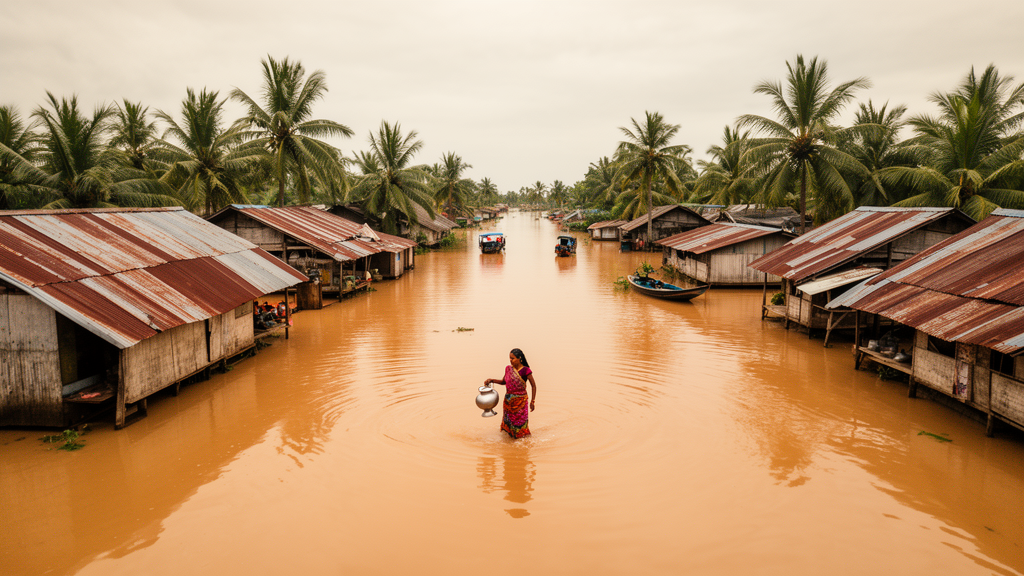
When floodwaters sweep across the low-lying districts of Bangladesh, they carry more than silt and debris. They carry pathogens into wells, ponds, and storage containers, turning an ordinary glass of water into a potential vector of diarrheal disease, cholera, and typhoid. For public health officials, the challenge has always been knowing which households face the greatest danger before the outbreak begins. A new study published in PLOS Water offers a data-driven answer, using machine learning to predict which families in flood-affected communities are most likely to fall ill from contaminated water, and revealing which factors matter most in driving that risk.
The research, led by Md. Mamun Miah and colleagues including Kabir Hossain, Hafiz T. A. Khan, and H. M. Shahadat Ali, focused on two of Bangladesh’s most flood-prone districts, Noakhali and Feni. Both lie in the country’s coastal delta region, where monsoon rains, tidal surges, and river overflow regularly inundate villages and overwhelm sanitation infrastructure. The team conducted a cross-sectional survey, going door to door to interview 501 respondents selected through simple random sampling. The face-to-face interviews captured a detailed picture of each household: who lived there, what they earned, where their drinking water came from, how they treated it, how often and how severely floods reached them, and whether medical help and community preparedness programs were within reach.
The headline finding was stark. In these flood-affected areas, 63.7 percent of surveyed households—319 of the 501—reported at least one member suffering from a waterborne disease. That figure underscores why the researchers argue that conventional, reactive approaches to post-flood health crises are insufficient. If nearly two out of three households are affected, interventions based on guesswork or broad geographic targeting risk wasting scarce resources on families at comparatively lower risk while missing those most vulnerable. A predictive model, the authors reasoned, could sharpen the focus.
Before any algorithm could be trained, the raw survey data required careful preparation. The researchers ran a sequence of feature selection techniques to distill dozens of potential variables into a compact, informative set. They began with correlation analysis to detect redundant variables, then assessed multicollinearity using the variance inflation factor, a standard diagnostic that flags predictors which overlap too heavily with one another. Mutual information analysis followed, measuring how much each variable contributed non-linear information about disease outcomes. Finally, the team applied Recursive Feature Elimination with Cross-Validation, or RFECV, an iterative method that repeatedly trains a model, drops the least useful feature, and tests whether predictive performance holds up across data splits. The process retained ten predictors: age, gender, monthly household income, household size, flood frequency, flood severity, source of drinking water, availability of medical assistance, water purification method, and community preparedness for preventing waterborne diseases.
With the feature set fixed, the researchers benchmarked five widely used machine learning algorithms: Logistic Regression, Random Forest, Support Vector Machine, K-Nearest Neighbors, and Extreme Gradient Boosting, better known as XGBoost. Each model was optimized through randomized hyperparameter tuning, a search strategy that samples combinations of algorithm settings rather than exhaustively testing every possibility, paired with five-fold cross-validation to ensure the tuning generalized beyond a single data split. The models were then evaluated on an independent test set they had never seen during training, using a battery of metrics including accuracy, precision, recall, specificity, F1-score, and the area under the receiver operating characteristic curve, or ROC-AUC, which captures how well a model separates affected from unaffected households across all decision thresholds.
The Random Forest classifier emerged as the strongest performer, delivering the most balanced results on the test set. It achieved an accuracy of 61.4 percent, precision of 71.9 percent, recall of 64.1 percent, specificity of 56.8 percent, an F1-score of 67.8 percent, and a ROC-AUC of 0.643. Those numbers tell a nuanced story. The precision figure is particularly notable: when the model flags a household as high risk, it is right roughly seven times out of ten, which matters greatly in resource-constrained settings where misdirected aid carries real costs. The ROC-AUC of 0.643 indicates performance modestly better than random guessing—useful, but not infallible. The researchers were transparent about this, and they also tested more elaborate approaches, including stacking and weighted soft voting ensembles that combine multiple models. Neither outperformed the single Random Forest, a reminder that in applied machine learning, complexity does not automatically buy accuracy, especially with moderate-sized survey datasets.
What elevates the study beyond a standard prediction exercise is its commitment to explainability. Black-box models are notoriously difficult for health officials to act on, so the team turned to SHAP—SHapley Additive exPlanations—a technique rooted in cooperative game theory that assigns each feature a contribution value for every individual prediction. The SHAP analysis identified flood severity, community preparedness, water purification practices, and socio-economic factors as the most influential drivers of predicted risk. In practical terms, households facing the deepest or most prolonged flooding, lacking effective water treatment, and situated in communities without organized prevention efforts were consistently ranked as most vulnerable, with income and household size shaping the risk profile as well.
These findings carry immediate implications for how flood response is organized in Bangladesh and beyond. Rather than distributing water purification tablets or deploying medical teams uniformly across an affected district, health authorities could use a trained model to triage, prioritizing households whose characteristics match the high-risk profile identified by SHAP. The same logic supports early warning strategies: because flood frequency and severity are among the top predictors, seasonal forecasts and river gauge data could feed into risk models before floodwaters arrive, allowing pre-positioning of supplies in the most exposed communities. The emphasis on community preparedness as a key predictor also suggests that investments in local education, sanitation planning, and coordinated response networks yield measurable reductions in disease risk that algorithms can detect.
The authors are careful to frame the framework as promising but not yet deployment-ready. External validation—testing the model on data from other flood-affected regions—is required before it can be trusted at scale, and the moderate ROC-AUC signals that unmeasured variables, from pathogen concentrations in specific water sources to individual hygiene behaviors, likely influence outcomes. Still, the study demonstrates a replicable pipeline: rigorous survey design, statistically grounded feature selection, hyperparameter-optimized modeling, and transparent interpretation. All analyses were conducted in Python, and the methods are documented in enough detail to be adapted by other research teams working in low- and middle-income countries where waterborne disease remains a leading burden.
As climate change intensifies monsoon variability and sea-level rise pushes saline floodwater deeper into the Bengal delta, the stakes of this kind of predictive public health work will only grow. Bangladesh has long been on the front line of climate adaptation, and studies like this one point toward a future where the response to a flood begins not when the first patients arrive at a clinic, but when a model, trained on the experiences of hundreds of households, flags which doors relief workers should knock on first. The 319 affected families in Noakhali and Feni are, in that sense, more than statistics; they are the training signal for a smarter, faster defense against the diseases that follow the water.
Subject of Research: Machine learning prediction of household-level waterborne disease risk in flood-affected districts of Bangladesh
Article Title: Predicting households risks of waterborne diseases in flood-affected areas using machine learning: A study of Noakhali and Feni, Bangladesh
Article References: Miah, M. M., Hossain, K., Khan, H. T. A., & Ali, H. M. S. (2026). Predicting households risks of waterborne diseases in flood-affected areas using machine learning: A study of Noakhali and Feni, Bangladesh. PLOS Water, 5(8), e0000542. https://doi.org/10.1371/journal.pwat.0000542
Image Credits: AI Generated
DOI: 10.1371/journal.pwat.0000542
Keywords: waterborne diseases, machine learning, Bangladesh, flooding, Random Forest, SHAP, public health, feature selection, XGBoost, early warning, Noakhali, Feni
Cite Scienmag News
Violet Maxwell. (October 9, 2026). Machine Learning Maps Household Waterborne Disease Risk in Flood-Hit Bangladesh. Scienmag. https://scienmag.com/machine-learning-maps-household-waterborne-disease-risk-in-flood-hit-bangladesh/
Violet Maxwell. "Machine Learning Maps Household Waterborne Disease Risk in Flood-Hit Bangladesh." Scienmag, 9 October 2026, https://scienmag.com/machine-learning-maps-household-waterborne-disease-risk-in-flood-hit-bangladesh/. Accessed 9 October 2026.
Violet Maxwell. "Machine Learning Maps Household Waterborne Disease Risk in Flood-Hit Bangladesh." Scienmag. October 9, 2026. https://scienmag.com/machine-learning-maps-household-waterborne-disease-risk-in-flood-hit-bangladesh/


