

Wednesday, October 21, 2026
Science
No Result
View All Result
  • Login
  • HOME
  • SCIENCE NEWS
  • CONTACT US
  • HOME
  • SCIENCE NEWS
  • CONTACT US
No Result
View All Result
Scienmag
No Result
View All Result
Home Science News Agriculture

Controlled indoor rice phenotyping links NeRF reconstruction and grain segmentation

October 21, 2026
in Agriculture
Alan Morgan
By Alan Morgan Scienmag Editorial Profile - Precision Agriculture
Reading Time: 2 mins read
0
Controlled indoor rice phenotyping links NeRF reconstruction and grain segmentation

Controlled indoor rice phenotyping links NeRF reconstruction and grain segmentation

65
SHARES
587
VIEWS
Share on FacebookShare on Twitter
ADVERTISEMENT

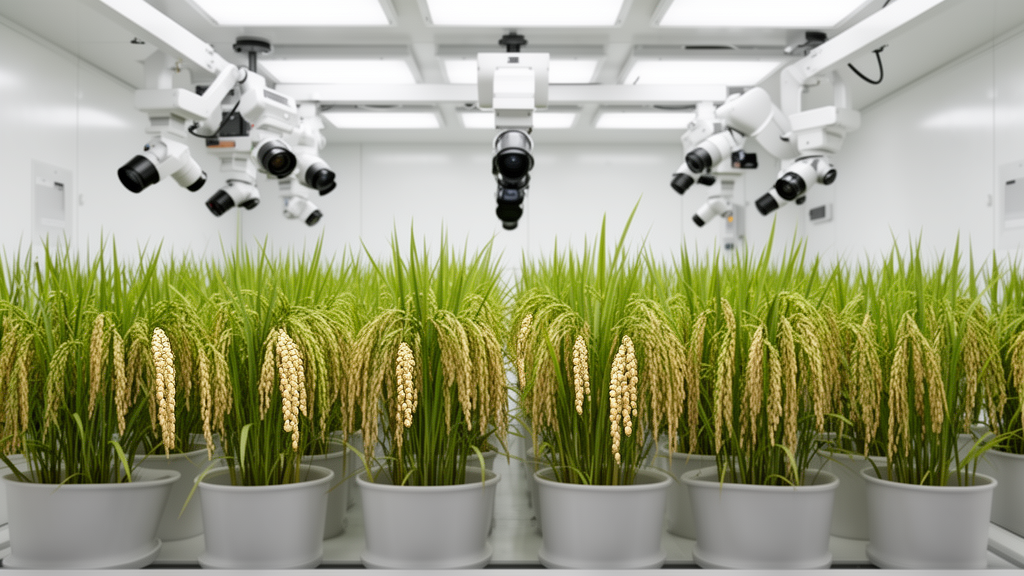
An end-to-end computational workflow called PRSNeRF can reconstruct individual rice grains from multi-view images, separate densely adjacent grains in three dimensions and extract plant-level traits in about 3.3 minutes per plant. The study evaluated rice grown under controlled indoor conditions, combining contour-guided neural radiance field reconstruction with Mamba-based point-cloud instance segmentation. Its reconstructed point clouds supported automated estimation of grain count, grain dimensions and voxel-based occupancy traits.

Adhesion between neighboring grains can make instances difficult to distinguish, while the scale of a plant’s point cloud creates a substantial segmentation problem. PRSNeRF addresses the task in two stages: CoNeRF produces a three-dimensional representation from multi-view images, and PRSNet assigns separate identities to individual grains. The researchers tested reconstruction on the Blur Rice benchmark and assessed segmentation on the RiceNeRF-IS dataset.

CoNeRF integrates image deblurring, contour-guided sampling and a rendering-projection consistency mechanism. These components are designed to improve geometric fidelity and suppress floating artifacts in the reconstruction. Under a fixed budget of 5,000 training iterations, the method reduced the scaled NeRF-space Chamfer distance from 10.61 to 7.81.

It also required substantially less time than the 30,000-iteration NeRFacto baseline: training time decreased from 368 seconds to 77 seconds, and point-cloud export time fell from 120 seconds to 10 seconds. These results apply to the benchmark conditions and comparison setup used in the study. PRSNet handles the next stage by identifying separate grain instances in the reconstructed point clouds.

Its architecture includes a Mamba-based encoder, adaptive Gaussian detail enhancement, multi-scale feature fusion and three-dimensional dynamic anchor boxes. In plant-level five-fold cross-validation on RiceNeRF-IS, PRSNet achieved an overall average precision of 87.31%, outperforming OneFormer3D by 22.30 percentage points. The segmented point clouds then provided the basis for automated measurements of grain number, grain dimensions and voxel-based occupancy.

The study presents PRSNeRF as a connected workflow linking image-based reconstruction, point-cloud instance separation and quantitative trait extraction, with a reported end-to-end processing time of approximately 3.3 minutes per plant. Its demonstrated performance is limited to controlled indoor acquisition and the specific datasets and baselines evaluated. The evidence does not establish equivalent results for field-grown rice, outdoor imaging or other crop species, and the early-access article is described as subject to further editorial revision.

Within the tested setting, however, the workflow shows that improvements in three-dimensional rendering and point-cloud analysis can support faster automated rice phenotyping while producing grain-level measurements.

Subject of Research: Automated three-dimensional rice-grain phenotyping using NeRF reconstruction and Mamba-based point-cloud segmentation

Article Title: A 3D grain-level phenotypic extraction framework for rice using contour-guided NeRF reconstruction and mamba-based point cloud segmentation

Article References: Qu, F., Huang, H., Song, W., Zhang, W., Wu, L., Tang, C., Zhang, J., & Sun, Y. (2026). A 3D grain-level phenotypic extraction framework for rice using contour-guided NeRF reconstruction and mamba-based point cloud segmentation. Plant Methods. https://doi.org/10.1186/s13007-026-01603-9

Image Credits: AI Generated

DOI: 10.1186/s13007-026-01603-9

Keywords: rice phenotyping, 3D reconstruction, neural radiance fields, point-cloud segmentation, Mamba networks, computer vision, grain traits, rice panicles, plant breeding, grain-level, phenotypic, extraction

Cite Scienmag News

Alan Morgan. (October 21, 2026). Controlled indoor rice phenotyping links NeRF reconstruction and grain segmentation. Scienmag. https://scienmag.com/controlled-indoor-rice-phenotyping-links-nerf-reconstruction-and-grain-segmentation/


Alan Morgan. "Controlled indoor rice phenotyping links NeRF reconstruction and grain segmentation." Scienmag, 21 October 2026, https://scienmag.com/controlled-indoor-rice-phenotyping-links-nerf-reconstruction-and-grain-segmentation/. Accessed 21 October 2026.

Alan Morgan. "Controlled indoor rice phenotyping links NeRF reconstruction and grain segmentation." Scienmag. October 21, 2026. https://scienmag.com/controlled-indoor-rice-phenotyping-links-nerf-reconstruction-and-grain-segmentation/

Tags: 3D reconstruction3D rice grain segmentationautomated grain trait estimationcomputer visioncontour-guided neural radiance fieldscontrolled environment plant imagingdense grain separation techniquesefficient 3D reconstruction algorithmsextractiongrain traitsgrain-levelIndoor rice phenotypingMamba networksmulti-view image analysisNeRF-based grain reconstructionNeural Radiance Fieldsphenotypicplant breedingpoint cloud instance segmentationpoint-cloud segmentationrice grain phenotyping workflowrice paniclesrice phenotypingvoxel-based plant trait analysis
Share26Tweet16
Previous Post

Spatial analysis associates dECM deployment with myocardial organization changes

Next Post

Lab tests reveal variable carbon use and heat tolerance in post-fire fungi

Related Posts

Nova food framework may underserve populations with greatest need
Agriculture

Nova food framework may underserve populations with greatest need

October 21, 2026
Xinjiang wheat stripe rust reveals diverse lineages and uneven resistance breakdown
Agriculture

Xinjiang wheat stripe rust reveals diverse lineages and uneven resistance breakdown

October 21, 2026
Rhizobium and organic-mineral fertilizer improve faba bean in saline soil
Agriculture

Rhizobium and organic-mineral fertilizer improve faba bean in saline soil

October 21, 2026
Two Cactus Populations Reveal Divergent Reproductive Strategies at Short Geographic Scales
Agriculture

2015 field study finds divergent reproduction in two Opuntia robusta populations

October 20, 2026
Plant growth-promoting microorganisms enhance maize performance under salinity stress: a comprehensive meta-analysis of morphological, physiological, and biochemical responses
Agriculture

Plant growth-promoting microorganisms enhance maize performance under salinity stress: a comprehensive meta-analysis of morphological, physiological, and biochemical responses

October 20, 2026
Aromatic amino acids show context-dependent biostimulant effects in horticulture
Agriculture

Aromatic amino acids show context-dependent biostimulant effects in horticulture

October 20, 2026
Next Post
Lab tests reveal variable carbon use and heat tolerance in post-fire fungi

Lab tests reveal variable carbon use and heat tolerance in post-fire fungi

  • Mothers who receive childcare support from maternal grandparents show more optimized

    Mothers who receive childcare support from maternal grandparents show more parental warmth, finds NTU Singapore study

    27656 shares
    Share 11059 Tweet 6912
  • University of Seville Breaks 120-Year-Old Mystery, Revises a Key Einstein Concept

    1061 shares
    Share 424 Tweet 265
  • Bee body mass, pathogens and local climate influence heat tolerance

    682 shares
    Share 273 Tweet 171
  • Researchers record first-ever images and data of a shark experiencing a boat strike

    546 shares
    Share 218 Tweet 137
  • Groundbreaking Clinical Trial Reveals Lubiprostone Enhances Kidney Function

    531 shares
    Share 212 Tweet 133
Science

Embark on a thrilling journey of discovery with Scienmag.com—your ultimate source for cutting-edge breakthroughs. Immerse yourself in a world where curiosity knows no limits and tomorrow’s possibilities become today’s reality!

RECENT NEWS

  • Lab tests reveal variable carbon use and heat tolerance in post-fire fungi
  • Controlled indoor rice phenotyping links NeRF reconstruction and grain segmentation
  • Spatial analysis associates dECM deployment with myocardial organization changes
  • Student-Led Evaluation Identifies Friction in Guadalajara Digital Library

Categories

  • Agriculture
  • Anthropology
  • Archaeology
  • Athmospheric
  • Biology
  • Biotechnology
  • Blog
  • Bussines
  • Cancer
  • Chemistry
  • Climate
  • Earth Science
  • Editorial Policy
  • Marine
  • Mathematics
  • Medicine
  • Pediatry
  • Policy
  • Psychology & Psychiatry
  • Science Education
  • Science News
  • Social Science
  • Space
  • Technology and Engineering

Subscribe to Blog via Email

Enter your email address to subscribe to this blog and receive notifications of new posts by email.

Join 5,150 other subscribers

© 2025 Scienmag - Science Magazine

Welcome Back!

Login to your account below

Forgotten Password?

Retrieve your password

Please enter your username or email address to reset your password.

Log In
No Result
View All Result
  • HOME
  • SCIENCE NEWS
  • CONTACT US

© 2025 Scienmag - Science Magazine

Discover more from Science

Subscribe now to keep reading and get access to the full archive.

Continue reading