


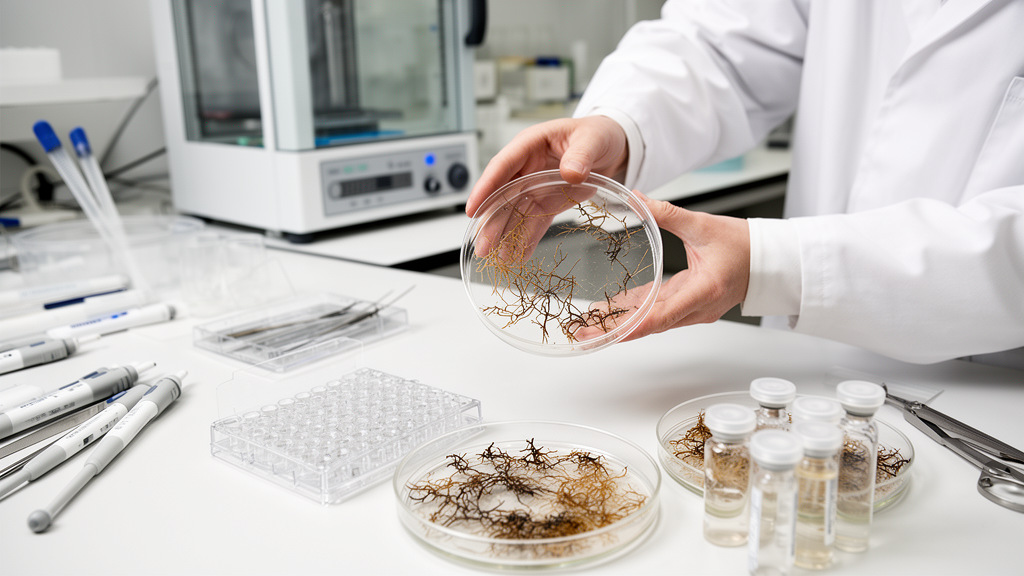
Saprotrophic fungi isolated from pyrogenic carbon in a frequently burned pine forest exhibited varied growth strategies, while laboratory tests found only weak coordination between growth on fire-derived carbon and tolerance of elevated temperatures. The study examined seven isolates: four tentatively identified as Trichoderma strigosellum and three assigned to Mucor species. The results also showed substantial variation among isolates of the same species, cautioning against treating pyrophilic behavior as a uniform species-level trait.
The fungi came from birch wood pyrolyzed at 350 °C for one hour in a muffle furnace, a procedure designed to simulate low-intensity fire. Portions of the resulting material were placed in double-layered mesh litter bags on the floor of a mixed longleaf and loblolly pine stand near Tifton, Georgia. The stand had been managed with prescribed fire at three- to four-year intervals since 1989, when it was established following conversion from row-crop agriculture.
The bags were positioned near the soil surface in vegetation gaps, exposed to a prescribed fire in February 2022 and collected the following month. Fungi were subsequently isolated in spring from visibly colonized pieces of the pyrolyzed birch wood. Molecular analysis used the fungal internal transcribed spacer region for identification, supplemented by sequencing the translation elongation factor 1-alpha gene because the ITS region alone can be ambiguous for Trichoderma.
The researchers tentatively classified four isolates as T. strigosellum, designated TS1 through TS4. The other three were identified as one Mucor genevensis isolate, MG1; one Mucor fragilis isolate, MF1; and an unidentified Mucor species, MS1. These identifications were described as tentative, and the experiment therefore characterized traits in a small set of isolates rather than establishing species-wide responses.
Three complementary growth experiments tested whether the fungi could grow on complex fire-derived carbon and whether that capacity accompanied heat tolerance. In the initial experiment, each isolate was grown on medium containing powdered pyrogenic carbon, medium containing sucrose as a relatively simple carbon source, or water agar as a minimal-resource control. Ten replicates were used for each isolate and substrate, and radial mycelial expansion was measured every 48 hours over 240 hours.
Maximum growth rate was defined as the greatest mycelial extension during each strain’s linear growth phase. High variability among replicates for MG1, MF1 and TS4 on pyrogenic carbon led the researchers to repeat the test for those isolates and report the less-variable results. In that first comparison, TS1, TS2 and TS4 grew faster on pyrogenic carbon than on sucrose, as did MF1; each of those pairwise differences had P < 0.001.
MG1 and TS3 showed similar maximum growth on pyrogenic carbon and sucrose, with post hoc P values of 0.874 and 0.814, respectively. MS1 behaved differently, growing more slowly on pyrogenic carbon than on either sucrose or water agar, also with pairwise P < 0.001. These observations demonstrated that isolates recovered from colonized burned material did not have a common growth response under laboratory conditions.
The temperature experiment focused on four isolates selected to span their observed maximum growth rates on pyrogenic carbon: TS2, TS3, MS1 and MG1. Each was cultivated on pyrogenic-carbon and sucrose media at 25, 30, 35 and 40 °C, producing 192 plates with six replicates per combination. Radial growth was recorded every 24 hours for 96 hours.
Temperature significantly affected growth for all four isolates, but only TS2 and TS3 showed significant substrate effects. Every isolate reached its highest maximum growth at 25–30 °C, consistent with mesophilic rather than truly thermophilic growth. MG1 and TS2 retained 60–84% of their peak growth at 35 °C, whereas TS3 and MS1 showed close to zero growth at that temperature.
None of the isolates grew at 40 °C. The two isolates that performed relatively well at 35 °C followed contrasting carbon-growth patterns. MG1 grew equally on pyrogenic carbon and sucrose across the tested temperatures, with no significant substrate effect, while TS2 consistently achieved greater maximum growth on pyrogenic carbon, with a highly significant substrate effect.
Thus, the experiment did not support a strong association between faster growth on pyrogenic carbon and greater thermotolerance. The measured scope was narrow: the researchers assessed mycelial traits in culture rather than survival of spores, heat-induced germination, performance in intact soil or carbon movement through a post-fire food web. Repetition revealed that some substrate-associated growth phenotypes could change between experiments.
TS3 initially showed similar growth on all three media, then grew faster on pyrogenic carbon than on sucrose in the temperature experiment; the latter pattern was reproduced in a third experiment using the same stock inoculum as the temperature study. MS1 also changed: it grew most strongly on sucrose in the first experiment, similarly on sucrose and pyrogenic carbon in the second, and returned to stronger sucrose growth in the third. In contrast, TS2, TS4 and MG1 maintained comparatively stable comparative growth patterns across the experiments.
Because the experiment measured colony extension rather than direct carbon uptake, the researchers said the shifts could reflect carbon limitation or differences in assimilation and would require methods such as isotope tracing to determine their mechanism. The researchers also examined mycelial density, defined as final biomass divided by final colony area, to explore possible exploration–exploitation tradeoffs along a proposed slow–fast continuum for saprotrophic fungi. TS2 and TS4, which had relatively slow maximum extension rates on sucrose, formed denser colonies on sucrose than on pyrogenic carbon, with P < 0.0001 in both cases.
MG1 showed no significant substrate effect on density, with F = 2.11 and P = 0.18. The two T. strigosellum isolates did not fit a single simple continuum, however: despite similar maximum extension rates, TS2 had roughly 100 times the density of TS4. The findings therefore indicate that colony extension, biomass density and substrate response can vary in ways that are not captured by one rate measure alone.
Fourier-transform infrared spectroscopy provided a chemical view of the fungal isolates and their responses to carbon source. Spectra from TS4 and MG1 differed in several assigned absorption regions. TS4 tissue had a peak at 892 cm−1 associated with the C–H deformation of β-1,3-glucan that was absent from MG1, while MG1 had a distinct peak at 1328 cm−1.
TS4 also had a sharper shoulder at 1160 cm−1 in the polysaccharide region and a more complex shoulder from 1656 to 1630 cm−1. Within-isolate differences also appeared between carbon treatments. TS4 grown on pyrogenic carbon had small peaks at 3445 and 3490 cm−1 interpreted as amines, a peak at 825 cm−1 consistent with aromatic-hydrocarbon C–H out-of-plane bending and a protein-associated peak at 1550 cm−1 that was absent from its sucrose-grown tissue.
MG1 grown on sucrose had an additional peak at 931 cm−1, assigned to α-1,6-glucan C–H deformation, that was not detected in its pyrogenic-carbon-grown tissue. These spectral observations show that substrate was associated with detectable differences in recovered fungal tissue chemistry, but they do not by themselves establish a specific physiological mechanism. Overall, the experiments show that fungi associated with pyrogenic carbon in this managed pine ecosystem cannot be assigned a single, predictable combination of carbon-use and heat-tolerance traits.
The isolates differed in maximum extension, temperature response, biomass density and chemical profile, and some changed their comparative growth patterns across repetitions. The study was limited by its sample of seven isolates, only four of which entered the temperature experiment, its use of one laboratory-produced birch-derived pyrogenic carbon and its focus on cultured mycelia. It also did not measure ecosystem-scale carbon flux or directly establish pyrogenic-carbon assimilation.
Even so, its results identify substantial intraspecific variation as a key uncertainty when estimating how saprotrophic fungi respond to fire and contribute to post-fire carbon cycling.
Subject of Research: Growth and heat-tolerance variation among seven saprotrophic fungi isolated from pyrogenic carbon in a frequently burned pine forest
Article Title: Intra- and interspecific variation in growth and heat tolerance traits of saprotrophic fungi isolated from pyrogenic carbon in a frequent fire ecosystem
Article References: Chung, Y. A., McElroy, F., Zaman, S., Scott, C., Novak, L., Henson, M. S., Moss, A., & Abney, R. B. (2026). Intra- and interspecific variation in growth and heat tolerance traits of saprotrophic fungi isolated from pyrogenic carbon in a frequent fire ecosystem. Frontiers in Ecology and Evolution, 14, Article 1948541. https://doi.org/10.3389/fevo.2026.1948541
Image Credits: AI Generated
DOI: 10.3389/fevo.2026.1948541
Keywords: pyrogenic carbon, post-fire ecology, saprotrophic fungi, pyrophilic traits, heat tolerance, fungal growth, Trichoderma strigosellum, Mucor, FT-IR spectroscopy, carbon cycling, Intra-, interspecific
Cite Scienmag News
Roger Howard. (October 21, 2026). Lab tests reveal variable carbon use and heat tolerance in post-fire fungi. Scienmag. https://scienmag.com/lab-tests-reveal-variable-carbon-use-and-heat-tolerance-in-post-fire-fungi/
Roger Howard. "Lab tests reveal variable carbon use and heat tolerance in post-fire fungi." Scienmag, 21 October 2026, https://scienmag.com/lab-tests-reveal-variable-carbon-use-and-heat-tolerance-in-post-fire-fungi/. Accessed 21 October 2026.
Roger Howard. "Lab tests reveal variable carbon use and heat tolerance in post-fire fungi." Scienmag. October 21, 2026. https://scienmag.com/lab-tests-reveal-variable-carbon-use-and-heat-tolerance-in-post-fire-fungi/


