


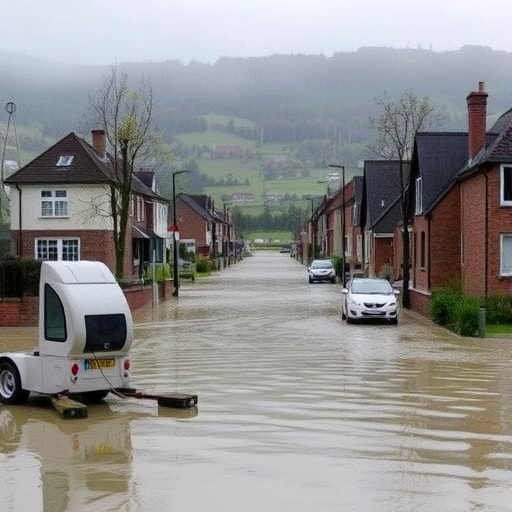
In an increasingly interconnected and climate-vulnerable world, understanding the complex interplay of environmental hazards is crucial for protecting lives, infrastructure, and economies. A new groundbreaking study led by Ronco, Tilloy, Corbane, and colleagues, published in Nature Communications in 2026, reveals that the confluence of multiple natural hazards—known as compounding hazards—substantially amplifies flood-related economic losses across Europe. This pivotal research sheds light on the cascading vulnerabilities produced when flood events are combined with other simultaneous or sequential natural threats, challenging existing risk assessment frameworks and demanding a transformative approach to disaster preparedness and resilience planning.
The study addresses a critical gap in the field of natural disaster risk management: traditional flood risk evaluations tend to consider hazards in isolation. However, real-world scenarios rarely involve a single hazard. Instead, floods often unfold alongside other events such as heatwaves, droughts, or high wind incidents. This research meticulously integrates hydrological, meteorological, and socio-economic datasets across a pan-European scale to capture the nuances of hazard interactions. By employing advanced statistical models and spatial-temporal analysis techniques, the team demonstrates that compounded hazard scenarios can trigger disproportionately higher economic damages compared to isolated flood events.
Central to the study’s findings is the concept of risk amplification via hazard interactions. For instance, when flooding coincides with prior drought conditions, the soil’s altered absorption capacity and vegetation stress can exacerbate surface runoff and erosion. Similarly, when floodwaters coincide with high wind events, the physical stresses on infrastructure intensify, leading to more widespread damage than expected from either hazard alone. The researchers systematically quantify how these compounded effects evolve over time, revealing that sequential hazard exposures create “damage cascades” that ripple through critical infrastructure, housing, and agricultural systems.
From a methodological standpoint, the authors leverage cutting-edge hydrometeorological modeling frameworks intertwined with machine learning approaches to predict flood loss under compounding hazard conditions. Their dataset integrates meteorological archives, satellite imagery, groundwater level records, and historic damage databases, creating one of the most comprehensive multi-hazard risk assessments to date. This fusion of data sources enables the detection of subtle interdependencies that augment flood vulnerability, transcending the limitations of single-hazard predictive models that have dominated the flood risk literature until now.
One of the landmark revelations of the study is the identification of geographic and socio-economic hotspots where compounded hazards translate into especially severe economic impacts. Coastal regions, river deltas, and urban centers with dense infrastructure and population densities face heightened risks due to the synergistic effects of simultaneous hazards. The analysis highlights that vulnerable communities with lower adaptive capacity suffer disproportionately, emphasizing the need for targeted mitigation strategies that integrate social vulnerability alongside physical and environmental risk factors.
Economically, the implications are staggering. The authors calculate that compounding hazards could increase flood-related economic losses across Europe by an estimated 30-50% over the coming decades if current climate and land-use trends persist. This magnification arises not only from more frequent and intense floods but also from the emerging complexity of hazard combinations that current disaster risk models and insurance frameworks are ill-equipped to handle. The study calls for policy revisions that incorporate multihazard scenarios into urban planning, insurance risk pools, and emergency response protocols.
Furthermore, the research explores how climate change acts as a multiplier in creating and intensifying compounding hazards. Rising global temperatures alter precipitation patterns, increasing the likelihood of concurrent droughts and floods, while amplifying storm intensity. These evolving climatic realities mean that the probability distribution of hazard overlaps is shifting, triggering unprecedented flood-risk profiles. Through climate projection simulations, the study emphasizes that adaptive strategies must be anticipatory and flexible, accommodating the uncertainty and complexity of future multihazard interactions.
Crucially, Ronco and colleagues argue for a paradigm shift in how flood risk management is conceptualized and operationalized. They advocate for integrated hazard assessments that transcend disciplinary silos and embrace the systemic nature of environmental risks. This approach would require cross-sector collaboration between hydrologists, urban planners, climate scientists, economists, and policymakers to co-develop resilience frameworks capable of withstanding the compounded shocks posed by multiple hazards. The study posits that such innovations in science and governance are fundamental to safeguarding Europe’s socio-economic fabric.
In practical terms, the study proposes the adoption of advanced data fusion techniques and real-time multi-hazard monitoring systems to enable early warning and dynamic risk assessment. By harnessing sensor networks, remote sensing platforms, and AI-driven analytics, stakeholders can anticipate hazard compounding events with more precision and adapt risk communication accordingly. These technological advances will empower communities and emergency services to implement nuanced response strategies that prioritize the interdependencies and temporal sequences of hazards.
Beyond immediate flood and damage impacts, the research also delves into secondary and longer-term repercussions of hazard compounding, such as supply chain disruptions, health crises due to water contamination, and increased insurance insolvencies. The authors provide evidence that such cascading effects exacerbate economic losses far beyond the flooded region’s boundaries, affecting interconnected economic sectors at national and continental scales. This systemic perspective warns against underestimating the cascading risks embedded in multi-hazard environments.
The study acknowledges that while multi-hazard risk modeling is complex and data-demanding, continued advancements in computational capabilities and big data analytics offer unprecedented opportunities for deeper understanding. The authors recommend prioritizing investments in data infrastructure, cross-border data sharing, and interdisciplinary research consortia to enhance predictive accuracy of multihazard flood risks. Understanding such compound risks will be indispensable for aligning European Union climate adaptation goals with local and national resilience commitments.
Importantly, the research reinforces the idea that resilience building is not just a technical challenge but also a socio-political one. The disproportionately high losses borne by marginalized populations highlight urgent equity concerns that must be embedded within risk governance frameworks. Social justice-oriented policies that integrate community engagement, equitable resource distribution, and inclusive recovery planning are highlighted as vital complements to technical hazard mitigation measures. Without addressing the human dimension of compounding hazards, economic resilience will remain partial and fragile.
In conclusion, this seminal article coalesces climate science, hydrology, economics, and social vulnerability into a comprehensive portrait of the multifaceted threats posed by compounding hazards across Europe. Its revelations are a call to action for reconceptualizing flood risk in an era of environmental complexity, urging systemic resilience over siloed hazard management. As Europe confronts the growing specter of climate extremes, the insights from Ronco et al. offer a vital roadmap for science, policy, and society to co-navigate an uncertain and perilous future.
The consequences of ignoring compounding hazards could be catastrophic, making this research an essential catalyst for integrating multifaceted risk awareness into the heart of modern disaster preparedness. It challenges stakeholders from city planners to international organizations to rethink and redesign flood mitigation strategies that truly reflect the entangled, aggravating nature of contemporary environmental threats.
This research stands as a beacon reminding humanity that in the intertwined fabric of nature and society, resilience depends not only on dealing with isolated problems but on comprehending and managing their confluence with scientific rigor, technological innovation, and ethical commitment.
Cite Scienmag News
Violet Maxwell. (May 19, 2026). Compounding Hazards Amplify Europe’s Flood Costs. Scienmag. https://scienmag.com/compounding-hazards-amplify-europes-flood-costs/
Violet Maxwell. "Compounding Hazards Amplify Europe’s Flood Costs." Scienmag, 19 May 2026, https://scienmag.com/compounding-hazards-amplify-europes-flood-costs/. Accessed 4 September 2026.
Violet Maxwell. "Compounding Hazards Amplify Europe’s Flood Costs." Scienmag. May 19, 2026. https://scienmag.com/compounding-hazards-amplify-europes-flood-costs/


