


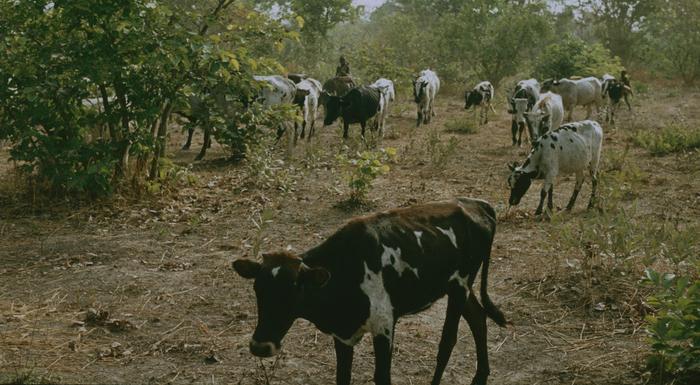
FRANKFURT. During the German and French colonial period, at the end of the 19th to the middle of the 20th century, around 50,000 farmers from the Kabyè ethnic group were forcibly resettled from the densely populated north to the sparsely populated south in what are now the West African states of Togo and Benin. Whereas the German colonial power needed workers to build transport routes, the French government wanted to develop the region for agriculture.

Credit: Juergen Runge, Goethe University Frankfurt, Germany
FRANKFURT. During the German and French colonial period, at the end of the 19th to the middle of the 20th century, around 50,000 farmers from the Kabyè ethnic group were forcibly resettled from the densely populated north to the sparsely populated south in what are now the West African states of Togo and Benin. Whereas the German colonial power needed workers to build transport routes, the French government wanted to develop the region for agriculture.
To this day, however, farming is difficult in this part of the country – naturally a tree savannah – where the soil is less fertile and the climate alternates between two wet and two dry seasons. Climate change only serves to exacerbate these agricultural problems. Beyond that, it also acts as an accelerant for land use conflicts with the semi-nomadic Peulh/Fulbe ethnic group, who graze their herds of cattle there.
In the fertile hilly north, where the Kabyè traditionally farm on terraces bordered by low stone walls, the resettlements resulted in labor shortages, market distortions and rural exodus. The indigenous population became increasingly impoverished, amid a looming threat of socio-cultural collapse, which Togo’s political leadership has been trying to counteract since the country’s independence.
As part of the “Indigenous People of West Africa, IPWA” project, an international team of researchers now wants to examine the consequences of the colonial era in detail and disclose current restrictive social and political structures in indigenous ethnic groups in order to promote good governance that includes indigenous leaders. The aim is to pave the way for indigenous communities to be involved in identifying innovations, solutions and pathways to adapt to and mitigate environmental and climate change.
The three-year IPWA project will start in July 2024 and will receive €620,000 in funding by the German Research Foundation (Deutsche Forschungsgemeinschaft, DFG), the Canadian New Frontiers in Research Fund (NFRF), the US National Science Foundation, the Swiss National Science Foundation and the São Paulo Research Foundation (FAPESP).
IPWA is part of a consortium on global environmental and climate change among indigenous groups with researchers from Canada, Brazil, Switzerland, Thailand and the USA.
Project: Confronting “Green Colonialism” – Indigenous-led Action and Solutions for Food-Water-Energy Sustainability (IPWA).
Goethe University Frankfurt
University of Alberta, Canada
Michigan State University
University of St. Gallen, Switzerland
University of São Paulo, Brazil
Université de Kara, Kara, Togo
Université d‘Abomey-Calavi, Cotonou, Benin
Cite Scienmag News
Violet Maxwell. (July 24, 2024). Colonial legacy: Goethe University Frankfurt researches international project on land use conflicts in West Africa. Scienmag. https://scienmag.com/colonial-legacy-goethe-university-frankfurt-researches-international-project-on-land-use-conflicts-in-west-africa/
Violet Maxwell. "Colonial legacy: Goethe University Frankfurt researches international project on land use conflicts in West Africa." Scienmag, 24 July 2024, https://scienmag.com/colonial-legacy-goethe-university-frankfurt-researches-international-project-on-land-use-conflicts-in-west-africa/. Accessed 4 September 2026.
Violet Maxwell. "Colonial legacy: Goethe University Frankfurt researches international project on land use conflicts in West Africa." Scienmag. July 24, 2024. https://scienmag.com/colonial-legacy-goethe-university-frankfurt-researches-international-project-on-land-use-conflicts-in-west-africa/

