


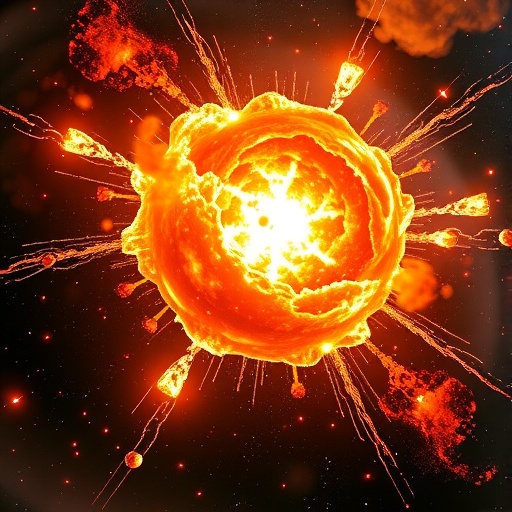
Jaspreet Singh Randhawa, an assistant professor of physics at Mississippi State University, has been awarded the highly esteemed CAREER Award by the National Science Foundation (NSF). This distinguished grant will provide $700,000 in funding to support Randhawa’s ambitious five-year research initiative focused on nuclear reactions that fuel the most violent and energetic stellar explosions observed in the cosmos. Such cosmic phenomena include supernovae and neutron star bursts, events that are central to the synthesis of many of the universe’s heavy elements and the evolution of galaxies.
In this pioneering research, Randhawa aims to unravel the complexities of nuclear processes that occur under the extreme conditions characteristic of dying massive stars and neutron star surfaces. By harnessing cutting-edge experimental techniques, including the use of radioactive ion beams composed of highly exotic nuclei with lifespans ranging from mere milliseconds to a few seconds, his team will collect empirical data that terrestrial laboratories have never accessed. These rare isotopes, fleeting in existence, mirror the unstable nuclear states formed during astrophysical explosions, thereby opening an unprecedented window into nuclear astrophysics.
A major thrust of Randhawa’s project centers on elucidating how particular nuclear reactions govern the production of elements during stellar explosions. Massive stars, as they near the end of their life cycles, undergo catastrophic supernova explosions, dispersing a gamut of elements essential to planetary formation and biological life. The intricate nuclear pathways active in these environments dictate the yields and distribution of elements from carbon and oxygen up to gold and beyond. Understanding these reaction rates and mechanisms will significantly refine theoretical models that simulate supernova dynamics and nucleosynthesis.
The experimental campaign will be conducted at premier nuclear physics facilities, including the Facility for Rare Isotope Beams (FRIB) at Michigan State University and the Nuclear Science Laboratory at the University of Notre Dame. These institutions are equipped with state-of-the-art accelerators and detectors designed to produce and analyze rare isotopes, providing critical insight into their nuclear structure and reaction behavior. The measurements gathered will directly inform astrophysical models by constraining uncertain reaction rates that have, until now, been approximated theoretically.
One exciting application of this research lies in improving the accuracy of computer simulations that depict the explosive end-states of stellar evolution, particularly supernova explosions and neutron star mergers. Such models are indispensable for interpreting a vast array of astrophysical observations, including electromagnetic signals and neutrino emissions. Moreover, the data will aid in deciphering discoveries anticipated from next-generation space telescopes set for launch in 2027, which are expected to capture X-ray bursts and other high-energy phenomena originating from compact stellar remnants across the universe.
Randhawa’s work is a continuation of his previous groundbreaking studies, including his recent published work in The Astrophysical Journal. In that research, he led the first-ever direct measurement of a pivotal nuclear reaction taking place on neutron star surfaces during explosive episodes. These insights are enhancing our understanding of how heavier elements form through rapid proton capture and other processes under extreme density and temperature conditions that cannot be replicated naturally on Earth.
Aside from expanding fundamental knowledge of astrophysical nucleosynthesis, this NSF-funded project embodies a strong commitment to workforce development and STEM education. Graduate and undergraduate students will receive invaluable hands-on training in experimental nuclear physics, ensuring the cultivation of the next generation of scientists skilled in interdisciplinary research. There is also a dedicated outreach component involving a Physics Olympics initiative targeted at high school students, especially those from rural communities, with the goal of sparking enduring interest in science and technology fields.
The endeavor stands at the nexus of nuclear physics and astrophysics and promises to address longstanding questions about the origin of the elements and the processes shaping our cosmic environment. The data gathered will shed light on the conditions that prevailed during the formation of the solar system itself, thereby connecting stellar phenomena billions of years ago to life’s molecular building blocks on Earth today.
By coupling advanced nuclear experimental techniques with astrophysical modeling, Randhawa’s research will bridge laboratory physics with cosmic phenomena, an approach that is vital for decoding the complex histories encrypted in starlight and elemental abundances. This integration is key to answering fundamental queries about the lifecycle of matter in the universe and the astrophysical sites that act as cosmic forges, producing the diverse array of elements vital to planets, biology, and technology.
The success of this project will have a ripple effect on multiple scientific fronts—from nuclear physics and astrophysics to planetary science and cosmology—potentially leading to high-impact publications, new theoretical frameworks, and the refinement of astrophysical reaction networks. As humanity prepares to leverage the observational capabilities of upcoming space missions, the precise nuclear data from Randhawa’s research will enable more accurate interpretations of observed X-ray bursts, elemental abundances, and gamma-ray signatures emanating from explosive stellar phenomena.
Mississippi State University’s physics department underscores the importance of such research initiatives in driving scientific innovation and student development. The CAREER Award recognition not only highlights Randhawa’s individual contributions but also elevates the university’s stature as a leading center for nuclear astrophysics research. Through collaborations with national laboratories and educational institutions, this project underscores the synergy required to tackle some of the most profound questions in modern science.
Jaspreet Singh Randhawa’s research represents a bold step forward in humanity’s quest to understand the cosmic origins of matter. By dissecting the nuclear reactions underpinning the universe’s most violent stellar explosions, his work promises to illuminate the processes that sculpt elements crucial to the fabric of planets and life itself. This deeper comprehension of stellar alchemy will resonate through the scientific community and beyond, capturing the imagination of those fascinated by the cosmic narrative woven into every atom.
—-
News Publication Date: Not Provided.
Web References:
- Mississippi State University College of Arts and Sciences: www.cas.msstate.edu
- Mississippi State University Department of Physics and Astronomy: www.physics.msstate.edu
- Mississippi State University main site: www.msstate.edu
- Related research article: https://www.msstate.edu/newsroom/article/2026/03/msu-physicist-recreates-neutron-star-reaction-reveals-how-explosive-stars
Keywords
Astrophysics, supernovae, neutron stars, stellar explosions, nuclear astrophysics, rare isotope beams, nucleosynthesis, cosmic element formation, nuclear reaction rates, Facility for Rare Isotope Beams (FRIB), neutron star surface reactions, stellar nucleosynthesis modeling.
Cite Scienmag News
Katie Riggs. (June 5, 2026). Physicist Wins NSF CAREER Award to Investigate Stellar Explosions and Element Formation. Scienmag. https://scienmag.com/physicist-wins-nsf-career-award-to-investigate-stellar-explosions-and-element-formation/
Katie Riggs. "Physicist Wins NSF CAREER Award to Investigate Stellar Explosions and Element Formation." Scienmag, 5 June 2026, https://scienmag.com/physicist-wins-nsf-career-award-to-investigate-stellar-explosions-and-element-formation/. Accessed 4 September 2026.
Katie Riggs. "Physicist Wins NSF CAREER Award to Investigate Stellar Explosions and Element Formation." Scienmag. June 5, 2026. https://scienmag.com/physicist-wins-nsf-career-award-to-investigate-stellar-explosions-and-element-formation/


